By People’s Daily reporters
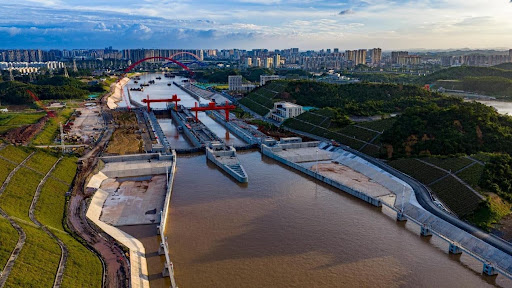
The Pinglu Canal officially opened to navigation on Sept. 16. As a landmark infrastructure linking the Belt and Road Initiative and the New International Land-Sea Trade Corridor, it is China’s first major canal constructed since 1949 to directly connect inland waterways to the sea.
Stretching 134.2 kilometers, this waterway offers southwest China its shortest, most cost-effective, and most convenient outlet to the sea, carving a new landmark into China’s extensive inland river network.
The Xijiang River, a major inland waterway in southern China, and the Beibu Gulf, an inlet of the South China Sea, were once separated by rolling mountain ranges. In the past, exports shipped by water from southwest China had to take a detour via Guangzhou Port in Guangdong province, adding more than 500 kilometers to the journey. With the completion of the Pinglu Canal, the river and sea, once divided by mountain barriers, are now connected for the very first time.
In Baise, located in southern China’s Guangxi Zhuang autonomous region, Su Yonghui, head of the logistics management department of leading aluminum producer Geely Material, did the math.
“In the past, imported raw materials had to be transported from Qinzhou Port in the Beibu Gulf using both rail and road. Shipment volumes were limited, and freight costs were high. Now, with waterway transport, our overall logistics costs have fallen by 30 percent, saving us more than 10 million yuan ($1.49 million) a year,” he said.
In Nanning, the capital of Guangxi Zhuang autonomous region, a cross-border industrial and supply chain for new energy batteries has drawn industry chain leaders BYD and Do-Fluoride, alongside over 50 upstream and downstream enterprises. The full industrial chain generates an output value exceeding 60 billion yuan.
“With the canal open, logistics costs will drop, market response will quicken, and the competitiveness of enterprises will further rise,” said Bi Guochu, director of the Nanning municipal bureau of industry and information technology.
The figures tell a clear story of lower costs and greater efficiency.
“Logistics costs are expected to fall by 18 to 30 percent, and in the longer term, the canal is expected to save the regions along its route more than 5 billion yuan in freight costs every year,” said Li Yuntao, deputy director of the investment and development department of the Pinglu Canal Group.
Two major markets highlight the potential for mutual benefit.
On one side is China, home to over 1.4 billion people; on the other is ASEAN, with a population of nearly 700 million.
“A new major corridor for mutual benefit has been added between these two huge markets,” said a diplomatic envoy in China from an ASEAN country after an inspection tour of the Pinglu Canal.
“The marine-oriented economy is rooted in industry. An ‘artery-and-branch’ layout of marine-oriented industries is precisely suited to Guangxi’s interconnected network of land, sea, rivers and canals,” said Huang Lanxi, director of the policy research office of the Communist Party of China Guangxi Zhuang Autonomous Regional Committee.
He noted that the Pinglu Canal Economic Belt serves as an artery, concentrating industries that handle large volumes of cargo and are well suited to port and waterway transport. Other parts of the region form the “branch veins,” with numerous industrial parks and enterprises serving as “fine veins” deeply integrated into the division of labor across industrial chains.
But the network supporting this “artery-and-branch” layout extends far beyond the Pinglu Canal.
Across Guangxi, 65 major land corridors connect the region with other parts of China, sea access points, and border ports. The autonomous region also operates 50 ASEAN-bound container shipping routes, air links to ASEAN nations, and 12 international terrestrial fiber-optic cables for cross-border digital communications.
With coordinated development across land, sea, air, and digital connectivity, Guangxi is positioning itself as a hub facilitating market operations for both domestic and international dual circulation.
Large vessels now berth at the docks, and cranes swing into action. The Dalanping first operating area of Qinzhou Port, part of the Beibu Gulf Port, is a hive of activity.
In May 2026, 122 loaders and other pieces of equipment manufactured by Liugong Group, a Chinese multinational construction machinery company based in Liuzhou, Guangxi Zhuang autonomous region, were shipped to Jakarta, Indonesia.
In July, a new shipping route to Aqaba Port in Jordan began operations, sending more than 2,600 new energy vehicles from Chongqing and other parts of China directly to the Middle Eastern market.
“After the canal opens, inland waterway transport will be connected with the ocean shipping network, further enhancing the capacity and efficiency of the port,” said Chen Shengchang, general manager of the operating area.
The physical canal is now open, while an invisible network of connectivity is also becoming increasingly seamless.
The Guangxi Maritime Safety Administration has helped establish China’s first waterway designated as equivalent to an A-class navigation area. Inland vessels meeting the required qualifications can, under specified conditions, sail directly to deep-water berths at Beibu Gulf Port, solving the “last mile” problem between river and sea. Meanwhile, the Pinglu Canal Group has developed a smart canal sensing system that enables comprehensive monitoring across land, water, air, and space.
Technology is not only making canal operations more efficient but also providing new support for ecological conservation.
At the point where the river meets the sea, engineer Chen Zhu monitored the smart fishway at the Qingnian water control hub.
Two barbel chubs were swimming upstream against the current. Their swimming speed, body length, and body width were captured by the system in real time.
The Qingnian water gate, built in 1959, has long provided water resources for local communities but also blocked fish migration. As the old gate was replaced with a new structure, an innovative composite fishway, the first of its kind in China, was built alongside the Qingnian water control hub.
“Fish from both the sea and the river can find their way home here,” Chen said.
He added that the difference in water level between the upstream and downstream sides of the hub is nearly 10 meters. To allow fish to move gradually between the different levels, the fishway was carefully designed with a winding, three-loop vertical-slot structure.
So far, 78,474 fish have been recorded swimming upstream and 119,987 swimming downstream, with more than 10 species successfully completing their migration.
The canal excavation involved moving 315 million cubic meters of earth and rock. With such a massive volume of material, where could it all go?
Professor Xiao Jianzhuang, president of Guangxi University, led a team specializing in the resource utilization of solid waste. The team visited the project site more than 90 times and explored a range of ways to reuse the excavated material, including land formation, green building materials, mine-pit restoration, and land reclamation.
Through seven disposal and utilization technologies, more than 98 percent of the excavated soil and rock was put to productive use rather than treated as waste.
At an open stretch of land along the canal, Tang Xiaofu, an associate professor at Guangxi University, stepped into a greenhouse and picked a plump winter melon.
The land was formed using soil excavated during the canal construction to fill valleys, then improved and fertilized using scientific methods.
“We grow tomatoes in winter and melons in spring. The annual output value can reach 50,000 yuan per mu (about 667 square meters),” Tang said.
More than 10,000 mu of such farmland has now been developed along the canal.
“Building the Pinglu Canal to high standards and with high quality means respecting and protecting nature,” said Hu Ya’an, an academician of the Chinese Academy of Engineering who has been deeply involved in the canal’s construction.
In his view, the Pinglu Canal not only is a new example of ecological conservation in major engineering projects around the world, but also sets a new benchmark for quality in canal construction worldwide.