By Zeng Yichen, People’s Daily
At 3 p.m., inside a 24-hour unmanned parcel station in Wudun village, Mogao township, Dunhuang, northwest China’s Gansu province, villager Zhang Jianpeng saw a moving dot on the screen of his phone — tracking a driverless delivery vehicle heading his way from a logistics hub 15 kilometers away.
Thirty-five minutes later, alerted by a notification, Zhang stepped outside. “It’s almost here,” he said.
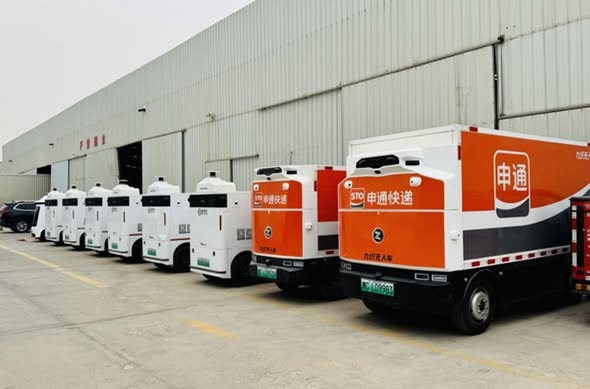
The “it” was an orange, box-shaped autonomous vehicle turning onto the asphalt road. Equipped with rooftop lidar sensors, it navigated obstacles and followed its programmed route. Despite having no driver, it strictly observed traffic rules — slowing for turns and yielding to pedestrians — before stopping precisely at the station entrance.
Zhang scanned a QR code on the vehicle. A side compartment door slid open, revealing neatly stack parcels. In less than 10 minutes, he sorted and unloaded the packages bound for the station. The vehicle then closed its door and moved on to its next stop.
“When the vehicle arrives, I take out the parcels, scan them, and place them into the lockers,” Zhang explained.
The parcel station has been converted from an unused village building. It is equipped with smart lockers and a self-service pickup area. “The facilities are designed based on villagers’ daily needs,” Zhang said. “They also come with surveillance, smart scanning systems, and voice-visual instructions, making them accessible, especially for elderly users.”
Dunhuang, a major tourist destination with a population under 200,000, faces logistical challenges due to widely dispersed settlements and seasonal labor shortages. Courier companies have long struggled with rural delivery.
“Trips to remote townships like Yangguan sometimes involve just one delivery — not even covering the fuel cost,” said Zhang Chutong, head of a local courier company. “This demotivates couriers. Waiting to accumulate more orders causes delays, turning ‘express delivery’ into ‘slow delivery,’ which frustrates villagers.”
Dunhuang’s open roads and lighter traffic in suburban and rural areas make it an ideal testing ground for scaling autonomous delivery. The adoption of driverless vehicles has helped ease last-mile logistics challenges in remote villages.
“These vehicles operate reliably even in extreme weather,” Zhang Chutong noted. “They maintain a stable daily range of about 130 kilometers, even at temperatures as low as minus 28 degrees Celsius. That reduces the workload for couriers and lowers operating costs.”
By his estimates, a single autonomous vehicle can handle around 1,000 parcels per day, improving delivery efficiency by 30 percent and cutting costs by 40 percent.
Working in tandem with unmanned stations, courier companies now deliver packages in bulk to designated pickup points, further reducing per-delivery costs. This model has improved both sustainability and experience of rural logistics.
In Wudun village, resident Yang Shuhua said the new system has made daily life much easier. “We just enter a pickup code at the station and collect our parcels anytime,” she said.
She recalled that many villagers used to work outside during the day and only returned after the stations had closed. “We worried that fresh items would spoil, so we often avoided ordering them,”she said. “Now that concern is gone.”
The station also allows villagers to send out agricultural products. “When our apricots are in season, we can ship them directly from here,” Yang added. “It’s very convenient.”
As Dunhuang continues to upgrade its rural logistics network, the city has been advancing a three-tier delivery system covering the city, townships, and villages. So far, parcel delivery services have reached all eight rural townships and 56 administrative villages.
“Going forward, we will continue exploring new models for rural delivery,” said Yang Xuewu, head of the Dunhuang postal administration. “Our goal is to better serve remote, low-volume villages–ensuring smoother outbound channels for agricultural products and efficient inbound delivery of consumer goods.”