By People’s Daily reporters
On March 27, the United Nations Secretary-General’s Advisory Board on Zero Waste released the first list of cities selected for the “20 Cities Towards Zero Waste” initiative. Three Chinese cities — Hangzhou in Zhejiang province, Sanya in Hainan province, and Suzhou in Jiangsu province — were included. These cities exemplify innovative approaches to waste reduction and resource efficiency.
Hangzhou: Digitizing Waste Management
In Hangzhou’s Binjiang district, residents like 67-year-old Wang use smart recycling stations that open automatically via QR code scans. Supported by a “carbon credit” incentive system, these facilities reward proper waste sorting with redeemable points for daily essentials or community services. This model has driven consistent participation in recycling programs.
Behind this community-level innovation lies Hangzhou’s citywide digital governance platform, which tracks household waste from disposal to final processing, enabling real-time monitoring and closed-loop management.
According to Yang Min, deputy director of the Hangzhou municipal bureau of coordinated administrative law enforcement, the system uses big data to optimize collection routes, facility allocation, and transportation schedules. Results underscore the success: In 2025, Hangzhou’s total recycling volume reached 2.46 million tons, up 5.13 percent year on year, with household recyclables increasing by 18.26 percent.
Sanya: Robotics and Plastic Reduction in Tourism
On the sandy shores of Yalong Bay in Sanya, beach-cleaning robots comb the coastline, extracting buried debris with vibrating screens while preserving sand. “Each robot cleans over 3,000 square meters per hour,” notes Zhao Guocheng, assistant researcher at the Hainan Research Institute of Shanghai Jiao Tong University.
As a premier tourist destination, Sanya has also enforced strict plastic bans in scenic areas.
Since November 2020, Wuzhizhou Island has replaced disposable plastics with reusable or biodegradable alternatives. According to Jiang Xiangyu, head of the greening office of the management center of Wuzhizhou Island, coastal areas are cleaned daily before visitors arrive. On the island, waste is systematically sorted: recyclables are packaged and sold, kitchen waste is repurposed, and garden waste is composted locally, significantly reducing the amount that must be transported off the island for incineration.
To date, Sanya has established 218 regular inspection points for plastic reduction, cutting annual use of plastic disposables by around 8,000 tons and recycling nearly 30,000 tons of plastic waste.
Suzhou: Industrial Waste as a Resource
Early in the morning at the Suzhou Industrial Park (SIP) , forklifts shuttled between workshops and warehouses. Several containers of waste emulsified liquid were loaded onto a truck, each labeled with a QR code and destination tag.
“These will soon be sent for reuse,” said Guo Jun, a worker responsible for waste transport.
Suzhou boasts a complete industrial system. The output value of industrial enterprises above the designated size, or those with annual revenue of over 20 million yuan ($2.9 million) from principal businesses, reached nearly 5 trillion yuan in 2025. However, what comes along is huge volume of complex industrial waste. Effectively managing and reusing this waste has become a central challenge for urban governance.
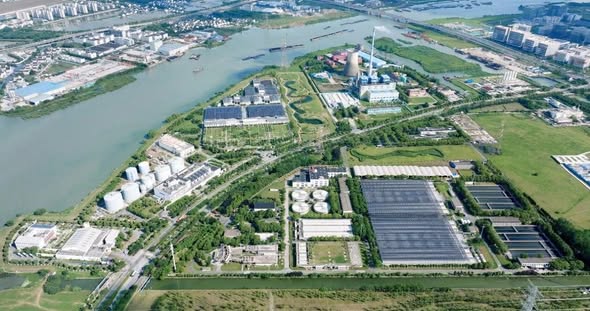
At a circular economy industrial park of the SIP, a network of crisscrossing pipelines forms the backbone of a waste-to-resource ecosystem. Every day, industrial sludge, kitchen waste, and municipal wastewater from local enterprises and urban operations are collected here, then diverted into specialized treatment systems tailored to each type of waste.
In a sludge treatment workshop, pretreated sludge is sent into drying equipment powered by steam from a nearby thermal power plant. The dried sludge is then co-fired for electricity generation, and the resulting steam is fed back into the system.
Adjacent to the sludge treatment area, kitchen waste is processed through anaerobic fermentation to produce biogas, which is purified and fed into the city’s gas network. Residual waste enters the sludge system for further treatment, while processed water is recycled as reclaimed water for industrial cooling and daily cleaning.
At this circular economy industrial park, waste from different sources is reorganized, redistributed, and reused, forming a stable circular economy network. According to statistics, Suzhou’s comprehensive utilization rate of bulk industrial solid waste has reached 98.1 percent, setting a leading benchmark for industrial waste management in China.