Jiang Xiaodan, People’s Daily
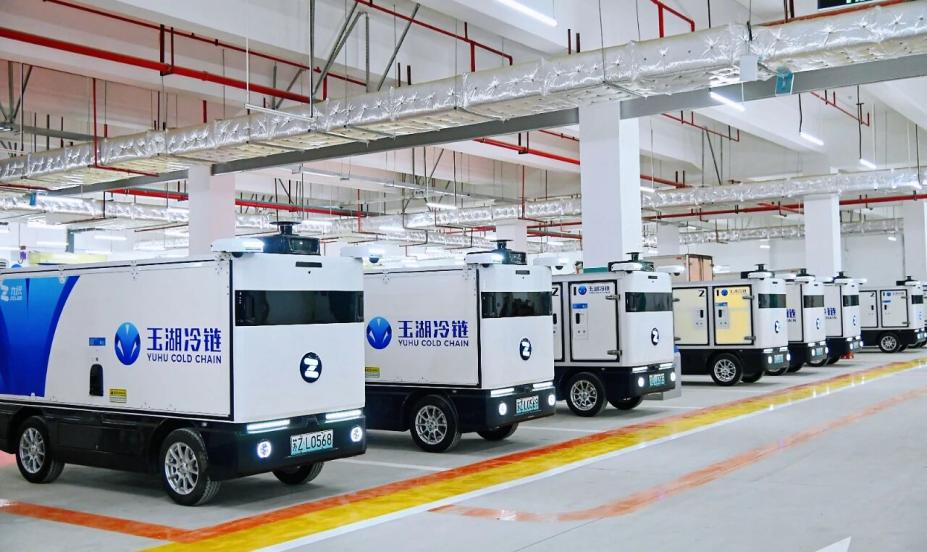
At the break of dawn, refrigerated trucks loaded with frozen goods begin their orderly departure from a state-of-the-art cold-chain logistics park operated by Yuhu Cold Chain, a leader in China’s cold-chain food supply sector, located in Guangzhou, Guangdong province.
Inside the massive, digitally controlled warehouses, automated forklifts glide silently through a cool mist, precisely moving pallets between towering shelves. Parked outside, trucks carry away batches of perfectly preserved cargo. For local food supplier Chen Zexin, watching this routine is reassuring. “This shipment of imported Argentine beef,” he notes confidently, pulling up a tracking app on his phone, “is maintaining at minus 18 degrees Celsius. It will reach downtown customers within the hour.”
This efficiency is a far cry from Chen’s early days in 2022. “Initially, I hired individual drivers,” he recalls. “My biggest summer worry was drivers shutting off refrigeration to save fuel mid-delivery.” He vividly remembers the disaster at a Shenzhen market: staring at a truckload of thawed, unusable beef. The financial loss nearly wiped out his investment and brought a wave of customer complaints. Issues like temperature failures, unexpected thawing, soggy packaging, and compromised meat quality were common industry headaches.
Facing mounting losses, Chen discovered a new standard: Yuhu Cold Chain’s technologically advanced logistics park opening in Guangzhou. In 2024, he moved his operation.
From the outset, the difference was clear. Staff attached a “Yuhu Code” — essentially a tracking ID — to each carton. “We monitor temperature, humidity, and location constantly from warehouse to delivery,” Chen explains, highlighting his phone screen. “The system sends instant alerts if anything moves out of spec.” Just weeks after relocating, the system flagged a temperature anomaly in transit. Park staff responded immediately, arranging backup transport while tracing the cause. “In the past, those goods would have been a complete loss,” Chen states. “Coming here was absolutely the right decision.”
Yuhu Cold Chain (Guangzhou), operated by Yuhu Cold Chain, is Guangdong’s first fully temperature-zone digital cold-chain warehousing and trading park. Through technological innovation and operational upgrading, it pushed cold-chain logistics toward greater specialization and higher value along the supply chain.
According to Huang Jiebin, general manager of Yuhu Cold Chain (Guangzhou), the park integrates more than 60 digital and intelligent technologies, enabling real-time temperature monitoring, intelligent task scheduling, and end-to-end traceability.
“Big data tackles the most persistent operational frustrations for our merchants,” he said. “Logistics costs have dropped by 18 percent, and truck space utilization rate has increased to 90 percent.”
Digital coordination has also improved distribution efficiency. Hundreds of refrigerated trucks are connected to an intelligent dispatch system that plans optimal routes in real time. The average number of delivery stops per driver has increased from 20 to 30 per day. The park now handles more than 1,500 tons of goods daily, with same-day delivery within Guangdong and a 35 percent improvement in order fulfillment efficiency.
Standing in front of a large screen showing smart data, Huang pointed out that the park’s four cold storage facilities operate under a shared warehouse model. Supported by digital systems, the entire storage process has become automated, intelligent, and fully visualized.
Ahead of the 2026 Chinese New Year, Chen imported another batch of beef from Brazil, later selling it at a favorable price during the holiday. He purchased the goods through the park’s online platform, which aggregates products and prices from multiple countries. “You can place an order with one click. It saves a lot of time searching for suppliers, and customs clearance is much easier,” he said.
The park has launched a “direct procurement and sales express” initiative, which builds direct business links between on-site merchants and downstream wholesalers, delivering a 30 percent growth in new client resources for the park’s 600 settled tenants.
A frozen food wholesaler surnamed Li from Guangzhou’s Liwan district, was one of the new clients Chen gained after settling in the park.
“I used to get up at 2 a.m. just to rush to the wholesale market to secure inventory. I was frequently fined for illegal parking, while the product quality remained unstable,” Li shared. “Now I can place orders right from my store, with cold-chain trucks delivering goods punctually. The frozen products stay firm and dry with guaranteed quality.”
Freed from the trouble of rushing around for purchases, Li truly experienced the convenience brought by digital and intelligent upgrading.
Fueled by booming online consumption and instant retail demand, China’s cold-chain logistics industry has maintained steady growth. The sector is undergoing comprehensive upgrades: innovative refrigeration equipment, in-depth AI integration, customized industrial large models, and new supply chain scenario applications.
Empowered by cutting-edge technologies and upgraded operational models, the industry has continuously improved service competitiveness and unlocked robust market vitality.
According to data from the cold-chain committee of the China Federation of Logistics and Purchasing, China’s total cold-chain logistics demand hit 381.4 million tons in 2025, representing a 4.5 percent year-on-year increase.