NASA, NASRDA RENEWS GEOHAZARD SPACE GEODESY COOPERATION AT CGG TORO

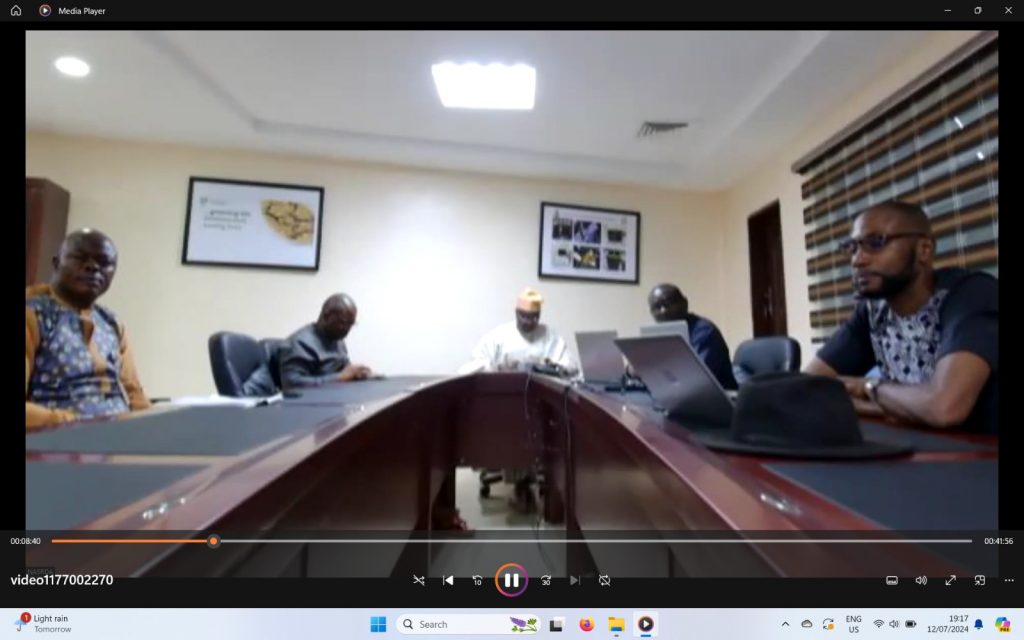
The National Aeronautic Space Administration (NASA) of the United States and the National Space Research and Development Agency (NASRDA) have agreed to renew their existing Memorandum of Understanding (MoU) signed in 2008 on Space Geodesy for Geohazard Research at the Centre for Geodesy and Geodynamics (CGG) Toro, Bauchi State
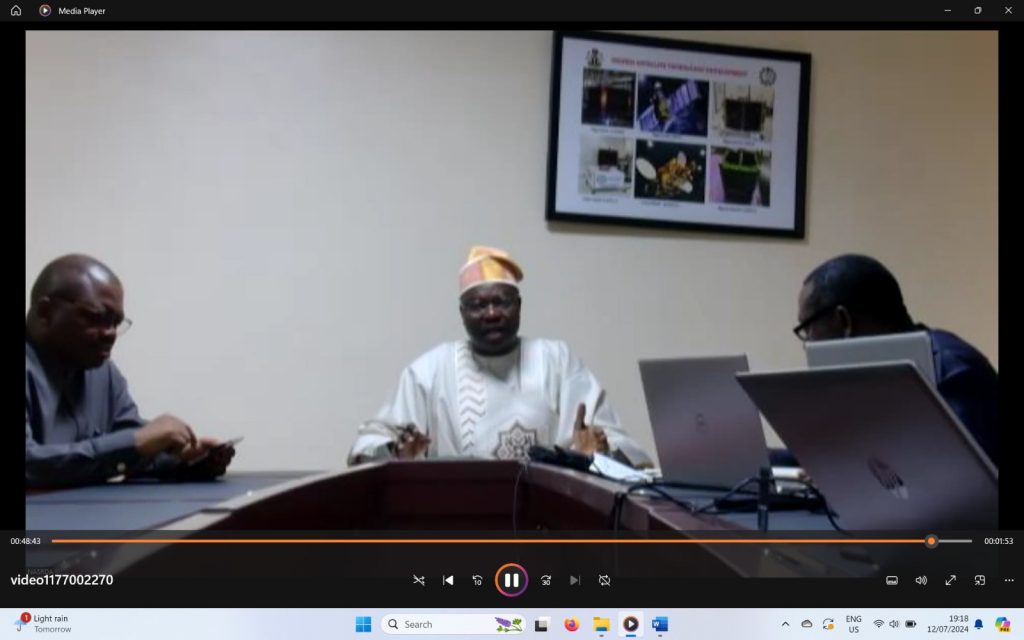
Leading the Nigerian contingent and chairing the virtual meeting attended from the NARSDA headquarters in Abuja on Friday, the Director General of NASRDA, Dr. Mathew Adepoju said his organisation places a great premium on its relationship and collaboration with NASA and will continue to do everything to expand and deepen it.

Recall that NASRDA signed an MoU with NASA in 2008 on Space Geodesy for Geohazard Research. The MoU which has witnessed about three extensions is being coordinated by the Director, Centre for Geodesy and Geodynamics, (CGG) Toro, Dr. Dodo D. Joseph who has ensured the sustenance of the MoU.


Dr. Adepoju in his opening statement expressed concern about some aspects of the MoU that have not been implemented and has to do with capacity building and the transfer of technical know-how between both organisations. According to him, under the renewed hope agenda of Nigeria’s President, Bola Ahmed Tinubu, one of the top priorities for NASRDA is Geodesy and Geodynamics as well as the monitoring of Nigeria’s tectonic base and coastal movements.

He assured the NASA team that Nigeria was seeking a symbiotic relationship and not a parasitic one with NASA insisting that it is ready to make valuable contributions to the relationship.

The Director General said: “As one of your global outposts; with improved training of our officers, the report and monitoring activities from Nigeria and Africa will be of great importance and make your work even better and easier.

“Not many countries in Africa have the kind of equipment and personnel that we have, so we can serve as a regional hub not only for Nigeria but for West Africa and Africa as a whole. When our staff receives such anticipated training, we can as well organise regional training for other countries. You have my full support and commitment to all the deliberation that will happen here. We want this collaboration to be successful and our relationship deepened.”

Responding, members of the NASA team took turn to express excitement at the resuscitation of the cooperative agreement between the sister organisations.

Elizabeth Anderson of the Office of International and Interagency Relations said NASA places great value on its relationship with Nigeria which she said dates to the 1960s when the countries began to work together on research going through the 70s and the 80s. “I believe this is one of our oldest relationships. We are also looking forward to extending and deepening this relationship, especially in our globe and educational programmes. We are happy to discuss our geodesy programmes as well as other areas of engagement,” she said.

Stephen Merkowitz of the Earth Science Division said NASA was looking forward to revitalising the MoU as he disclosed how critical the CGG Toro is to its geodetic data. “My understanding is that we have had some trouble getting that reliable data out, so we will certainly be happy working with you to improve the situation. We will certainly welcome any opportunities for enhanced cooperation as we look forward to the discussion,” he said.

Also, David Stowers of the Earth Science Division assured the NASRDA team of NASA’s interest in returning to a state of having things functioning again and returning to a state where the two agencies can exchange activities and data.

Dr. Dodo who initiated and anchored the meeting, and also doubles as the Technical Point of Contact for the MoU took time to review the agreement, evaluating the agreement signed many years ago, the state of the MoU, and the way forward. He also explained the responsibilities and commitments of both parties in the MoU.

He disclosed the various ingredients of the agreement which was first entered in 2008, renewed in 2013 and 2018 each with a 5-year implementation period while the next will be in 2028 making it 10 years after the last one.

According to him, the goal of the cooperative agreement is to advance international programs cooperation in Space Geodesy such as the Global Geodetic Observing System (GGOS), African Geodetic Reference Frame (AFREF), and initiative of the international Global Navigation Satellite Systems (GNSS) Service. On the other hand, Space Geodetic Techniques include the Global Navigation Satellite (GNSS), Satellite Laser Ranging (SLR), and Very Long Baseline Interferometry (VLBI).

Other areas of cooperation include participation in global, regional, and local observations and networks to provide data to address solid earth deformation and earth orientation, the international terrestrial reference frame, earth orientation parameters, and international celestial reference. The geohazards research areas will include earthquakes, floods, landslides, subsidence, and volcanic eruptions among others.

Diaspora Group Praises Tinubu’s Commitment To Fight Corruption

Nigeria Professionals in Diaspora (NPID) has commended President Bola Tinubu’s achievements in the fight against corruption while advising against the creation of a new Ministry of Livestock to reduce the cost of governance.

NPID, which is made up of renowned Nigerian professionals living and working abroad, made this known in a press conference addressed on Saturday in Abuja to applaud President Tinubu on his remarkable achievements since assuming office, his unwavering commitment to fighting corruption, and to advise against the creation of a new Ministry of Livestock to reduce the overall cost of governance.

Speaking at the event, the NPID President, Dr. David Olakunle, expressed the organization’s profound appreciation for President Tinubu’s transformative leadership and the significant strides made under his administration.

“We, the members of the Nigeria Professionals in Diaspora, are gathered here today to applaud President Bola Ahmed Tinubu for his exceptional leadership and the profound positive impact he has had on our beloved nation, Nigeria, in a short period,” said Dr. David Olakunle.

The NPID highlighted President Tinubu’s swift and decisive actions to address the country’s most pressing challenges, particularly in the areas of economic reform, infrastructure development, and the fight against corruption.

“Since assuming office, President Tinubu has demonstrated an unparalleled commitment to revitalizing Nigeria’s economy and laying the foundation for sustainable growth,” said Dr. Olakunle. “His bold policy decisions, such as the removal of fuel subsidies, have been instrumental in stabilizing the country’s fiscal position and paving the way for long-term economic prosperity.”

The organization also commended the President’s focus on infrastructure development, which has been a crucial driver of economic transformation. NPID praised the accelerated construction of roads, bridges, and other critical infrastructure projects across the country, which have improved connectivity, facilitated the movement of goods and services, and created numerous job opportunities for Nigerians.

“President Tinubu’s commitment to infrastructure development has been truly remarkable,” said Mr. Kunle Adebayo, the NPID Secretary. “The roads, railways, and other infrastructure projects being delivered under his leadership are not only enhancing the quality of life for our citizens but also laying the foundation for Nigeria’s long-term economic competitiveness.”

Furthermore, the NPID highlighted President Tinubu’s unwavering dedication to the fight against corruption, which has been a longstanding challenge in the country. The organization lauded the President’s efforts to strengthen institutional frameworks, empower anti-corruption agencies, and hold public officials accountable for their actions.

The press conference also addressed the NPID’s concerns regarding the proposed creation of a new Ministry of Livestock, which the organization believes would be an unnecessary addition to the government’s structure and would increase the overall cost of governance.

“While we acknowledge the importance of the livestock sector to Nigeria’s agricultural landscape, we believe the creation of a separate Ministry of Livestock would be a misguided decision that would further burden the country’s already strained fiscal resources,” said Dr. Olakunle.

The NPID argued that the existing structures within the Ministry of Agriculture and Rural Development could be strengthened and optimized to address the needs of the livestock industry, without the added cost and bureaucracy of a new ministry.

“Our analysis suggests that the resources required to establish and maintain a standalone Ministry of Livestock could be better utilized to enhance the efficiency and effectiveness of the existing agricultural frameworks,” said Mr. Ikechukwu Obinna, a senior NPID member. “This would allow for a more streamlined and cost-effective approach to supporting the livestock sector’s development.”

The organization urged President Tinubu to carefully consider the long-term implications of creating a new ministry and to instead focus on optimizing the existing institutional structures to address the challenges faced by livestock farmers and stakeholders.

In conclusion, the Nigeria Professionals in Diaspora (NPID) commended President Bola Ahmed Tinubu for his transformative leadership, his unwavering commitment to fighting corruption, and his focus on driving economic growth and development in Nigeria. The organization pledged its continued support and cooperation in realizing the President’s vision for a prosperous and sustainable Nigeria.

“President Tinubu’s achievements in such a short period have been truly remarkable,” said Dr. Joe Ella Abechi. “We, the members of the NPID, stand ready to work alongside the President and his administration to further strengthen our nation, enhance the well-being of our citizens, and position Nigeria as a global leader in the years to come.”

Food Security: Coalition of CSOs Commend Agric Minister Over Policies

The Coalition of Civil Society Organisations in Nigeria, COCSON, Friday, hailed the Minister of Agriculture and Food Security, Senator Abubakar Kyari, over policies driven to boost food security and crash high food prices.

The commendation was made during a press conference held in Abuja, where the spokesman, COCSON, Adebayo Oluwaseun, on behalf of the Coalition acknowledged and appreciated the Minister while noting that the leadership he has demonstrated since his appointment had impacted positively on the agricultural sector as he is currently revolutionizing the industry and ensuring Nigeria and Nigerians are food secure.

According to Oluwaseun, the Minister has been committed to the implementation of the National Agricultural Technology and Innovation Plan, NATIP, which has been instrumental in modernizing the agricultural space, whereby there have been technological advancements and empowerment of smallholder farmers across the country.

He said: “It is with great pride and a profound sense of optimism that we, the members of COCSON, gather here today to applaud the Honourable Minister of Agriculture, Alhaji Mohammed Mahmood Abubakar, for his exceptional leadership and the transformative impact he has had on the agricultural landscape of our beloved country, Nigeria.

“Since his appointment, Minister Abubakar has demonstrated an unwavering dedication to driving positive change, implementing bold initiatives, and positioning the agricultural sector as a key driver of economic growth and sustainable development in Nigeria.”

According to COCSON, the Minister has empowered women and youth in the agricultural sector, including initiatives to provide specialized capacity building and access to financing, and giving opportunities to underrepresented groups, enabling them to become active contributors to the sector’s growth and development.

“The Minister’s unwavering support for women and youth in agriculture has been truly transformative. By investing in their skills, knowledge, and entrepreneurial spirit, he has not only empowered these crucial demographics but also paved the way for a more inclusive and sustainable agricultural ecosystem in Nigeria.

“The coalition is confident that under your stewardship, the sector will continue to thrive, contributing to the country’s food security, economic prosperity, and sustainable development.

“Kyari’s dedication, innovation, and tireless efforts have truly set a new standard for agricultural leadership in Nigeria. We, the members of COCSON, pledge our unwavering support and commitment to working alongside the Minister to further strengthen the agricultural sector and realize our collective vision of a prosperous, food-secure, and environmentally sustainable Nigeria”, he added.

Meanwhile, the Secretary, COCSON, Fatima Usman, “Under Minister Abubakar’s leadership, the NATIP has been a game-changer, revolutionizing the way we approach agriculture in Nigeria.

“Through this innovative plan, we have witnessed a remarkable increase in crop yields, improved access to cutting-edge farming techniques, and the creation of numerous job opportunities for our youth in the agricultural value chain.

EFCC’s Biased Outbursts Against Bello Has Raised Fear of Compromised Investigation, MPPR Cries Out, Demands Fairness

….Says chairman should tell Nigerians why he wants Bello to follow the back door to see him?

Leadership of the Movement for the Protection of People’s Rights MPPR on Friday, disclosed that slouchy statements from the Economic and Financial Crimes Commission Boss, Mr. Ola Olukoyede on the person of Yahaya Bello has continued to show that the chances of justice for the latter are very slim.

In a statement jointly signed by Comrade Musa Abdullahi, the Secretary General and Comrade Abiola Adegbite, Dir, Media & Publicity, the group warned the anti-graft agency boss to quit looking for ways to bring in Yahaya Bello via backdoor.

It read: “Since the establishment of the Economic and Financial Crimes Commission ( EFCC) in 2002, its activities have elicited both support and suspicion in the fight to tackle graft cases in Nigeria. Patriotic citizens from all walks of life have consistently stood by the EFCC in the difficult mandate given to it through an Act of the National Assembly.

“Going through the recent press statement issued by the EFCC in which it has accused an imaginary named former Governor and two ex- ministers of spearheading a planned protest against the Commission is not only baseless, absurd but also cowardly. The story credited to the EFCC giving credence to some faceless 259 civil society organisations under the aegis of nonexistent Coalition for Transparency is a disgrace carried too far in the anti- graft war in Nigeria and Africa as a whole.

“With the story credited to the EFCC, one would think that the Commission was deliberately fashioned for lies, gross mischief, and drain pipe purpose – a channel of deception and castration of Nigeria’s puberty. From all indications, the groups being celebrated by the EFCC are either the creation of the Commission or the agency cash and carry, non existent nor unregistered NGOs/ CSOs arrangement and hatchet jobbers with them on retainership basis. Not long ago, one of such beneficiaries wrote a petition to the National Judicial Council,( NJC) against a Judge handling the case between the EFCC and a former Governor of Kogi State, Alhaji Yahaya Bello. Sadly, the author of the said petition to the NJC was once arrested and charged to court by the Nigeria Police for mischief, falsehood, and frivolous claims against a former Attorney-General of the Federation. What a shame and a coincidence for the EFCC- to be hobnobbing with such a disgruntled and malicious character parading himself as an activist.Has the EFCC forgotten the ethos of crime101 of profiling and carrying out due diligence of any of its friends before association?

“Rather than remain a vile witness of dishonour, false alarms, arbitrariness and politicization of the anti- graft war, we must posit that the era of fighting the anti-corruption war with disobedience to court orders, selective prosecution, intimidation, gestapo like arrests, defamation of character and blackmail are gone forever with the wind. The Commission should rather concentrate its energy on the investigation of N23 billion Kano- Maiduguri abandoned rail line contract, the CCTV contract scam awarded for Lagos and Abuja worth over USD100 million, monies in billions spent by NDDC, the Humanitarian Affairs Ministry’s mind boggling “N729 billion” fraud, among others and also during the COVID-19 lock down.

“Consequently, they also have an obligation to identify the Nigerian government officials who have been collecting bribes and perpetuating money laundering through Bitcoins platforms since 2016. But they all left these serious state matters in the coolers to go after a politically assumed enemy and a juggernaut who has become a rallying point for the youths in Nigeria and a formidable ally of Mr President. These are all in a bid, to please their monstrous paymasters and retain the office of the Chairman of the EFCC. How long will Olukayode be using unethical methods and gestapo like arrests and movements to persecute and hound Yahaya Bello in order to please his self-serving ambition and cohorts

“Nigeria is a country founded on constitutional democracy, anchored on the rule of law and due process. Therefore, we challenge the EFCC to disclose the identity of the ex-Governor and two former ministers spearheading the concocted protest against the EFCC, including the venue and time where the meeting took place. They must furnish Nigerians with details of the attendance list of the meeting and the money earmarked for the imaginary and phantom protest as alleged! How can the Commission stoop so low to embark on the dissemination of such hearsay, falsehood, orchestrated plots, red imaginary shadows, misrepresentation and innuendos without due process and the rule of law? The EFCC has become the accuser, prosecutor, and judge in its own case. What a misnomer?

“We must state categorically, to those who are either ignorant of the law establishing the agency or trying to display some affinity with the arrogance of the EFCC to note the motive behind the creation of the Commission wasn’t meant for the abuse of prosecutorial powers or usurp political authority. This presupposes that the Commission and its agents must act in accordance with the constitution and civil conduct in the discharge of their duties in consonance with the rule of law and civility in all its obligations to the citizenry, but the reverse is now the case under the present leadership.

“We wish to ask the EFCC some salient questions relevant to the handling of their case against Alhaji Yahaya Adoza Bello. Why are they shopping for a pliable judge to handle their persecution of Bello? Contrary to the standing operational procedure? Why did the Chairman place a call directly to Bello and want him to follow the back door if there is no hidden agenda? What was the motive behind the Chairman’s placement of direct call to Bello? Why was he interested in ushering him via the Chairman’s special entrance gate and exclusive door? A back door arrangement that Bello rejected outright till date has become his being hounded regrettably!

“This brings us to the shadow boxing placement of Bello on the watch list of Interpol. The apt description of the action of the EFCC in this regard can be described as ultravires, premeditated, teleguided, and an agenda for settling scores, having an axe to grind

“It is a big shame, ridiculous and embarrassing for obvious reasons, the EFCC is granting interviews and issuing statements in a clearer attempt to ambush and preempt judicial officers handling their case against Bello who are already in various courts of competent jurisdiction. What a shameless act by the agency!

“The EFCC must desist from further overheating the polity, from undemocratic and unconstitutional practices in the handling of this case and others. The era of plotting shenanigans and suffocating excuses in the fight against graft is over. Therefore, all cases before the courts must be allowed to be exhausted in full and the outcome decided. The anti-graft body must not be seen to probate and reprobate in a desperate bid to crucify any accused persons under investigation or prosecution under its watch. Actions of resorting to self-help, amounts to prejudicial and subjudicial, that are entrenchently intolerable in terms of both legal and moral compliance.

“Only an institution that has abandoned its core mandate would embark on a proxy war, name calling, and grandstanding. Blaming white witches and village people for their incompetence, lack of due diligence, and unprofessional conduct. Wasting taxpayers’ monies on wild goose chase that would lead Nigerians to no where, except the land of voodoo warriors insinuating about planned and sponsored protests against the EFCC

“For the umpteenth time, let us state that the placement of Bello on the watch list, which is already before the court, is mischievous, self-serving, arbitrarily obnoxious and devoid of fairness.
It is on this ground that we are urging the Chairman of the EFCC to resign from office forthwith due to his inability to discharge his mandate without fear, favour, and biases.

“Let us make it abundantly clear that natural justice is anchored in the will of Almighty God taught to mankind. The EFCC should always act with fear of God devoid of sentiments and preferential treatment of requesting suspects to see the Chief Prosecutor through his special backdoor. Nigerians are still waiting for explanation on other high suspects granted such merited or unmerited favours. The criteria used for the selection process and the fate of those who accepted and others who rejected such private gestures! The Nigerian people are interested in the overall outcome of what transpired during both day and night visits through the Chairman’s exclusive door!

“Finally, the desperate agenda to crucify Bello amounts to giving a dog a bad name in order to hang it. The constant review of human regulations and laws is evidence of civility, as Edmund Burke aptly captures it plainly when he said, “Bad laws are worst sort of tyranny.”

“The EFCC has goofed once again and should explain to Nigerians the extant rule of the exclusive backdoor passage, which Yahaya Bello declined and rejected.

“We therefore call on the International Community, Donor Agencies and Partners to dispassionately read in between the lines in terms of the backdoor arrangement/exclusivity offered by the Chairman of EFCC to Bello and the glaring double – standards and inconsistencies in the handling of the anti-graft war as it relates to politically exposed persons in Nigeria!

“With the above, the Chairman of EFCC has no moral right to stay a day longer in office as the Chairman of the agency!”

Alleged Corruption: Fire, Probe Great Green Wall DG, Maina Bukar Now – CSO Urges Tinubu

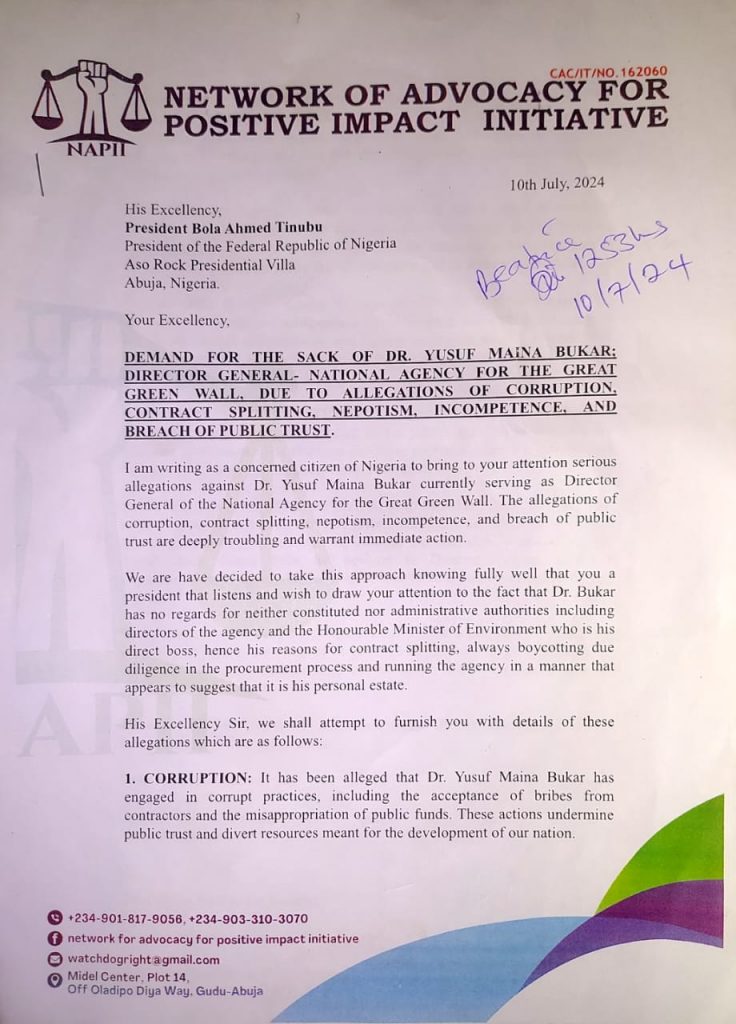
A group under the aegis of Network Advocacy for Positive Impact Initiative has called on President Bola Tinubu to sack the Director-General of the National Agency for the Great Green Wall, NAGGW, Dr. Yusuf Maina Bukar over alleged corruption and other allegations.

The group made this call during a press briefing held in Abuja on Wednesday.

The Director Press/Consultant, Ambassador Austine Peacemaker, while speaking to newsmen, disclosed that the group is aware of Dr. Bukar’s lavish spending on personal expenses, including luxury cars and foreign trips.

Among other things, he accused Dr Bukar of corruption, contract splitting, nepotism, incompetence, and breach of public trust.

The group also called on the National Assembly to begin a thorough investigation and hold public hearings on the allegations against Dr. Bukar, while also urging the Federal Ministry of Environment, to take concrete steps to address the allegations and ensure transparency and accountability.

According to the group, Dr Bukar’s continued leadership as Director-General, undermines the agency’s credibility and hinders the effective implementation of projects, demanding an urgent implementation of appropriate legal measures to hold him accountable for his actions.

“We have written and addressed a letter to the government as we deeply believe that Nigerians deserve transparency, accountability, and effective leadership in public offices, we can not sit and allow the renewed hope agenda of President Bola Ahmed Tinubu to be rubbished and brought to ruin by undeserving public stewards.” It added.

They, however, served a seven-day ultimatum, stating that if their demands are not met, They will immediately commence a public march/ civil protest at the Ministry of Environment and the agency to press home their demands.

See attached letter;

Culture-tourism integration injects vitality into China’s Quanzhou city, vital hub of Maritime Silk Road

By Fu Wen, Chen Shihan, People’s Daily

Located in southeast China’s Fujian province, Quanzhou is one of the most important Chinese ports along the historic Maritime Silk Road. “Quanzhou: Emporium of the World in Song-Yuan China” was added to the UNESCO World Heritage List on July 25, 2021, bringing the total number of China’s UNESCO World Heritage sites to 56.

The serial property encompasses 22 sites of administrative buildings and structures, such as the Site of the Maritime Trade Office, the Confucius Temple, and the Kaiyuan Temple. They bear witness to the city’s prosperous maritime trade and reflect its inclusiveness and commitment to opening up.

Apart from the exceptional heritage preservation efforts, Quanzhou has been working on the deep integration of culture and tourism to maintain its historical features and revitalize its intangible cultural heritage.

In 2023, Quanzhou’s tourism revenue surged 68.9 percent year on year to 100.24 billion yuan ($13.79 billion). The city welcomed nearly 86.53 million tourists home and abroad, a year-on-year increase of 53.9 percent.

At around 10:00 am, Jinyu Alley, in Licheng District of Quanzhou, became bustling with life. The alley is named after “golden fish” in Chinese with its origin dating back to the Northern Song dynasty (960-1127). It showcases the charm of the city’s traditional architecture and epitomizes its cultural essence. At its entrance gathered groups of tourists, taking photos with the decorative golden fish patterns.

Just a short distance south of the alley is Zhongshan Road, which runs from north to south through Quanzhou. The road houses the well-preserved qilou building complex, a quintessential architectural style in southern China. Strolling along the road, visitors can embrace a sense of leisure and relaxation.

Quanzhou is home to a number of Chinese ancient city gates, such as the Chaotian Gate, Quanshan Gate and Deji Gate, standing as silent witnesses to the city’s profound history. The original signboards of many time-honored establishments also serve as nostalgic reminders of the city’s bustling trade history.

In Quanzhou’s Ancient City, located in Licheng District with a total area of 6.41 square kilometers, there are eight UNESCO World Heritage sites, including the Kaiyuan Temple, the Confucius Temple, and the site of the Southern Clan Office. The abundant historical relics, well-preserved ancient urban layout, and bustling crowds in the city all provide a captivating glimpse into its past prosperity and grandeur.

However, in the past, the Ancient City looked different from how it does now: cables were haphazardly installed between severely aged houses, and sewage would flow across the streets when it rained. As a result, many original inhabitants had moved away, and the once vibrant atmosphere of the city gradually faded away.

In 2017, a renovation project kicked off in Quanzhou. Following the principle of exerting minimal impact on the daily lives of residents, the city adopted a series of science-based plans and management measures. The project mainly included upgrading the building facades, burying cables underground, paving roads, enhancing the city’s night view, and integrating cultural elements into the landscape design. The extensive renovation has successfully brought back the charm of the Ancient City.

“Our goal is to protect not just the ancient buildings, but also the city’s authentic way of life and its cultural heritage that has evolved and flourished over thousands of years,” said He Zhenliang, head of the cultural heritage preservation and management office of the Confucius Temple, Quanzhou.

Quanzhou string puppetry was inscribed into the first batch of China’s national intangible cultural heritage list as early as 2006. In recent years, a large number of young people have joined in the efforts to protect and inherit this art form, infusing it with fresh vitality.

According to Li Yunfeng, an inheritor of Quanzhou palm puppetry, another type of Quanzhou puppetry, young people in their thirties now make up the majority of the staff members at the Palm Puppetry Art Protection and Inheritance Center in Jinjiang city, Fujian province, which he works for.

“We perform more than 400 shows each year,” said Li.

Puppetry is not the only traditional art in Quanzhou that has been passed down for generations.

As the sun set, people gradually took their seats at the Nanyin Pavilion, sipping tea and enjoying the melodious tunes. Every week, the pavilion holds four free performances.

Nanyin is one of China’s oldest music styles and a UNESCO Intangible Cultural Heritage, often referred to as the “living fossil” in Chinese music history. It holds a special place in the hearts of Quanzhou locals, evoking nostalgic memories from their childhood.

Currently, Quanzhou is home to six UNESCO Intangible Cultural Heritage elements, 36 intangible cultural heritage projects at China’s national level, and 128 at China’s provincial level, said He Yibin, deputy head of Quanzhou Municipal Culture, Radio, Television and Tourism Bureau.

According to He, Quanzhou has set up 12 museums of intangible cultural heritage, 166 venues for the inheritance of intangible cultural heritage, and 1,000 halls to demonstrate intangible cultural heritage. Besides, two training sessions for intangible cultural heritage inheritors are hosted each year to help them expand the market. Besides, the intangible cultural heritage has been made more accessible through training courses on short video shooting offered to inheritors. A special fund worth 10 million yuan has also been set up to support the development of intangible cultural heritage items, such as traditional operas and Nanyin.

Today, fascinating daytime tours and beautiful night views have become new features of Quanzhou’s tourism.

In the evening, Zhongshan Road comes alive with captivating performances of martial arts, chest-slapping and acrobatic lion dances, offering an engaging experience for visitors. Art markets and music performances under old banyan trees make both locals and visitors slow down to take in the harmonious atmosphere. Puppet shows, Nanyin and traditional operas have all increased the frequency of nighttime performances.

“Quanzhou is currently working to provide a round-the-clock experience of cultural tourism. The city has become increasingly popular with the growing number of nighttime cultural and tourism consumption areas,” said an official with Quanzhou Municipal Culture, Radio, Television and Tourism Bureau.

China’s maritime foreign trade contributes to over one-third of global maritime transport

By Wang Wenzheng, People’s Daily

Maritime transport is the lifeline of global trade, as it handles over 80 percent of the international movement of goods.

According to the Analysis Report on Chinese Port Operations 2024 (hereafter referred to as “the Report”) released by the Transport Planning and Research Institute, China’s Ministry of Transport, the volume of China’s foreign trade via maritime transport accounted for 30.1 percent of global marine shipping in 2023, up 2.2 percentage points year on year.

Driven by the recovery of demand for foreign trade and the restructuring of the global trade system, China’s foreign trade via marine shipping experienced rapid growth. In 2023, Chinese coastal ports handled 4.96 billion tons of foreign trade cargo, a year-on-year increase of 9.6 percent.

Containers, coal, metallic minerals, mineral building materials and petroleum make up the five major categories of cargo handled by Chinese coastal ports, accounting for 84 percent of the total throughput of all coastal ports in 2023. In particular, the throughput of imported coal and crude oil went through rapid growth, while that of imported iron ores remained at a high level.

While maintaining rapid growth, the structure of China’s foreign trade via marine shipping has continuously improved. In 2023, containers were responsible for transporting 23.3 percent of foreign trade cargo by sea in China, 0.2 percentage points higher from a year ago, maintaining steady growth year by year. Now, with the upgrading of customs clearance services at major Chinese coastal ports, exporters now find it easier to ship their cargo overseas via containers.

For instance, Yiwu Customs, east China’s Zhejiang province, has established a special window at Yiwu Port for the UEFA European Championship, offering targeted guidance to sports-related enterprises. It has enabled “one-click declaration,” allowing over 99 percent of export goods purchased via the market to be released by computer review almost instantly.

Besides, intelligent surveillance systems have been installed at the Yiwu West railway station, allowing for automatic container entry and inspection without the need for box opening.

At Ningbo-Zhoushan Port, Zhejiang province, Ningbo Customs has leveraged blockchain technology for authentication and traceability of bulk cargo, resulting in a significant boost in clearance efficiency. This has driven the loading efficiency of new energy vehicles to spike from 180 to 1,000 per day.

If maritime transport serves as the lifeblood of China’s foreign trade, ports are the vital nodes along these crucial pathways.

Rizhao city, east China’s Shandong province, boasts an extensive reach of rail transportation. One rail route starting from Rizhao Port stretches westward, entering Kazakhstan through Alashankou, northwest China’s Xinjiang Uygur autonomous region, then continuing through Russia, Belarus, Poland, and Germany before reaching the port of Rotterdam in the Netherlands – a journey spanning over 10,000 kilometers.

Recently, Rizhao Port has been approved to launch international multimodal transport services for transit goods, which means that cargo shipped to Rizhao Port from across the world by sea can be transported by rail to Mongolia, Russia, North Korea, Vietnam and Central Asian countries.

China’s major coastal ports are experiencing rapid growth in cargo throughput, with many ports seeing an annual growth rate of over 10 percent.

According to the Report, 23 Chinese coastal ports reported cargo throughput of over 200 million tons in 2023. Among them, Ningbo-Zhoushan Port took the lead with a throughput of 1.32 billion tons.

Behind this enormous throughput lie the continuously strengthened overall maritime support and infrastructure capabilities of China’s coastal ports. China has established the world’s largest maritime support and infrastructure system.

According to data released by China’s Ministry of Transport, from 2013 to 2023, the number of navigational marks along China’s coast increased by 68.8 percent to 20,600, all of which can be remotely monitored and controlled using the BeiDou Navigation Satellite System (BDS).

The advancement of charting services has resulted in comprehensive coverage of electronic charts along China’s coast, and these electronic charts can be published online and updated in real time. In 2023, 4.92 million copies of electronic coastal charts were issued in China.

Besides, China has established a coastal ground-based augmentation system enabled by the BDS, which consists of 23 BDS differential stations and 75 BDS continuously operating reference stations. The system provides centimeter-level high-precision navigation and positioning services.

Furthermore, China has built a maritime safety communications network, which serves as an integral part of the Global Maritime Distress and Safety System, offering communications services for maritime distress situations.

China is also actively promoting the development of 4G and 5G infrastructure and satellite communications applications, continuously enhancing the capabilities of satellite broadband data communications.

According to the Report, the cargo throughput of China’s coastal ports and the country’s foreign trade via marine shipping will continue to maintain steady growth. The total foreign trade cargo throughput of coastal ports in China is expected to reach around 5.1 billion tons this year, a year-on-year growth of about 3.2 percent.

Li Qing, deputy head of the China Waterborne Transport Research Institute under the Ministry of Transport, said that China will continue to accelerate the application of artificial intelligence, 5G, and big data technologies in the port and shipping industry, increase the port efficiency, promote the digital, intelligent, and green development of its coastal ports, and enhance the overall capabilities of ports.

Foreign travelers enjoy greater convenience in China

By Zhang Tianpei, People’s Daily

China has launched a series of policies to facilitate foreign travelers, becoming a huge magnet for tourists around the world.

Currently, foreign nationals from 54 countries are eligible for the 72/144-hour transit visa-free policies that are effective at 38 ports in 18 provincial-level regions across China. Besides, China has also allowed visa-free entry of foreign tourist groups aboard cruise ships via all cruise ship ports along the country’s coastline, and relaxed the conditions for foreign nationals to apply for port visas in the country.

China recorded 14.64 million inbound trips made by foreigners in the first half of this year, up 152.7 percent year on year, according to data from China’s National Immigration Administration (NIA).

“The number of foreigners visiting China is expected to continue rising in the second half of this year,” said an NIA official.

Anderson, a Danish university student, stumbled upon the information online that he was eligible for a 144-hour visa-free transit in China. Upon making this discovery, he was filled with excitement and wasted no time in booking a flight that would transfer at Chengdu Tianfu International Airport, southwest China’s Sichuan province, right at the start of summer vacation.

“I love giant pandas so much. I heard that Sichuan is the hometown of giant pandas, so I’ve always wanted to visit it,” said Anderson.

“This visa-free transit policy offers much convenience. The transit procedure went really fast. It gives me another regular choice when I choose tourist destinations. I look forward to visiting more cities in China to better understand the profound Chinese history and culture and experience the splendid folk customs across the country,” he said, thumbing up to China’s 144-hour visa-free transit policy.

Currently, citizens from 54 countries are exempted from visa requirements during transit for 72 or 144 hours in China when heading for a third nation. As China continues to expand its visa-free “circle of friends,” the country has witnessed a significant increase in the number of inbound tourists this year, which is giving a huge boost to its inbound tourism market, said an NIA official.

Immigration inspection departments at all ports in China have launched multiple new measures to facilitate the entries of foreign nationals, including reducing the waiting time for inspection, self-service completion of declaration forms, and establishing multilingual volunteer service teams, to provide high-quality and efficient entry services for inbound tourists.

Tourist groups each consisting of two foreigners or more, and organized or received by Chinese travel agencies, can now enter China visa-free on board cruise ships via the cruise ports in 13 Chinese cities, including Shanghai, Tianjin, Guangzhou and Sanya. They can stay in China for no longer than 15 days.

The adoption of the 15-day visa-free policy for international cruise tour groups came after years of successful trials across different regions in China, which began in Shanghai in October 2016. Official data showed that since the inception of the pilot initiative, Shanghai has experienced an annual average growth of 10 percent in cruise tourist arrivals.

Now the policy has been expanded to more Chinese cities, which will help to attract more foreign cruise ships to Chinese cruise ports, driving the cruise industry and port development.

Besides, seven cruise ports, namely Dalian, Lianyungang, Wenzhou, Zhoushan, Guangzhou, Shenzhen, and Beihai, have been designated as visa-free transit ports for nationals from 54 countries, an NIA official noted.

At 10:00 pm on July 3, at the visa office of Terminal 3 of Beijing Capital International Airport, Wang Meifang, an immigration officer with the Exit-Entry Administration of Beijing Municipal Public Security Bureau, received a phone call for help from the head of a Chinese tech firm, who urgently needed to invite two foreign experts to China.

Wang explained port visa application requirements in detail, inquired about the information of the tech firm’s invitation, and guided the caller to submit online passport copies, invitation letter and relevant certificates. Everything was nailed in less than half an hour.

At 4:53 am on July 5, the two foreign experts landed at Beijing Capital International Airport. Wang had already completed preparations for visa processing in the visa office of the Terminal 3. After having their photos taken and paying visa fees, the two experts received their visas, full of praise for the efficient, fast and meticulous border inspection services.

As of now, port visa services have been provided at 100 ports in 73 cities in China that see a large number of international flights and a high volume of foreign nationals entering China.

“We welcome more foreign friends to travel, do business, work, study, and invest in China,” said an NIA official. According to the official, China issued 686,000 port visas in the first half of 2024, up 267.9 percent from a year ago.

Sack Dr. Bukar, Probe Alleged Scandal in Great Green Wall Agency

A foremost civil society organization, Network Advocacy for Positive Impact Initiative, has demanded the immediate removal and probe of Dr. Yusuf Maina Bukar as Director-General of the National Agency for the Great Green Wall (NAGGW), over allegations of corruption, contract splitting, nepotism, incompetence, and breach of public trust.

At a press conference in Abuja, the group presented a detailed dossier outlining the allegations against Dr. Bukar, including corruption, embezzlement, bribery, and mismanagement of public resources. They also accused him of appointing unqualified family members and associates to key positions and failing to deliver on the Agency’s mandate despite significant funding.

The group’s Director, Amb. Austine Peacemaker, diring a press briefing held in Abuja on Wednesday, said, “We will not stand idly by while public officials betray the trust placed in them. We demand accountability and transparency in government, and we expect the President and the National Assembly to take immediate action.”

Austine challenged that given the level and implications of the allegations in the agency, If Dr. Bukar is not held accountable, it will undermine the credibility of the Agency and the President Bola Ahmed Tinubu’s renewed hope agenda and the government’s commitment to enhance and promote transparency and accountability. It will also embolden other public officials to engage in corrupt practices, further eroding public trust in government and its agencies.

He noted that a letter was duly addressed to the government on the said matter, and the group expects an action. It also reiterated that an ultimatum of seven-day has been issued to remove Dr. Bukar and initiate a thorough investigation into the allegations. If their demands are not met, they have vowed to organize a public march to the Ministry of Environment and NAGGW to press for justice and accountability.

This development comes as a blow to the Great Green Wall Initiative, a flagship program of the Nigerian government aimed at combating desertification and land degradation. The allegations against Dr. Bukar have raised questions about the government’s commitment to transparency and accountability in public offices.

The government has yet to respond to the demands, but sources indicate that an investigation might be underway. The outcome could have significant implications for the future of the Great Green Wall Initiative and the government’s efforts to address environmental degradation and poverty in Nigeria

Volunteer services for people with disabilities in China see major advancements

By Yi Shuran, People’s Daily

Is it possible for the visually impaired to enjoy the pleasure of running? Absolutely!

Recently, at the Beijing Olympic Forest Park, a unique sight unfolded as a group of visually impaired individuals ran in the soft morning light, assisted by volunteers.

The runners and volunteers were connected by a 30-centimeter guide rope. Together, they swung their arms and took steps in unison, progressing from initial awkwardness to perfect coordination, from a slow walk to a brisk run.

He Yajun, who has lost all sight, said that with the help of the volunteer guides, he could enjoy the happiness of wind rushing past his ears, which boosted his confidence in better integrating into society.

It is not an easy task to help the visually impaired run. Every volunteer guide must go through professional training, during which they run with their eyes covered to understand the experience of those who cannot see.

They must stay fully concentrated and always be vigilant of the surroundings, ready to alert the runners of any subtle changes.

With their professionalism and dedication, these volunteers have become “clear eyes” for visually impaired runners.

By the end of 2023, the number of volunteers for people with disabilities in China has reached nearly 1.89 million. Together, they had provided services to those with impairment 27.76 million times.

Volunteer services for people with disabilities in China are becoming increasingly professional and diversified, expanding from simple visits and housekeeping to targeted and specialized assistance in recent years. This has further improved the living quality of those with disabilities while also providing them with emotional support, fostering a more inclusive social environment.

For instance, in Nanjing, capital of east China’s Jiangsu province, a volunteer team composed of special education teachers, university students and scholars has been offering customized reading assistance for children with autism at children’s rehabilitation centers. In Guangzhou, capital of south China’s Guangdong province, volunteers who have received professional training are helping those with mental disabilities master essential life skills.

To better meet the aspirations of people with disabilities for a better life, China has adopted a forward-looking approach to align the needs of people with disabilities with available volunteer resources, aiming to further standardize and professionalize volunteer services.

In China, many regions have been actively engaging outstanding individuals from all walks of life, especially those with relevant skills, to serve as volunteers, and developing courses and textbooks for volunteer training, so as to improve the quality of volunteer services.

For example, in central China’s Hunan province, regular training sessions have been conducted to  offer courses such as “volunteer services and social governance” and “professional and sustainable development of volunteer services.” These efforts have effectively improved the professionalism of both volunteer organizations and individuals.

Besides, some regions in China have reinforced information sharing to leverage each volunteer’s expertise to address the varied needs of people with disabilities. For example, Shanghai has launched a mini program that provides end-to-end communication services between volunteers and people with disabilities to ensure quick response to their personalized demand for mobility, medical assistance, and legal consultation.

Moving forward, China will continue to build and improve relevant platforms to enhance data sharing and coordination of volunteer services region-wide and across the country, so as to make volunteer services more professional and reach more people with disabilities.

The continuous advancement of volunteer services for people with disabilities in China reveals a deeper sense of social progress and compassion.

China remains committed to improving volunteer services for people with disabilities through policy enhancement and increased funding, among others, and will continue to engage more professional and dedicated volunteers to help more people with disabilities enjoy a better life.