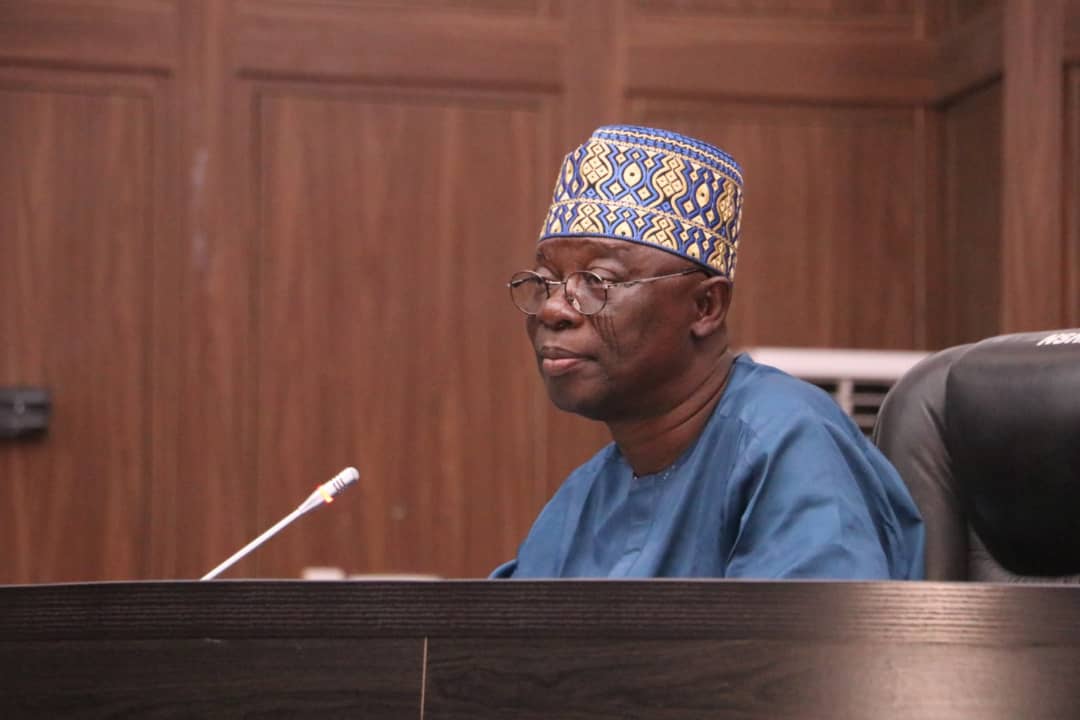
DSS and Accusations of Disobedience to Court Orders– Setting the Records Right

By Peter N. Afunanya

Recently, the media is awash with various commentaries about DSS disobedience to Court Orders. These accusations, as wrong as they are, have peaked in the Emefiele saga. It may interest the public and indeed the avowed critics of the Service to note the following incidents and timelines to show that it has religiously obeyed Court orders in respect of the case and even others.

In 2022, the Service commenced the investigation of Mr Godwin Emefiele on suspicion of Terrorism Financing, Money Laundering among others and subsequently applied to the Federal High Court, Abuja for his arrest and detention. But the Chief Judge objected to the order and clearly stated that the Service did not need an order to investigate or arrest him. Emefiele was to later obtain a restraining order issued by Justice MA Hassan of the FCT High Court against the Service. Instructively, the DSS obeyed this Order and did not arrest or detain Emefiele.

However, on 9th June, 2023, Emefiele was suspended as CBN Governor by the President. Based on new information and suspected criminal infractions, the Service, as expected by law, arrested and detained him using a Magisterial Order. On 10th July, 2023, Justice Hamza Mu’azu of the FCT High Court, while recognising that the DSS had every legal right to arrest, detain and investigate Emefiele, ordered for his release or prosecution within seven days. The Service expeditiously and expressly complied with the order and charged him for illegal possession of firearms and ammunitions being one of the criminal suspicions. The Muazu Order had, by implication, extended Emefiele’s detention by seven days with effect from 10th July, 2023 when the initial detention order had expired.

Within the same period, Justice Bello Kawu of the same FCT High Court, while dismissing reliefs sought by Peter Abang, Counsel to Emefiele on 14th July, 2023 ordered for the release or prosecution of Emefiele within 48 hours. However, the Service had complied with the seven days ultimatum issued by Justice Muazu. In obedience to rule of law, Emefiele was arraigned before Justice Nicholas Oweibo of the Federal High Court, Ikoyi, Lagos, on 25th July, 2023 for illegal possession of arms and ammunition. The Service had long issued a press statement over the incident that happened at the Court between its staff and those of Nigerian Correctional Service (NCoS) and pledged to investigate it. Though the investigation is ongoing, the preliminary findings are quite shocking considering the ignoble roles played by some public officials.

As normal with criminal investigations, security agencies re-arrest suspects when there is adequate suspicion of commission of a crime or as may be revealed by an ongoing investigation. Emefiele was re-arrested on the basis of this. Even though the re-arrest was tainted by the overzealousness of personnel of the Service and NCoS, it was nonetheless legally procedural.
Later, the Service applied for an Exparte Order at the FCT High Court presided by Justice Edward Okpe (and not Justice Mu’azu as erroneously and massively reported in the media) to detain Emefiele for 14 days. Against the established rules regarding exparte applications, a lawyer suddenly appeared in the Court for Emefiele. While the Judge did not outrightly reject the DSS request, he struck out the motion upon its withdrawal by the Service counsel. But this is not without his guidance. Earlier, the Judge had drawn the attention of the Counsels to Section 293 of Administration of Criminal Justice Act (ACJA) which also recognises the Magistrate Court as a competent Court that can first be approached for an order for custody of a suspect under investigation. In other words, the Service, having taken the hint of the Court, took the right steps. What transpired at the Court was, thereafter, variously misrepresented by some mischief makers. Part of the disinformation is to the effect that the Court “struck out the application and stated that it was an abuse of judicial process”. That was not what the Court said. What Justice Okpe said was “the Applicant having withdrawn the application, same is hereby struck out”. That was all. The Court records are there. But purveyors of fake news distorted the message to suit their intent; just to make the Service look bad – a sort of giving the dog a bad name in order to hang it.

Many had gone to town with stories of DSS fragrant disobedience to Court Orders especially in view of the last episodes at the High Courts in Lagos and Abuja. With what played out at the Court on 27th July 2023 under Justice Okpe, the Service immediately applied and obtained a detention Order from a Magistrate Court. So, Emefiele is legally detained. For reasons that the Emefiele case is subjudice, the Service will restrain from making further comments on the subject matter.

For either lack of knowledge or deliberate act to ignore the truth, there has been sustained bashing of the Service and its leadership in the media and public spaces. It is ironical that the same people who condemn media trial are daily taking the Service through the same. The actual points are however, not lost on the Service. It is aware of the depth of the orchestrations and even deeper plot to incite the judiciary against it.

Targeting DSS DG, YM Bichi, for insidious media attacks is needless. Any DGSS, even if brought from heaven among the angels, will discharge the DSS mandate. There isn’t a time in our national sojourn for greatness that key organs of government will cease to exist or not needed. The DSS, like the CIA, FBI among others, is a major and positive instrument of State administration and management. It is essential for statecraft, governance, stability and public order. Scraping it as being canvassed by the uninformed is unreasonable. It is indeed obvious the DSS is misunderstood. It is obvious there is a mob action against the Service. Allow the DSS be. Allow Bichi, a fine gentleman officer, be. Support DSS. Support Nigeria. As in the national anthem, Arise, O Compatriots.

Some critics have made varied insinuations including abusing the Service, its leadership and completely distorting the significant historical role of the Service in nation building. Others have said it is wobbling and of no relevance. Laughable. The DSS is not tottering. It is standing and firmly too. Even the worst of its critics knows that the Service has played (and still plays) stabilising roles for the nation. Its loyalty and patriotism are incomparable. The Service is a stabilising force for the country’s democracy. Same for the indivisibility and indissolubility of Nigeria’s sovereignty. Only a collaborative support from stakeholders will strengthen this. The Service does not claim to know it all; a reason it allows for constructive criticism and makes out time to explain itself in line with transparency and democratic accountability.

Whether on Emefiele, Bawa or Kanu, the Service has obeyed judicial orders and handled the cases procedurally and in accordance with the rule of law. Critics are encouraged to be a bit more discerning and up their research capabilities. Doing so will reveal that the Service obeys orders. The Court of Appeal judgement on Kanu is recommended for detailed study. Maybe, we can decipher the difference between Discharged and Acquitted and what the use of either or both mean in the final order of a Judge. The DSS is an ardent respecter of the law. Anyone may argue this but it is true. It is in this regard that it has applied for either a stay or notice of appeal on some of the matters. One who does not obey the laws will not resort to legal procedures like the DSS has done.

Let those seeking justice not intimidate the Judges or derail law enforcement efforts. Judges deliver justice without fear or favour and should be allowed to discharge their duties honourably. For the umpteenth time, the Service reiterates its unequivocal stance on rule of law and respect for the judiciary. This position remains unchanging despite the futile attempts to paint it otherwise.

Peter N. Afunanya Ph.D, fsi, is the
Public Relations Officer, Department of State Services (DSS) National Headquarters
Abuja.

China National Archives of Publications and Culture tells stories of civilization exchanges

By Liu Chengyong

In the long course of human history, many civilizations emerged. Some faded away with the passage of time, and some endured despite twists and turns.
Chinese civilization has remained uninterrupted for thousands of years, only growing more vibrant as time passes. This would not have been possible without the collection, preservation and passing down of classics and publications.
Oracle bones, pottery symbols, bronze inscriptions, stone carvings, seals, bamboo and wooden slips, woodblock printing, rubbings, ancient books, chorography, maps – these artifacts record the marks of Chinese civilization, character symbols, and cultural context. They are the creators of the Chinese civilization and witnesses to the Chinese history.
Today, these cultural treasures of the Chinese nation are preserved and presented at the China National Archives of Publications and Culture, which comprises headquarter in Beijing and branches in Xi’an, Hangzhou and Guangzhou. They strengthen the bridge of mutual learning between China and civilizations worldwide.
Boasting a rich and valuable collection, the China National Archives of Publications and Culture is dubbed as a cultural gene bank of the Chinese nation. It collects nearly 24 million precious copies and editions of various publications and gathers almost 500 million data entries, with 24 million open to the public.
Like a time tunnel, the editions and copies archived tell the stories of exchanges and mutual learning among human civilizations, such as the journey of Zhang Qian, a royal envoy in China’s Han Dynasty (202BC-220AD), to the Western regions via Central Asia, which eventually led to the opening of the ancient Silk Road, the “Journey to the West” by Tang Dynasty Buddhist monk Xuanzang (618-907), the story of Tang Dynasty monk Jianzhen who brought Buddhism to Japan, and the legendary voyage to Southeast Asia, South Asia, West Asia, and East Africa by Chinese navigator Zheng He of the Ming Dynasty (1368-1644).
They record the extraordinary journeys of different civilizations, from their initial encounters to the exchanges and mutual learning that developed between them across various historical stages.
During the Southern Song Dynasty (1127-1279), China was a leading country in terms of navigation technologies. A green-glazed bowl with Chinese character Ji exhibited at the headquarter of the China National Archives of Publications and Culture was salvaged from the Shipwreck Huaguangjiao No.1 of the Southern Song Dynasty.
In Chinese, Ji symbolizes the Chinese people’s longing for an auspicious and peaceful life. This relic mirrors the demeanor of ancient Chinese sailing afar and pioneering outward on the Maritime Silk Road hundreds of years ago.
The archives gathers a wealth of other valuable items that witness the history of cultural exchanges. These include a Song Dynasty (960-1279) edition of the Great Tang Records on the Western Regions, which chronicles Xuanzang’s journey along the ancientSilk Road. Also featured is a copy of the original 1688 French publication of “An Introduction to The Analects of Confucius.” This work marked the first communication of Confucian thought in French, and was a national gift to Chinese President Xi Jinping from his French counterpart Emmanuel Macron in 2019.
Two “cultural exchange day” events were recently held at the China National Archives of Publications and Culture, which were joined by 88 sinologists from some 60 countries as well as over 30 foreign experts of culture, museum studies and publishing.
They were amazed by the infrastructure construction, high-quality exhibitions and displays, and the tremendous cultural treasures of the China National Archives of Publications and Culture. They also expressed their hope to strengthen communication with the archives and jointly promote the inheritance and preservation of Chinese classics and materials overseas.
With a focus on its core mission of collection, the China National Archives of Publications and Culture reaches out to the grassroots, general public, and overseas to comprehensively advance surveys, investigations, and acquisitions.
Adhering to the principles of collecting everything that should be collected, and preserving everything that should be preserved, it brings together Chinese classics and materials scattered across the country, circulating among the people, and lost overseas. It strives to include editions embodying the outstanding cultural achievements of human civilization, gathering strength for advancing human development and progress.
Different nations and civilizations are rich in diversity and have their own distinct features. No one is superior or inferior to others. Based on its diverse collection, the China National Archives of Publications and Culture strengthens mutual learning among civilizations, builds communication mechanisms and dialogue platforms for cultural exchanges, carries out international cultural exchange and people-to-people communication activities, and gathers domestic and foreign experts to launch theoretical and practical studies of bibliography.
At the same time, assisted by technology, industry and art, the archives actively innovates communication and promotion approaches, explores to establish multidimensional cultural communication paths, and works to realize the expression of bibliography in diverse forms. It excavates and presents the Chinese culture, vividly tells the historical and cultural stories behind Chinese classics and materials, and displays and disseminates the beauty of civilization and the splendor of culture.
(Liu Chengyong is the director of the China National Archives of Publications and Culture.)

EMEFIELE AND HIS MOB SYMPATHISERS

By Chibuike Ohaegbulam

Once upon a time, there was a man called Godwin Emefiele who lived and worked in a country known as Nigeria. Emefiele was a banker and rose to be the Group Managing Director of Zenith Bank. In 2014, Emefiele was appointed the Governor of Central Bank of Nigeria (CBN). He became very powerful. Very influential that he discarded his old friends and benefactors.

While rumour mills had it that Emefiele would be sacked when a new Government took over in 2015, he, instead, consolidated power. He made new friends and patronised them. He was in charge of the country’s vault. He could dispense favours in any way he wished. From N150 per dollar when he took over as CBN, the foreign exchange shot up. As people complained, Emefiele paid deaf ears. No one mattered. He was not answerable to anyone except to the President and his men. Emefiele grew wings. He became so proud. He was so insensitive to the cries of the common people.

Emefiele came up with an idea; an idea that favoured his friends and cronies. He created an unnecessary arbitrage for the foreign exchange. He had two rates; one for the ordinary people and those who did not have access to him and the other for the powerful, his friends and beneficiaries. All it took for any of such to be an overnight Billionaire was knowing Emefiele or being in his good book, just get dollar at a cheaper rate from the CBN and off load in the black market. Banks were starved of FX. Nigerians cried. Businesses suffered. Foreign Direct Investment was zero. International trade was in total collapse. Emefiele became a household name for the wrong reasons. He conjured many diversionary policies namely anchors borrowers, rice farmers association etc etc.

An African adage has it that those who the gods wish to kill, they first make mad. Emefiele became larger than life. He had other ideas. To crown his pride, Emefiele began to nurse a bigger ambition. He wanted to be the President of Nigeria. He organised his associates or they organised themselves. A Presidential ticket was procured for him with the whopping sum of a hundred million Naira. Opposition rose against him. He went to Court. Barefaced arrogance! Nigerians roared. Protests erupted. And citizens were told Rice Farmers Association bought the Presidential form for him. Emefiele or his supporters also procured several Sienna buses for the presidential campaign project. The buses were well adorned with his pictures. Was it possible a sitting CBN Governor would throw in his hat to become President, citizens asked. People watched, in surprise, how that would materialise. Emefiele was eventually stopped or he stopped himself. But he stopped. Measured reason prevailed. Emefiele went back to his work. It was said that Emefiele retreated mischievously.

As preparations for the elections went by, Emefiele devised a means seen by many as ways to scuttle the process or stop certain persons from winning. He started a redesign of the country’s currency. He gave short notice. He disobeyed Court orders; even Supreme court orders. He had the buy-in and support of the then President, called Muhammadu Buhari. Emefiele told him the policy would check vote buying. But it did not. Emefiele spoke to Nigerians very arrogantly. He talked tough. He discarded every advice. Nigeria went up in flames. People died. Some went naked or fainted in Bank halls. There was hunger. People started doing trade by barter – exchange of goods and items. People exchanged what they had with what others had that they didn’t have. POS operators became masters. Sick people could not buy drugs. Transport fares went up. Rural dwellers called their relatives in the city to send them help. Both old and new currencies became scarce. Children could not take food to school. Only those who knew Emefiele or those that knew such persons enjoyed. The President at that time, even made a broadcast to beg Nigerians. He pleaded for their understanding. There were several violent demonstrations. Everyone except Emefiele was agitated. Emefiele had the army. They gave him protection from everything – from arrest, investigation or anything. He was larger than life.

Eventually the election held. Emefiele and his cohorts did not stop it. One man named Bola Ahmad Tinubu won the election and was inaugurated as the President. Before then he had cried and said some persons wanted to stop him from winning even though it was his turn. He shouted “Emilokan”. He was to later declare that he was seized by the spirit and courage of Emilokan, it is my turn spirit.

About two months after Tinubu was sworn in as President, he suspended Emefiele due to financial reforms he wanted to carry out. Nigeria’s domestic intelligence service (some call it SSS and others, DSS) arrested Emefiele. Controversies trailed his arrest. Remember, Emefiele became a man of means having spent nearly 10 years as CBN Governor. He had deep pockets. He could buy anything. He was even flying in private jets. So due to his immense wealth, he “bought” everyone. Emefiele began to dramatize his arrest.

Story had it that all those who were once his critics started showing support for him. They even rumoured that a group of persons called Obidients and Atikulated were his core supporters. They never liked anything Batified. These groups turned Emefiele’s supporters overnight. If Emefiele was bad, they did not care. Politics took over Emefiele’s arrest or any effort to bring him to justice.

In the judiciary, lawyers who never had business with him came to his support. Civil society groups started singing his praise. There was a story that the day he was taken to court, some prison officers were falling head over heel to have his attention. The people of Nigeria said the prison officer in charge (an equivalent of a Police Assistant Commissioner of Police (ACP), did not explain why he was personally in court that day. Or was he aware the Judge would hand over Emefiele to prison authorities? People wondered if there was a conspiracy between prison authorities and Emefiele. Why should the prison fight for custody of someone? Was there a deal? There was even a gossip that prison people wanted to take Emefiele away for, at least, a night to get “something” from him. Many questions were asked! Were prison warders supposed to take someone they did not bring to court? All the episodes looked every inch organised.

It was told how Emefiele divided people because he had money. His trial lasted long. He scandalised everyone. He hired strong and well-funded Senior lawyers called SANs. He built a mob. His sympathisers were part of this mob. His sympathisers started to argue that possession of gun for which he was temporarily charged was not a crime. People who were once maltreated by Emefiele started to defend him. Everywhere you went – Radio, Tv, paper reviews and news rooms it was in defence of Emefiele. Power of money, they said. Power of reach, we were told. Emefiele had bought everyone. He had bought over same people who did not want him to be President and condemned him for trying to contest. His supporters became blind to reason and truth. They would not accept contrary views. Those who had long knives drawn against Tinubu hid under Emefiele. Strange alliances surfaced. Money spoke. Several otherwise sane people were at the beck and call of Emefiele. Those who benefited from him were in the amorphous crowd.

This shall be the storyline of the Emefiele saga. Children of today and those yet to be born will be told of the story of a man who was desirous of taking over his country and when he failed, used his allies to recruit enemies against the State and patriotic citizens. But let this not be the story. It must never be said that all Nigerians forgot easily soon or turned a blind eye to such gross travesty. It is largely said in local parlance, that if you fight corruption, it will fight back. Is the current situation a realisation of that saying? Is Emefiele fighting back by procuring disloyal elements who have loaned their conscience for a bite of what is left of his big purse? For a few pennies, they will defend even a dog who scratches the owner’s baby. Shamelessly, they and others alike feel that it is their turn to fleece off a bite of his pudding. So, they campaign aloud against further scrutiny of Emefiele’s actions in hopes that authorities would cave in and their pay master is left off the hook.

But it is important to recognize that the fight against corruption is often a complex and challenging endeavour. Of course, those who stand to lose from exposure will attempt to muddy the waters and sow doubt. However, the Nigerian people must not succumb to the distracting tactics employed by a man who inflicted unprecedented and unimaginable hardship upon them nor to the baits of his cohorts and lost sympathisers who have traded their principles for personal gain. Resilient citizens, desirous of the Nigeria of their dreams, must ensure that the country moves toward a future free from the shackles of corruption, thus must continue to press in demanding accountability, justice and transparency from leaders. The Emefiele saga, rather than being a mere tale of power struggles and manipulation, can also become a testament to the strength of a nation determined to hold its leaders accountable. The story can evolve into one where the citizens unitedly stood against attempts to derail justice and where the principles of fairness and integrity triumph over personal gain. Let the lessons of this saga inspire generations to come to be steadfast in their pursuit of a just and equitable society, where no one is above the law and the well-being of the nation takes precedence over individual interests.

Chibuike Ohaegbulam is a commentator on public affairs.

MASSIVE FRAUD ROCKS AMNESTY OFFICE AS HEADS OF UNITS GET ILLEGAL MONTHLY N15 M, N10M WELFARE ALLOWANCES

The stakeholders have called on the anti graft agencies and indeed the supervisory office, the National Security Adviser to look into how the N5.4 billion monthly allocation to the office is being spent.
The sources claim that certain members of staff in the office of the Interim Administrator of the Amnesty Office are being paid huge amounts for welfare.
The sources said some senior officers receive N15, and N10 millions, per month, respectively.
It was further stated that the heads of protocol, Audit, and the aides of Ndiomu receive the same N10 million for welfare in the Federal Government Agency.
It was gathered that the Directors of Administration and Audit who were posted from the office of Head of Service were dropped for retired civil servants because they raised concern over the curious financial deployments in the office.
It was gathered that the current DFA and the Head of Audit are both retired civil servants who have nothing to worry about their careers in the civil service.
It was learnt that a new Director of administration was deployed from the Head of Service but leadership of the Amnesty office prevented him from resuming effectively.
All the functions of the Administration Department were removed from the former Admin office and a new department known as Head of Human Resources has been created for the former Head of Admin, Mrs Khalinat Balogun, a staff of NTA who is not from the mainstream civil service.
The current DFA, Alhaji Ado Dikko, a retired civil servant with contacts at the Account General Office.
The sources also urged the Federal Government to investigate the cooperate system of the Amnesty office.
The office removes N500 million every month for a suspicious cooperative system.
Workers of the office who have expressed concern over the running of the office have been sent back to the ministries and replaced with newly employed ones.
Shortly before the end of the Buhari administration, the then National Security Adviser, Gen Monguno made moves to shut down the Programme which was resisted by the leaders and people of the Niger Delta.
When Barry Ndiomu was appointed, he said he was at the PAP with a mandate to wind down the programme.
The situation and tension in the region made it impossible for him to abruptly bring the programme to an end.
There are serious concerns that the Amnesty Office has lost its importance under Ndiomu having been relieved of its key roles in the region.
The Interim Administrator has since stopped fresh deployment of students for the scholarship programme which endeared government to many in the region.
Ndiomu also put an end to the training or empowerment programmes of delegates in the region.

Breaking: Edo Deputy Governor, Shaibu may be impeached Monday

***as rift with Obaseki worsens

In a daring move and barring any last minute change of plan, they are suspicions that the Edo State House of Assembly backed by Governor Godwin Obaseki may commence impeachment proceeding against the Deputy Governor Comrade Philip Shuaibu.

This is said to be in disobedience of the pronouncement of the Federal High Court, sitting in Abuja, which ruled last Friday that all parties maintain “Status Quo Ante Bellum”, pending the hearing slated for Thursday, 10Th August, 2023.

Hon. Justice Ahmed Mohammed of the Federal High Court Abuja issued a temporary order stopping the move by the Edo State House of Assembly and the Governor to impeach Shuaibu.

Insider information revealed that in disregard for the temporary order, an impeachment ambush has been set for the early hours of Monday, 7Th August.

It is said that the haste by the governor comes on the heels of his fear that the hearing adjourned till 10th August by the court may not favour his purported intension, hence the plan to hatch his impeachment process before the hearing date.

Recall that Shaibu approached a Federal High Court sitting in Abuja to stop the commencement of an impeachment process against him. In the suit marked: FHC/ABJ/CS/1027/2023, the Inspector General of Police;  State Security Service; the Governor of Edo State; the Speaker of Edo State House of Assembly, and the Chief Judge of Edo State are the first,  second,  third, fourth and fifth defendants respectively.

Shaibu is seeking an interlocutory injunction restraining the 3rd, 4th and 5th Defendants/Respondents or their agents from commencing an impeachment process against him.

He also prayed the court to restrain the governor of the state or other person acting on his order from harassing and preventing him from effectively discharging his duties as the deputy governor of the state.

In addition to the temporary order to maintain status quo ante bellum, in another ruling of the court made on July 27th, 2023, the defendants were directed to show cause. Without adherence to the pronouncements of the court, any impeachment process is deemed a fruitless adventure in the eyes of the law.

“Shuttle trucking” makes air transport more efficient

By Du Haitao, People’s Daily

A flight from Billund Airport in Denmark recently arrived at Hangzhou Xiaoshan International Airport in east China’s Zhejiang province, carrying 39.6 tons of imported goods.

The cargos were soon cleared through customs. Of that, 39.3 tons, mainly chemicals and spare parts, were shipped by trucks to Shanghai and Beijing.

These shuttle trucks, which run on fixed schedules and routes, connect the final destinations of cargos with the airports at which they arrive. This air-land intermodal transportation utilizes trucks’ cost and flexibility advantages to meet enterprises’ logistics demands.

It is estimated that shipping goods indirectly by consolidating cargo on flights to Hangzhou first and then trucking them to final destinations in China, reduces shipping costs per kilogram by 10 percent to 15 percent compared to direct air shipping to each destination.

In the first five months of this year, the Hangzhou Xiaoshan International Airport Customs supervised 4,039 truck shipments totaling nearly 9,109 tons, up 78.3 percent and 16.6 percent respectively compared to the same period last year.

To ensure efficient operations of the shuttle trucks, the Hangzhou Xiaoshan International Airport Customs implemented a 24/7 clearance plan to quickly process cargo. This mechanism enables goods to be shipped to their final destinations are cleared through customs on the same day they arrive in China.

The Customs is cooperating with airlines and relevant enterprises to expand the coverage area of the trucking service and contribute to the integrated logistics development in the Yangtze River Delta.

As China’s economy and society continue to develop, there are increasing demands for more efficient and convenient logistics transportation. As a form of air-land intermodal transportation, these shuttle trucks are more and more favored by the market.

Guangxi Civil Aviation Industry Development based in Nanning, capital of south China’s Guangxi Zhuang autonomous region, has launched an interprovincial shuttle truck service for imported express parcels to promote air-land transport connections in Nanning. This has greatly enhanced the capacity of Nanning’s airport to guarantee timely delivery of imported express parcels.

The airport of Nanning has an annual international air cargo and mail processing capacity of 150,000 tons. It operates 11 international cargo routes to 12 cities in 8 countries of ASEAN and South Asia.

Thanks to the shuttle truck service, seafood, fruits and other featured products from ASEAN countries can enter the Chinese market more conveniently. The airport of Nanning has become an important channel for ASEAN products to expand their market in China.

A similar services has been launched by Haikou Meilan International Airport, south China’s Hainan province, too, which sources goods from Guangzhou, Shenzhen, Zhengzhou and other cities and then exports them together. This facilitates effective connections between the Hainan Free Trade Port and domestic and foreign cities. At the same time, it expands the airport’s import channels, enhances coordination between air cargo services, reduces transportation costs for businesses, and further improves the airport’s freight capacity.

Experts said that the air-land intermodal transportation takes advantages of China’s developed expressway network and flexible trucking services, and thus well connects air and land transport and makes air transport safer and more efficient.

As innovations are made to improve such shuttle truck services and the transport network, the high-quality development of China’s logistics industry is expected to be further advanced.

Rural cultural activities brim with new vitality

By Liu Yang, People’s Daily

“Village Spring Festival galas,” “rural basketball league,” and “village soccer super league” are all the rage in China. These featured and vibrant rural cultural and sports events, known to the public via livestreaming and short video platforms, have received rave reviews.

They are a miniature of China’s remarkable achievements in developing public cultural facilities and activities in rural communities.

Village Spring Festival galas, featuring entertainment shows with local rural characteristics, has become a new Chinese New Year custom loved by rural communities across China. Rural sports activities have gathered millions of sports fans online and offline, setting a big stage for grassroots athletes and cultural performances. Besides, activities showcasing intangible cultural heritage, rural courtesy and customs shows, as well as rural food festivals are also attracting tons of visitors to the countryside.

These magnificent cultural activities do more than simply enriching rural life and lifting people’s spirits – they also expand new avenues for rural consumption and promote the transition and upgrading of the rural economic structure.

This huge surge in rural cultural activities didn’t just happen overnight. It’s the product of local culture progressively building up steam over time.

Many rural cultural activities had already accumulated decades of history before gaining such widespread attention. For example, village Spring Festival gala dates back to 1981 in east China’s Zhejiang province, when villagers in Yueshan village, Qingyuan county, Lishui built a stage to perform local operas and lantern dances. It has a history of more than 40 years.

The rural soccer league in Rongjiang county, southwest China’s Guizhou province first emerged in the 1990s, and the basketball tournaments in Taipan village, Taijiang county of the province have been held continuously for decades.

What also consolidated the foundation for the thriving cultural development in rural areas are the country’s efforts to advance poverty alleviation and rural vitalization.

After gaining wealth, rural residents have an enhanced demand for cultural enrichment, as well as a heightened sense of responsibility to inherit and develop local culture. Be it the village Spring Festival galas where villagers themselves play the lead, or rural sports events hosted with concentrated efforts, none of this would have been possible without the cultural confidence built up through rural prosperity, nor people’s eager anticipation to pass on and innovate the rural culture.

Riding the fast train of new media, rural cultural activities are being delivered to more people. According to statistics, as of December 2022, the number of Chinese rural internet users reached 308 million, or 61.9 percent of the total rural population. Last year, village Spring Festival galas hosted in Zhejiang province received a total of over 100 million online views. Short videos showcasing the stunt basketball and soccer moves also contributed to the popularity of rural basketball and soccer leagues.

The booming new media sector has significantly improved the communication of information among different regions. This provides huge support for gathering resources for the rich and colorful rural culture and for stimulating relevant industries. It also helps built an expansive platform for rural cultural activities to break through geographical constraints and reach wider audience.

The novelty of rural culture is a reason for rural cultural activities to have stood out from massive online information. Prizes of rural basketball and soccer leagues are mostly local farm produce, such as chickens and ducks. Aluminum basins and cymbals are always used as “bang sticks” by spectators to cheer. Local performances staged in the intervals of the games, including songs and dances with ethnic features, also make these events unique.

It just breaks people’s conventional impressions of farmers and rural lifestyles when farmers turn into athletes and performers dressed in their finest on the stage, and demonstrates the splendor of Chinese farmers and rural culture in the new era.

The booming rural cultural activities effctivelly drives rural economy. In recent years, village Spring Festival galas, rural basketball and soccer events, as well as other cultural activities have become a new focus of the integrated development of the cultural and tourism sectors. They not only led to a growth in the revenues of local B&Bs, hotels and restaurants, but also promoted local tourism resources, intangible cultural heritage items and farm produce.

According to statistics released by Qiandongnan Miao and Dong autonomous prefecture, Guizhou province, the number of tourists received and total tourism revenue of Xijiang Qianhu Miao Village in the autonomous prefecture multiplied when it hosted a village Spring Festival gala this year. Figures from the government of Rongjiang county also indicated a 39.73 percent rise in tourist visits to the county and a 52.08 percent growth in its tourism revenue this May because of a rural soccer league hosted there.

Besides, rural cultural activities also stimulate consumption, providing replicable experiences for the integration and mutual promotion of rural culture and economy.

Japan’s so-called “China threat” rhetoric cannot deceive world

By Zhong Sheng, People’s Daily

Japan says it seeks to “fundamentally reinforce its defense capabilities” and is planning to spend 43.5 trillion yen ($303.5 billion) on defense in the coming five years in a 2023 defense white paper it recently issued.

Turning a blind eye to facts, the white paper labels China as an “unprecedented and the greatest strategic challenge” to Japan. It hypes the so-called “China threat,” grossly interferes in China’s domestic affairs, and smears China’s defense policy, normal military development and legitimate military actions.

This clearly reveals the scheme of the Japanese side to find excuses for its own military expansion by fanning up the so-called “China threat.”

China pursues peaceful development and a defense policy that is defensive in nature. It has never challenged or threatened other countries. China reinforces national defense and military development to safeguard national sovereignty, security, and development interests, which is legitimate and beyond reproach.

Currently, the situations on the East China Sea and the South China Sea are generally stable. The Diaoyu Island and its affiliated islands have been China’s territory since ancient times. The navigation by the Chinese public service vessels in waters off the Diaoyu Island is a legitimate measure taken by China to exercise its national sovereignty in accordance with law.

Japan is not a country concerned with the South China Sea issue. It should stop creating chaos and confrontation. Military cooperation including joint naval patrol between China and relevant countries is consistent with international law and established international practice. Using China’s normal military development as an excuse and fanning up the rhetoric that China’s “unilateral attempts and actions to change the status quo” have been more and more frequent is just another awkward show of fabricating the so-called “Chinese military threat,” which intensifies the tension in the region.

On the East China Sea, no one has ever tried to change the status quo of the Diaoyu Island but Japan. In the Asia-Pacific, the ones who really threaten regional peace and stability and try to unilaterally change the status quo are some external countries that frequently show off their muscle with aircraft and warships for private interests.

Taiwan is China’s territory. The Taiwan question is purely China’s internal affair, which brooks no interference by any external force. The one-China principle, which matters the politic foundation of China-Japan relations, is a red line that shall not be crossed. Japan bears grave historical responsibility to the Chinese people on the Taiwan question. In recent years, instead of reflecting on its mistakes, Japan has repeatedly broken its promises on the Taiwan question and hollowed out the one-China principle.

From hyping that “Any contingency for Taiwan is a emergency for Japan” to the recent claim by a high-ranking Japanese official that Japan would likely provide defense equipment support or logistics support for Taiwan, Japan has turned a total blind eye to the basic norms governing international relations and the principles of the four China-Japan political documents, grossly interfered in China’s domestic affairs, and undermined the political foundation of China-Japan relations.

The remarks and deeds by the Japanese side have escalated tensions across the Taiwan Strait. This is extremely wrong and dangerous.

Japan has revealed its wrong perception of China by taking the latter as an “unprecedented and the greatest strategic challenge.” If Japan’s China policy was made based on this wrong perception, it would be misguided.

It is agreed in the fourth China-Japan political document that the two countries should “be partners, not threats.” This should be the basis for the mutual recognition between the two countries.

China’s Japan policy has been consistent and stable, and China never sees Japan as a threat. China opposes the “China threat” theory that’s biased and hostile.

For some time, Japan has made frequent negative actions on issues related to China, which severely disturbed the two countries’ bilateral relations. Only by abandoning the beggar-thy-neighbor mentality of zero-sum confrontation and establishing a correct understanding of China can Japan bring bilateral relations to the right track with concrete actions.

The true intention of Japan in hyping the so-called “China threat” is to find excuses for its own military expansion. The country says it follows a peaceful path, respects the rule of law and advocates peaceful diplomatic solutions to any disputes. However, what it does is undermining the post-war international order and seeking military expansion. It updated its National Security Strategy, National Defense Strategy and Defense Buildup Program, significantly lifted its defense budget and hyped the development of the so-called “counterstrike capability.”

The Japanese side has continuously violated the pacifist constitution and the “exclusively defense-oriented” principle in recent years and is moving further down the path of military expansion.

It also follows the wrong China policy of the United States, cooperating with the latter to make troubles on issues concerning China’s core interests. Regardless of the opposition from regional countries, Japan promoted NATO’s eastward foray, placing regional countries in the danger of major country gambling and bloc confrontation. This has triggered grave concerns and high alert from the international community.

Japan can never deceive the world with its efforts to hype the so-called “China threat” or with its excuses to seek military expansion. If Japan wants to be normalized, it should face up to and reflect on its history of aggression, stop interfering in China’s domestic affairs, stop undermining China’s interests, abandon its attempts to hype the so-called threats surrounding it and loosen the bonds on military development, and take a responsible attitude and concrete actions to win trust from its neighbors in Asia and the international community.

(Zhong Sheng is a pen name often used by People’s Daily to express its views on foreign policy and international affairs.)

China’s H1 economic performance reveals quality growth, strong fundamentals

By Bai Yifei, People’s Daily

This July, plums produced in Wushan county, southwest China’s Chongqing municipality, were hitting major cities in China, including Beijing, Shanghai, Guangzhou and Shenzhen, via charter flights.

Last year, one flight was scheduled per day for 15 days, and this year, the figures increased to two and 20 respectively.

The expansion indicates growing domestic demand, as well as a trend of economic pickup.

China’s National Bureau of Statistics recently released the country’s half-year economic data. Despite a complex and volatile external environment, the Chinese economy achieved a good start in the first quarter and continued the trend of recovery in the following three months. China’s GDP grew 5.5 percent year-on-year in the first half of 2023.

The continuous sound momentum for economic recovery demonstrated the country’s huge development potential and capability to advance in adversity.

To understand the Chinese economy, one should focus on not only its growth, but also its structure and quality.

China’s GDP growth in the first half of 2023 outpaced both the full-year expansion of 3 percent in 2022 and the 4.5 percent growth achieved in the first quarter this year. In addition, in the first half of this year, the added value of the service sector accounted for 56 percent of the GDP and final consumption contributed 77.2 percent to economic growth. The growth of investment in high-tech industries outran that of overall investment, and the structures of industries, consumption and investment were constantly optimized.

High-tech industries maintained sound growth; emerging industries kept growing; new business forms remained active. Green transition and economic growth have been well coordinated.

China’s economy has maintained growth for four consecutive quarters and the Chinese market has kept releasing its vitality. This well proves that the country has built a more stable foundation for its economy and is seeing stronger momentum for growth. High-quality development is constantly advancing.

The Chinese economy should also be viewed with a global perspective. The United States, the eurozone and Japan all reported economic growth below 2 percent in the first quarter of 2023. Even when the Q2 performance is taken into consideration, China’s economic growth in the first half of this year was still fast among major economies.

It was a hard-won achievement that China secured economic recovery, stable commodity price and stable finance in the first six months of this year when the world still suffered from sluggish recovery, high inflation and slowed global trade growth.

Recently, multiple international organizations including the World Bank and the Organization for Economic Co-operation and Development have uplifted their forecast on China’s economic growth this year, which demonstrates the confidence of the international community in the prospects of the Chinese economy.

The enterprises are always in the best position to tell how the economy is developing. The development of foreign enterprises in China offer an important perspective on understanding the Chinese economy.

Multiple foreign companies have shown their confidence in China’s economic performance through concrete actions. This year, U.S. carmaker Tesla announced that it will build a new mega factory in Shanghai, which will be dedicated to manufacturing the company’s energy-storage product Megapack. European aircraft manufacturer Airbus plans to build its second production line at its site in Tianjin. Multinational pharmaceutical and biotechnology company AstraZeneca signed a deal to expand its investment in Qingdao, east China’s Shandong province.

This indicates from the side that China enjoys broad market prospects and still remains a major engine driving the global growth.

Hospital train brings brightness to cataract patients in Xinjiang

By Liao Ruiling, People’s Daily

In Korla, Bayingolin Mongol autonomous prefecture, northwest China’s Xinjiang Uygur autonomous region, there is a train painted with rainbows – the “Sinopec Lifeline Express” hospital train.

The train, tied down to a track beside the Korla East Railway Station, began medical services on May 17 this year. It offers free cataract surgeries for local patients in need.

Abliz Bawudun, 72, from Langan township of Korla, developed blurry vision two years ago. He also suffered from diabetes and high blood pressure. Treating the disease was a heavy economic burden for his family.

After the “Sinopec Lifeline Express” hospital train was put into use, it launched cataract screening tests for local residents, and the 72-year-old thus had a free cataract surgery on the train.

The hospital train is a charity project for cataract patients jointly set up by China’s National Health Commission and the Chinese Foundation for Lifeline Express. Since 2002, Lifeline Express trains have made multiple trips to Xinjiang, offering free cataract surgeries for 11,220 patients in the autonomous region’s Aksu, Kashgar, Korla, Kuytun, Kizilsu Kirgiz autonomous prefecture, and Ili Kazakh autonomous prefecture.

The project has also set up ophthalmology centers at the People’s Hospital of Xinjiang Uygur Autonomous Region, the First People’s Hospital of Kashgar, the People’s Hospital of Yarkant County and the People’s Hospital of Kizilsu Kirgiz Autonomous Prefecture.

Though the train is not big, it is equipped with all necessary facilities such as examination devices, wards and operating rooms, and meets all medical standards, said Feng Jing, associate chief physician of the ophthalmology department of the Beijing Chao-Yang Hospital.

“We have professional internal medicine nurses, and are supported by relevant departments at our base hospital, so as to ensure the safety of all patients,” Feng added.

According to her, patients in complicated conditions would be transferred to the base hospital for treatment.

It is learned that apart from offering cataract surgeries onboard, the hospital train has dispatched a medical team to Ruoqiang and Qiemo counties that are not accessible by train to provide medical services for residents with poor vision there.

In Qiemo county’s Aketikandun township, Kuoshisatema township and Tatrang, the medical team launched screening tests for over 200 people and diagnosed nearly 100 cataract patients. These patients received free cataract surgeries in mid-July.

In Ruoqiang county, the medical team performed 36 cataract surgeries for local patients.

Sinopec joined the charity project in 2004 and donated 30 million yuan ($4.19 million) to build the “Sinopec Lifeline Express” three years later, which has been listed as a key national project for blindness prevention. So far, Sinopec has donated a total of 192 million yuan for the hospital train project.

The Lifeline Express trains have visited 47 places in 18 Chinese provinces, cities and autonomous regions, providing free cataract surgeries for more than 53,000 patients.