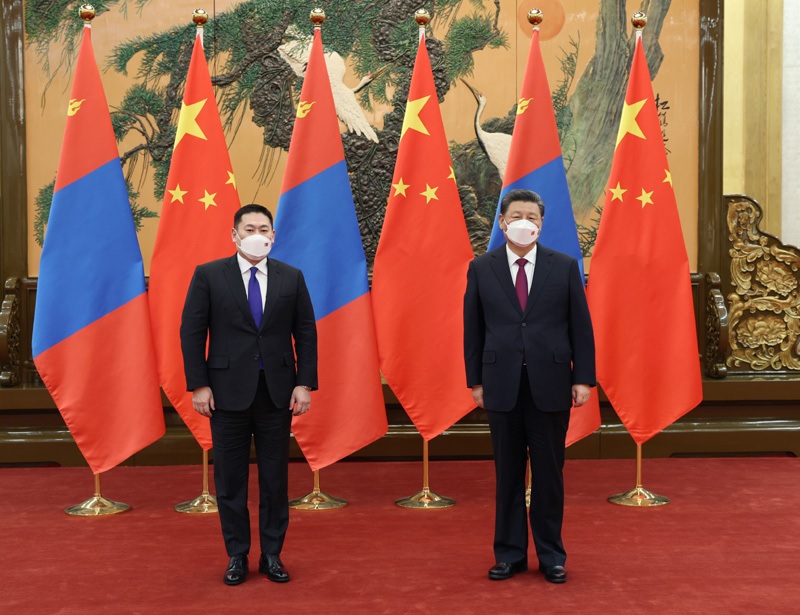
NPC Standing Committee spokesperson makes remarks on U.S. House Speaker Pelosi’s visit to China’s Taiwan region

On behalf of the National People’s Congress (NPC) Standing Committee, a spokesperson for the NPC Standing Committee on Tuesday made remarks on the visit to China’s Taiwan region by Nancy Pelosi, speaker of the U.S. House of Representatives. The following is the full text of the remarks:

On Aug. 2, in disregard of China’s solemn representations and firm opposition, U.S. House Speaker Nancy Pelosi went ahead with her visit to China’s Taiwan region. The move has gravely violated the one-China principle and the stipulations of the three China-U.S. joint communiques, gravely undermined China’s sovereignty and territorial integrity, gravely impacted the political foundation of China-U.S. relations, and sent a seriously wrong signal to “Taiwan independence” separatist forces. China’s NPC firmly opposes and strongly condemns the move.

There is only one China in the world, and Taiwan is an inalienable part of China’s territory. The Government of the People’s Republic of China is the sole legal government representing the whole of China. The one-China principle is the premise for the establishment of diplomatic relations between China and the United States, and is also the political foundation of China-U.S. relations. The United States has made solemn commitment to China on the Taiwan question, but in real action, it has constantly upgraded substantive relations and official exchanges with Taiwan, emboldened and supported “Taiwan independence” separatist forces, attempted to use Taiwan to contain China, and severely undermined the peace and stability across the Taiwan Strait. The Chinese government and the Chinese people have taken and will continue to take resolute and forceful measures to firmly safeguard China’s sovereignty, security and development interests.

The Taiwan question bears on China’s sovereignty and territorial integrity. For China, there is zero room for compromise and not an inch to give. The Anti-Secession Law has made clear stipulations on major issues including upholding the one-China principle, deterring separatist moves toward “Taiwan independence” and opposing interference in the Taiwan question by external forces. The stance of the Chinese government and the Chinese people on the Taiwan question has been consistent. It is the firm will of over 1.4 billion Chinese people to resolutely safeguard China’s national sovereignty and territorial integrity. Any attempt to obstruct China’s complete reunification and great national rejuvenation is doomed to fail.

KANO-KADUNA RAIL:   JUST 12 PERCENT  WORK DONE IN 11 MONTHS INSPITE COMPLETION PROMISE

The contractors of the much talked about Kaduna – Kano rail line China Civil Engineering and Construction Company (CCECC) has delivered  just 12% percent of work eleven months after President Muhammadu Buhari inaugurated the project, the Minister  of Transportation, Muazu Sambo has disclosed.

Recall that the former Minister of Transportation Rotimi Amaechi had in March assured Nigerians that the project would be delivered for commercial activities before May 2023, based on the pace of work by the contractors and the availability of funds.

Muazu, who spoke in Kano Thursday blamed insecurity as the major drawback largely responsible for the failure of the contractor to keep up with the expected pace of the project.

He however promised to engage the armed forces and the police to design a template for security, not only along this corridor but to serve as a template for all other corridors. This was contained in a press statement signed by Director Press and Public Relations, Eric Ojekwe.

The Minister also promised that the Federal government will prioritize the completion of the Kano-Kaduna Rail project due to the immense socio-economic impact it will have not only on the communities along the rail corridor but the country as a whole.

He said: “We know that most of the agricultural products in Nigeria are produced in the northern part of the country and taken to the south while goods that are imported into the country that comes through the seaports have to come through the south. So, it is an understatement if I say that this project is critical to the well-being of Nigerians”.

Mu’azu, also spoke on encroachment on lands for which the Ministry has already paid compensation and acquired, assuring that a high-level meeting with the Governor of Kano state, Abdullahi Umar Ganduje, should address such issues.

The Transportation Minister, later inspected the ongoing University of Transportation project, in Daura where he said the proposed December, 2023 completion date is not acceptable and urged Messrs. CCECC to hasten on earlier delivery date.

The Minister was accompanied on the inspection by the Permanent Secretary, Federal Ministry of Transportation (FMT), Dr. Magdalene Ajani, Board Chairman, Nigeria Railway Corporation, NRC, Engr. Alhassan Ibrahim, the Managing Director,  NRC, Engr. Fidet Okhiria, Director, Rail Transport Services, FMT, Engr. Jimoh Yusuf and others.

World in need of new global security governance for peaceful situations

The 2022 Summit of the North Atlantic Treaty Organization (NATO) recently wrapped up in Madrid. As the world’s largest military alliance, the NATO has woven a U.S.-centered global military network together with U.S. military allies in Asia Pacific and around 750 U.S. military bases in 80 countries and regions.

Facts prove that the U.S. military alliance system has already become a tool of the U.S. to maintain its global hegemony. This system is against the trend of the times and the aspiration of people, and seriously threatens world peace and security.

Humankind aspires to peace and security. However, U.S. military alliances have frequently launched wars. To seek private gains, the U.S. always neglects the purposes and principles of the UN, and the sovereignty and dignity of other countries, acting as a bully together with its allies.

Throughout the 246-year history of the U.S., there were only 16 years in which the country was not at war with others. The warlike country and its allies have repeatedly aroused anti-war protests around the world.

The world needs common development, but U.S. military alliances are forcing poverty and underdevelopment upon others. According to incomplete statistics, the wars initiated and joined by the U.S.-led NATO have displaced over 10 million refugees since 2001.

Struggling to live on the ruins caused by the U.S., people in Iraq and Afghanistan are not only facing poor infrastructure, high unemployment and scarce public services, but also expanding influence of terrorist forces.

As most countries in the world are calling for win-win cooperation, U.S. military alliances are hyping division and confrontation. Countries should work as one to cope with global governance challenges, but U.S. military alliances are clinging to Cold War mentality and zero-sum game.

Rather than being dissolved after the end of the Cold War, the NATO made five rounds ofeastward expansions led by the U.S., which finally triggered the conflict between Russia and Ukraine. Provoking confrontation between the two countries, the U.S. instigated the NATO to strengthen presence in the alliance’s east part, accelerate northward expansion and enhance sanctions against Russia. It looks like the U.S. has raised the curtain for a new Cold War in Europe.

Besides, the U.S. is also tightening its alliances in Asia Pacific. It knocked together the so-called Quadrilateral Security Dialogue and AUKUS, and invited its Asia Pacific allies for the first time to attend the NATO Summit, trying to build a military chain to contain China and make the peaceful situation in Asia Pacific tense. Besides, the U.S. has extended the reach of military alliances to the spheres of economy and technology, forging exclusive cliques to serve its scheme of major country competition.

The world is in dire need of new global security governance when it is facing complicated international situations and security challenges.

In April this year, China proposed the Global Security Initiative (GSI), calling on the world to stay committed to the vision of common, comprehensive, cooperative and sustainable security and to protect the indivisible security community where all mankind live, so as to pave the way for a new type of security that features dialogue, partnership and win-win instead of confrontation, alliance and a zero-sum approach.

The GSI responds to the strong voice made by the people around the world for peace and development and charts the course for global security governance. It will inject strong impetus into tackling security dilemma and building a community with a shared future for mankind.

The world should make joint efforts to implement the initiative. All countries’ sovereignty and territorial integrity must be respected, and any hegemonic practice that violates sovereignty must be opposed. The world should firmly safeguard the authoritativeness of the UN and true multilateralism, and abandon the outdated alliance-led practice that divides global security governance, so as to avoid a new Cold War.

Countries must accommodate each other’s reasonable security concerns, oppose pursuing security at the sacrifice of other’ security, stay committed to the general direction of promoting peace talks and jointly working for political solutions to hotspot issues, and oppose double standard and unilateral sanctions.

They should follow a coordinated approach to safeguarding traditional and non-traditional security, emphasize both development and security, and address root causes. They should work to safeguard the hard-won prosperity achieved in Asia Pacific over the past decades, build a regional security framework that’s balanced, effective and sustainable, oppose an “Asian version” of the NATO and oppose dividing the region with alliances.

The tide of history is mighty. Those who follow it will prosper, while those who go against it will perish. The U.S. should conform to the trend of the times and the aspiration of the people around the world, abandon the outdated alliance and confrontation mentality, and stop the wrongdoing of hindering world peace with military alliances.

Breaking: Gombe governor in certificate forgery mess, Court asked to disqualify him, deputy

The Peoples Democratic Party (PDP) and its Gombe State Governorship Candidate, Muhammad Jibrin Barde have urged the Federal High Court sitting in Abuja to disqualify Gov. Mohammed Inuwa Yahaya of Gombe State and his Deputy, Jatau Manassah Daniel from contesting and participating in the 2023 Governorship Election in Gombe State for submitting forged certificates.

In  SUIT NO: FJC/ABJ/CS/1301/2022 between Peoples Democratic Party & 2 Ors v. INEC & 3 Ors filed on the 2nd August, 2022,  PDP prayed the Court to disqualify the Inuwa and his deputy from contesting the election for submitting forged documents and certificates to INEC which was published on 22nd July, 2022.

In an Originating Summons  filed on their behalf by two Senior Advocates of Nigeria, Chief Arthur Obi Okafor, SAN and  J.J. Usman, SAN, the Plaintiffs submitted relying on series of Supreme Court decisions that Inuwa and his Deputy having deposed to FORMS EC-9, the said Forms constitute Certificates and making false statement in it amount to submitting forged certificates which is a disqualifying ground under Sections 177(d) and 182(1)(j) of the Constitution of the Federal Republic of Nigeria, 1999 (as Amended).

In a Court processes obtained by our Reporter, the Plaintiffs alleged that Jatau bears multiple names in his certificates to wit:

  1. Certificate of primary Education (ManassahJatau)
  2. West African examination Council School Certificate (Daniel Manassah J)
  3. University of Maiduguri Certificate (Manassah Daniel Jatau)
  4. National Youth Service Corp Certificate (Daniel Manassah)

without a deed poll and any valid change of name attached to his Form EC-9 submitted to INEC.

In 2022, Gov. Inuwa submitted FORM EC-9 (Affidavit of Personal particulars of Person seeking election into the office of governor of Gombe State)  where he stated that he worked in Bauchi State Investment Company Limited in 1984, A.Y.U & Co. Ltd between 1985-2003 as against what he deposed to in 2018 as working in Bauchi Investment Company Limited in 1985, A.Y.U & Co. Ltd between 1980-1990.

That  Gov. Inuwa in 2018 while presenting his personal particulars in aid of his qualification to participate in the Gombe State Governorship election stated in his INEC FORM CF001 that he worked with A.Y.U & Co. Ltd from 1980 – 1990, while in 2022, the same 3rd Defendant stated in his INEC FORM EC-9 that he worked with A.Y.U. & Co Ltd from 1985 – 2003.

The Governor  by his INEC FORM CF001 has stated under oath that  in 1980 -1990, he worked with A.Y.U. & Co Ltd, however, in 2022, the same Inuwa stated again on oath via his INEC FORM EC-9 that he worked with the same A.Y.U. & Co. Ltd from 1985 – 2003.

While his Deputy attached his Certificate of National Youth Service Corps dated the 31st July, 1980 which stated thus:

“This is to certify that Daniel Manassah NYSC/Mad/79/6201 has satisfactorily completed one year of the national Service from 1st August 1979 to 31stJuly 1979 in accordance with section 11 of the national Youth Service Corps decree No. 24 of 1973”

According the Plaintiffs, the Deputy Governor who claimed to be working with the Nigeria Army from the period of August 1979 till July 1980 has submitted an NYSC discharge certificate that stated on its face that he commenced his National Youth service in August 1979 and completed same in July 1979.

The Plaintiffs also contended that from the paragraph D of the Jatau’s INEC Form EC9, he claimed that he worked for the Nigeria Army from July 1979 till August 1980 and his reason for leaving the Nigeria Army in July 1980 was for the National Youth Service.

The Plaintiffs contended further that in Jatau’s INEC FORM EC-9, he commenced his NYSC after he left the Nigeria Army in July 1980 but the has submitted an NYSC Certificate that stated he commenced his National Youth Service in August 1979 and ended in July 1979.

The Plaintiffs argued FORM EC-9 being an affidavit on oath, both the Gov Inuwa and his  Deputy Jatau are not qualified to contest the election which they have set themselves to do.

The Plaintiffs urged the Court to disqualify them. No date has been given for the hearing of the case.

China, Africa work to build security community

China has always worked to develop relations with Africa, with a commitment to upholding the greater good in the pursuit of shared interests and following the principles of sincerity, pragmatism, affinity and good faith, said Chinese President Xi Jinping in a congratulatory letter to the second China-Africa Peace and Security Forum on July 25.

Xi noted that the country is ready to work with its African friends to adhere to the vision of common, comprehensive, cooperative and sustainable security.

China will work with Africa to safeguard the international system with the United Nations at its core, uphold international fairness and justice, promote the implementation of the Global Security Initiative, and build a China-Africa community with a shared future in the new era, Xi said.

Xi’s congratulatory letter fully indicated the high attention attached by China on China-Africa peace and security cooperation. It has charted the course for the two sides to enhance cooperation and solidarity and achieve common security.

Africa has been facing a number of uncertainties in its security situation, as well as untraditional security threats such as terrorism, COVID-19, climate change and food security. Against such a background, to enhance China-Africa peace and security cooperation is of more practical significance.

The second China-Africa Peace and Security Forum was attended by 50 ministerial-level officials and high-level representatives from the African Union(AU) and African countries.

They said China is a reliable friend, partner and brother of Africa and expressed their thanks to China for assisting and supporting Africa’s peace and security. They are ready to enhance solidarity and cooperation with China, and make positive contributions to build a China-Africa community with a shared future.

Realizing enduring peace and universal security is a common aspiration of the Chinese and African peoples. Peace and security cooperation is an important part of China-Africa cooperation.

At the 2015 Johannesburg Summit of the Forum on China-Africa Cooperation (FOCAC), the 2018 Beijing Summit of the FOCAC, and the eighth FOCAC ministerial conference held the last year, President Xi personally planned and promoted China-Africa peace and security cooperation.

He raised a series of important initiatives on peace and security and proposed to set up the China-Africa Peace and Security Forum to build a platform for the two sides to enhance communication in the specific field. The peace and security cooperation carried out by China and Africa under the framework of the FOCAC is an important measure of them to build a China-Africa community with a shared future.

Different from other major countries outside Africa, China, when participating in Africa’s peace and security affairs, fully respects the wills of regional countries, never interferes in their domestic affairs and follows the basic norms governing international relations.

China supports African countries and the African Union to play a leading role in Africa’s peace and security affairs, supports Africa to enhance its independent capability to maintain peace and stability and fight terrorism, supports African countries and regional organizations including the African Union to implement the “Silencing the Guns” initiative, and supports the UN to provide capital assistance for the African Union’s independent peacekeeping actions.

China is actively joining Africa’s efforts to advance peace and security capacity building. The recently-concluded First China-Horn of Africa Peace, Good Governance and Development Conference marked an important step of China and Africa to implement the Outlook on Peace and Development in the Horn of Africa, and provided important assistance for regional countries to independently solve regional peace and security issues.

To implement the China-Africa peace and security program proposed at the eighth FOCAC ministerial conference, China will launch 10 peace and security projects for Africa and keep providing military aid for the African Union. China supports African countries to independently safeguard regional peace and fight terrorism, and will launch China-Africa joint drills, training and light weapon management for peacekeeping.

China is committed to helping Africa improve its independent development capability. The country insists that Africa should put equal emphasis on development and security so as to achieve sustained security and eliminate hotbeds of all types of insecure factors.

China’s active role in development, peacekeeping and mediating hotspot African issues is widely commended. “China doesn’t interfere in African countries’ domestic affairs, and our cooperation is based on equality and mutual benefit,” said John Mulimba, Uganda’s Minister of State for Foreign Affairs in charge of Regional Cooperation.

China and Africa have always been sharing a same future. They should offer each other mutual assistance in security to build a high-level China-Africa community with a shared future.

As the world is going through profound changes and a pandemic both unseen in a century and entering a period of new turbulence and transformation, the two sides should uphold the spirit of China-Africa friendship, put in practice the Global Development Initiative and Global Security Initiative, and march toward the aspiration of building a security community, so as to make bigger contributions to tackling global security deficits and promoting world peace and development.

No Abuja – Kaduna train service until kidnap victims are rescued – FG

The Federal government has disclosed that it won’t resume train services along the Abuja-Kaduna rail corridor until all the kidnapped victims from the AK-9 train are reunited with their families.

Minister of Transportation, Muazu Sambo also added that the service would commence when the digital security systems that will monitor activities around the tracks are procured and installed.

The Minister who made these known in Abuja on Tuesday during an inspection of the Idu and Kubwa stations explained that resuming operations without rescuing those kidnapped will make Nigerians perceive the government as insensitive.

Train service along the corridor was suspended by the Nigerian Railway Corporation after an attack on the Kaduna-bound train on March 28th.

He said: “It is very important to get those Nigerians that have been kidnapped reunited with their families, otherwise it will appear the government is not sensitive whereas the government is not only sensitive but the government is doing everything it can to make sure that those who have been affected by this abduction are reunited with their families. I think it is an important step to do that first and foremost.

“Secondly, we must put in place adequateadequate security and infrastructural measures to protect and prevent all forms of threats that are possible and leave what we cannot do to God but everything humanly possible must be put in place to ensure that the reoccurrence of this nature is automatically eliminated forever.

“Technology can make that possible and we are trying to deploy the best technology available anywhere in the world that has served very well in other jurisdictions which we believe can also serve us very well in Nigeria.

“We are in the process of procuring the sensors and that is why I said we must ensure that we put in place every infrastructure that will ensure that lives are safeguarded.

“So, the technology that is going to be deployed is such that you can perceive a threat and eliminate it before you get to the location. That is being proactive.”

Sambo continued: “To save the lives of Nigerians is the topmost priority of the government. This railway asset is brought to bear to improve the lives of Nigerians.

“This was the project that was started under the previous administration and unlike the previous administration, we don’t allow any project to be abandoned.

“So, this administration completed it and it’s running it. It is really unfortunate that what happened happened but we must not let that deter us from providing succour to Nigerians.

“The best way to travel as far as I am concerned is by train and by the grace of God, we will make sure these services resume but not until those things I mentioned have been achieved.

“Rescue or reunion of those that have been kidnapped with their families and put in place technology that will ensure that threats to lives are eliminated.”

The minister also dismissed claims that NRC staff that were onboard the train have been abandoned.

He said: “It is totally unfounded. They are members of staff of the NRC. It will be highly unexpected that a member of your own family is affected in an incident and you have not gone to the family, you have not done the necessary steps to comfort them. It is not possible.

“We have done that and we are still doing and we will continue to do it until we have gotten them reunited with their families and by the grace of God, they will be reunited with their families.”

Development of rural express industry gives a boost to rural vitalization

By LiXinping, People’s Daily

Consumption potential of rural China is being constantly released thanks to the rapid development of the express industry.

The increasingly developed rural express network is leading to smoother logistics in China’s countryside, extending online shopping services to more and more rural consumers and making the rural market a new growth pole of the express industry.

As of 2021, express service outlets have been established in over 80 percent of China’svillages.

According to recent statistics released by the State Post Bureau, China’s express delivery companies handled 51.22 billion parcels in the first six months this year, up 3.7 percent year on year. During the same period, their business revenue increased by 2.9 percent to 498.22 billion yuan ($73.62 billion).

In particular, the share of business volume in central China saw an uplift of 1.1 percentage points, and the figure stood at 0.3 percentage points in the western region.

Rural e-commerce is thriving thanks to expanding express services in rural areas. The prosperous farm produce market and released potential in central China have become a major force driving the growth of the express industry.

The expanding express network brings convenience to rural residents and stimulates consumption potential in rural areas.

In the past, many villagers had to go to townships to send and receive parcels. According to a three-year action plan to extend express delivery to villages released in 2020, express delivery will be available in all qualifying administrative villages by 2022.

Express services have expanded the space of rural development. Relying on the express network, rural e-commerce now enjoys a more solid foundation. More and more agricultural products are entering the urban market, which on one hand meets the demand for individualized consumption, and on the other hand expands the source of income for farmers.

In 2021, 37 billion parcels were collected from and shipped to rural areas across China, facilitating rural-urban commodity exchanges totaling 1.85 trillion yuan.

The rural express network, apart from introducing more products to rural areas, is also taking agricultural products to the outside world, thus increasing the income for farmers.

With smoother rural logistics, a new batch of rural industries with local characteristics are emerging, forming a number of influential local brands. They have injected new impetus and energy into the modernization of agriculture and rural areas.

Besides, the development of the rural express industry has created new jobs and new entrepreneurialopportunities. Many couriers working in cities have returned to their hometowns in the countryside to run express delivery spots, which brings new job opportunities to local communities.The emergence of livestream commerce and short video marketing is also building a platform of entrepreneurship for Chinese villagers.

It is believed that as the rural express network further expands, more and more villages will be incorporated into the modern logistics network and embrace new opportunities. AChina with smoother logistics is taking shape.

5th Digital China Summit achieves fruitful results

By Liu Xiaoyu, Shi Yu, People’s Daily

The 5th Digital China Summit concluded with fruitful results in Fuzhou, capital of east China’s Fujian province on July 24.

The two-day summit included 18 sub-forums on hot issues in digital technologies, as well as more than 30 featured activities. More than 100 academicians and experts, and 100 big names in the digital industry participated.

It was also attended by representatives from over 1,000 Chinese and foreign enterprises. Nearly 2,000 guests joined in-depth negotiations over digital technologies and future cooperation.

The summit aimed to demonstrate the latest achievements in China’s digital construction, with 565 project agreements signed and a total investment value of 299 billion yuan ($44.28 billion), covering 5G, Internet of Things, artificial intelligence, industrial internet, cybersecurity and satellite applications. These projects are expected to give a boost to China’s digital industrialization and industrial digitalization.

A special achievements exhibition with an area of more than 200,000 square meters took place, where nearly 500 exhibitors showcased their achievements.

A low-power wearable navigation and motion sensing system was displayed by the State Key Laboratory of Information Engineering in Surveying, Mapping and Remote Sensing of Wuhan University. The system, as small as a bottle cap, can be used to track real-time information on firefighters’ rescue missions and monitor the positions of workers at construction sites.

On a big screen in the exhibition hall, targeted orders were sent to volunteers serving the exhibition through a service management system by the command center of a young volunteers association in Fuzhou. Combining online order making, services evaluation, and volunteer dispatching, the updated digital system is both efficient and environmentally friendly.

In a smart power protection center, information such as weather conditions, load rate of power protection equipment and alarms were displayed visually. The summit for the first time adopted a digital twin power grid and the power system was automatically inspected by smart robots, which helped reduce 50 percent of the support personnel.

The Digital China Summit has been successfully held for five years in a row in Fuzhou since 2018. It is an important platform driving China’s digital construction.

From 2018 to 2021, China moved up its ranking at the Global Innovation Index from 17th to 12th, and the country’s digital economy grew from 31.3 trillion yuan to more than 45 trillion yuan. The proportion of the digital economy in China’s GDP also rose from 34.8 percent to 39.8 percent.

According to a digital development report released by the Cyberspace Administration of China on July 23, China has built the world’s largest and most technologically advanced network infrastructure. With rapidly rising innovation capability in digital technologies, the country has become a frontrunner in emerging technologies such as artificial intelligence and quantum information, the report said.

Last year, industrial internet was applied in 45 major categories of China’s national economy, with a total output of over one trillion yuan. Digitalization has driven down costs by 17.6 percent and increased revenue by 22.6 percent for manufacturing enterprises.

At present, digital technology is moving toward a new stage featuring intensive application, regulated development and shared benefits, said Yu Xiaohui, head of the China Academy of Information and Communications Technology, during the summit. Industrial digitalization has become a major development direction of the digital economy, he added.

Nigeria Air: Hope rises as FG approves three aircraft

The process for the establishment of a new national carrier, Nigeria Air, got a boost on Wednesday with the Federal Government approving the lease of three aircraft for initial operations.

A statement Wednesday by Special Assistant to the Minister of Aviation on Public Affairs James Odaudu disclosed that by this approval, the national carrier would begin operations with domestic routes deploying the aircraft to be procured from Airbus and Boeing.

Minister of Aviation, Hadi Sirika, made the disclosure while briefing journalists after the Federal Executive Council (FEC) presided over by President Muhammadu Buhari.

Sirika announced that the airline would begin with domestic routes, then expands to regional and intercontinental routes. He was not specific with the actual date for the take-off of the airline operations.

On the likely date for the commencement of operations Sirika said “We will announce commencement soon. “

Sanya in S China sees steady progress of coral reef protection

By CaoWenxuan, People’s Daily

Coral reefs are among the oldest and most valuable ecosystems in the world. They are home to nearly 30 percent of marine species though they cover only less than two thousandth of the ocean floor.

However, global warming, marine pollution and over excavation have constantly degraded coral reefs in the last 20 years. Therefore, Chinese marine biologists are planting corals on the seabed to protect coral reefs and restore marine ecology.

Thanks to their efforts, scuba divers are now able to see a vibrant undersea world where species of fish swim in between swaying colorful corals in the waters around Wuzhizhou Island, a renowned tourist attraction in Sanya, south China’s Hainan province.

It’s beyond imagination that 10 years ago, in this vibrant undersea world, there were only shipwrecks and cement piles. The coral reef ecosystem in the waters near Wuzhizhou Island was once destroyed due to the warming seawater, fishing and coastal construction.

Under years of efforts made by scientific researchers, 30,188 corals have been planted on the seabed around Wuzhizhouisland, which covers around 50,000 square meters. The undersea “afforestation” efforts are leading to constant improvement of the marine ecosystem. Coral planting has even been made into a scuba diving program for tourists visiting the island since this year.

Since 2013, Sanya has implemented 19 projects to restore marine ecology, including the restoration of coral reefs and shoals, as well as shoreface nourishment. The city has restored 7.7 kilometers of coastline and a sea area of 51,584 square meters.

Coral planting is a harder form of “afforestation.” On one hand, the complicated marine environment creates huge challenges for planting activities, such as the fierce flow of sea water in the South China Sea caused by typhoons between July and October each year; on the other hand, sections of the seabed are differently affected by the environment and human disturbance, and their health levels also vary, so it calls for scientific researchers to make individualized plans.

The underwater “afforestation” relies on technological progress. There are large areas of coral reefs under the sea waters around Hainan province, which makes the province a major planter of corals. Coral reef restoration technologies have been constantly improved during the coral planting practice in the province.

For instance, the Hainan South China Sea Institute of Tropical Ocean has improved the efficiency of coral planting by applying a stainless steel seedbed; Hainan Universityhas made new breakthroughs in the restoration of fractured coral reefs by combining artificial fish reefs and coral reef restoration.

New methods and technologies are driving new progress inChina’s underwater “afforestation” and contributing Chinese wisdom to the global protection of the marine ecosystem.

Artificial methods are just a supplement to the restoration, while the reduction of human disturbance remains the key to bettering the marine ecosystem.

In recent years, China has enhanced its efforts to promote natural restoration of coral reefs, and coral reef protection has been included in a series of laws of the country.

Besides, China has joined the Convention on Biological Diversity, the Convention on International Trade in Endangered Species of Wild Fauna and Flora, as well as other international treaties.

The country has established five state- and province-level nature reserves and a special national ocean park involving coral reefs.

So far, nearly 30 percent of the offshore waters and 37 percent of the continental coastline of China have been incorporated into its ecological red lines, which is making the ocean more and more beautiful.