Science in disguise: Robotic antelope roams with the herd in Hoh Xil

By Liu Shiyao, People’s Daily

At Zhuonai Lake in the remote wilderness of Hoh Xil, the northeastern part of Qinghai-Tibet Plateau, a surprising newcomer recently appeared among a herd of Tibetan antelopes: a robotic replica. Moving naturally alongside the animals, the robot antelope was nearly indistinguishable from its living counterparts.

By allowing scientists to observe the herd at close range without disturbing it, the robotic antelope opens new possibilities for wildlife monitoring. Researchers at the Northwest Institute of Plateau Biology under the Chinese Academy of Sciences also expect it to collect droppings and placentas, providing more accurate and reliable data for behavioral and reproductive studies.

Hoh Xil, China’s largest UNESCO World Natural Heritage Site, sits at an average altitude of over 4,500 meters. Its bitter cold, thin air, and vast uninhabited expanses form one of the harshest environments on Earth, yet it remains a sanctuary for rare species such as Tibetan antelopes and wild yaks.

The deployment of embodied-intelligence robots in wildlife conservation and ecosystem management illustrates how technological innovation is advancing ecological protection. Across China, breakthroughs in science and technology are increasingly aligned with efforts to protect the environment.

Sound conservation begins with thorough surveys and databases, where technology plays a central role. A team from the China Academy of Space Technology, for example, has built an integrated monitoring system that combines satellites with ground-based observations. The system tracks forests, crops, and water resources, generating critical data to guide ecological compensation for public-benefit forests and to assess the value of rural land-use rights.

Clean energy development is another cornerstone of ecological protection and green, low-carbon development. China is investing heavily in clean energy and low-carbon technologies. Recently, construction began on the nuclear island of Unit 1 at Jinqimen nuclear power plant in east China’s Zhejiang province, equipped with the domestically developed Hualong One reactors. Once complete, the facility is expected to generate 55 billion kilowatt-hours of electricity each year. 

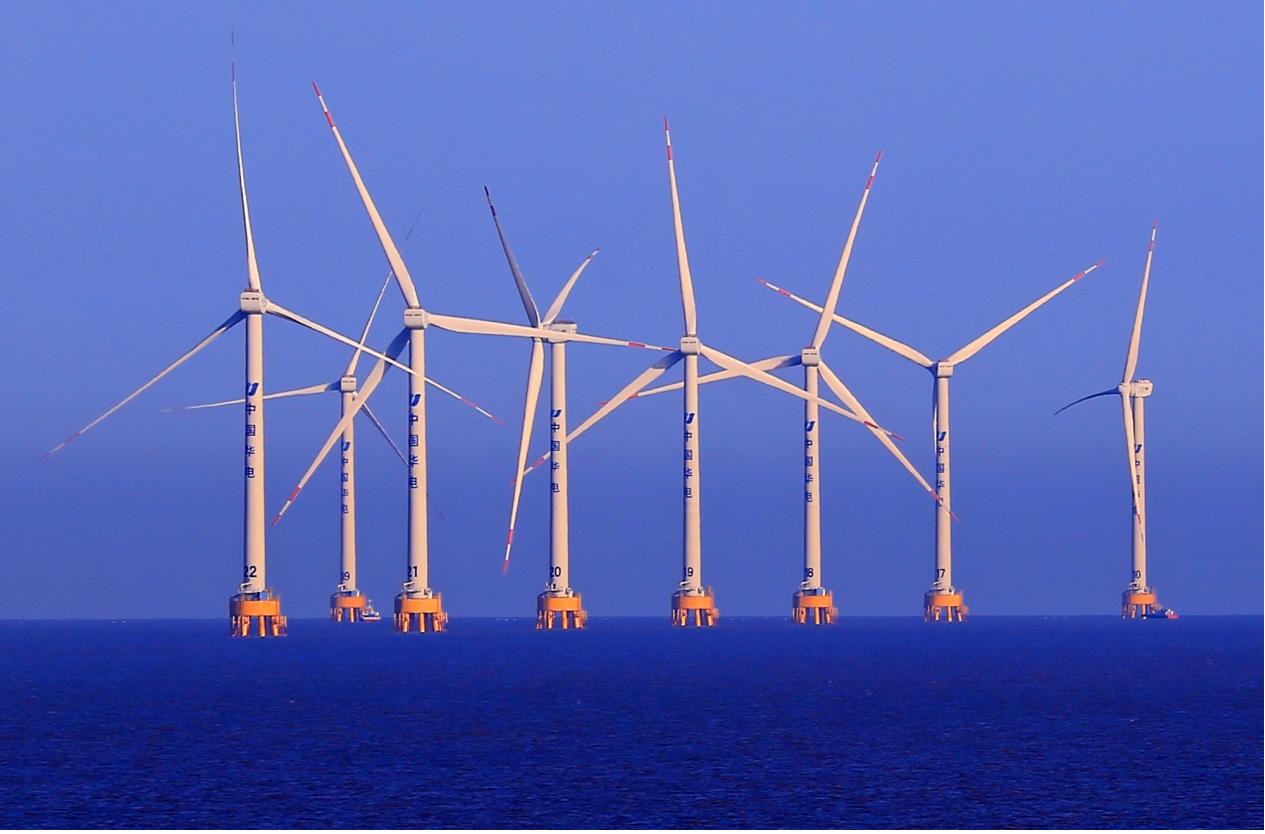
At the 800-megawatt offshore wind project in Dafeng, east China’s Jiangsu province, developed by China Three Gorges Corporation, the nation’s first booster station equipped with a meteorological radar has just been installed. The project enables precise marine weather monitoring and more efficient offshore wind power generation, setting a benchmark for the development of offshore clean energy.

From advanced wastewater treatment and cleaner coal use to data-driven monitoring of vehicle emissions, technological solutions are essential to green development. At the Baihetan hydropower station, the world’s largest clean energy corridor, a newly installed automated safety system now connects to more than 10,000 sensors. It continuously monitors deformation, seepage, stress, strain, and temperature, providing real-time analytics and early warnings to secure this massive renewable energy source.

New quality productive forces are inherently green productive forces. As scientific knowledge deepens and new technologies emerge, innovation will continue to drive ecological progress, building a greener, more sustainable home for all.

A victory for the Chinese people and the world

By Luo Cunkang

The exhibition Commemorating the 80th Anniversary of the Victory in the Chinese People’s War of Resistance Against Japanese Aggression and the World Anti-Fascist War, themed “For National Liberation and World Peace,” is being held at the Museum of the War of Chinese People’s Resistance Against Japanese Aggression.

Since its opening on July 7, the exhibition has attracted more than half a million visitors from China and abroad, offering a chance to retrace the wartime years, honor revolutionary martyrs, and reflect on the indomitable spirit of resistance that continues to inspire future generations.

On display are historical documents and artifacts, such as the earliest Declaration of War Against Japan issued by the Provisional Central Government of the Chinese Soviet Republic, detailed archives chronicling the capture and heroic sacrifice of revered war heroine Zhao Yiman, and Fang Dazeng’s Record of the Lugou Bridge Incident, the earliest journalistic account of the incident.

Covering 12,200 square meters, the exhibition presents 1,525 rare photographs and 3,237 cultural relics, providing a comprehensive account of the monumental struggle in which the Chinese people fought for national survival, national rejuvenation, and human justice.

The Chinese People’s War of Resistance Against Japanese Aggression was the first complete victory in modern Chinese history over foreign invasion. From 1931 to 1945, the Chinese people endured 14 years of relentless struggle, ultimately defeating the aggressive Japanese militarists and contributing decisively to the global triumph over fascism. 

As Chinese President Xi Jinping has emphasized, the great victory was a historic turning point at which the Chinese nation rose from severe crisis in modern times and embarked on a journey toward great rejuvenation, and also an integral part of the world’s triumph over fascism. The victory belonged to the Chinese people, and also to people across the world.

China’s resistance against Japanese aggression was inextricably linked to the future of humanity. The Chinese people fought not only for national independence but also for global peace. China was the first to fight against fascist aggression and sustained the longest resistance. The tremendous sacrifices of the Chinese people sustained the main Eastern Battlefield of the World Anti-Fascist War.

China tied down and fought the bulk of Japanese forces, wiped out more than 1.5 million enemy troops in the war, and prevented Japan from launching northward or southward offensives, making a major contribution to the triumph of the World Anti-Fascist War. These efforts significantly relieved strategic pressure on the Soviet Union, the United States, the United Kingdom, and other Allied powers. 

After the outbreak of the Pacific War, the Chinese battlefield continued to consume Japan’s main forces, providing crucial support to the Allies. Despite enormous hardship, China dispatched expeditionary forces abroad and provided vital strategic materials such as tung oil and tungsten to the Allies. 

China not only built the earliest anti-Japanese national united front in the East, but also advocated and helped forge the international anti-fascist united front, making historic contributions to the establishment of the United Nations (UN).

The ordeals of war deepened the Chinese people’s commitment to peace. Having endured more than a century of foreign aggression, humiliation, and exploitation since the mid-19th century, China did not embrace the law of the jungle but became more resolute in its determination to uphold peace. The great victory in the Chinese People’s War of Resistance Against Japanese Aggression was a new beginning for China and a significant milestone for humanity’s pursuit of peace and development.

In the world today, changes on a scale unseen in a century are unfolding at an accelerating pace. The Chinese people will continue to hold high the banner of peace, development, cooperation, and mutual benefit. They will unswervingly follow the path of peaceful development, firmly safeguard the hard-won victory, uphold a correct view of the history of World War II, and resolutely defend the UN-centered international system. By promoting the common values of humanity, China will work hand in hand with the peoples of all nations to build a community with a shared future for humanity.

(Luo Cunkang is the curator of the Museum of the War of Chinese People’s Resistance Against Japanese Aggression.)

Youths Unveil Bold Ideas as CiCMED Future Planters Bootcamp Rounds Off in Akwanga

By Abel Leonard, Lafia

Young Nigerians have showcased groundbreaking solutions to national challenges as the Community Initiative for Character Moulding and Entrepreneurship Development (CiCMED) concluded the 2025 Future Planters Bootcamp in Akwanga, Nasarawa State.

The event, which started on August 25 and ended on August 31, featured a week-long series of activities that brought together participants from across the country for sessions on leadership, entrepreneurship, innovation, and policy development. Teams worked on projects addressing agriculture, climate resilience, youth empowerment, and the creative economy.

Some of the standout innovations included greenhouse vegetable farming for year-round food security, cassava waste recycling into sustainable products, cold storage facilities to reduce post-harvest losses, and eco-friendly briquettes for cooking stoves aimed at reducing deforestation. Others explored creative tools such as songs and storytelling to foster unity and national renewal.

CiCMED’s Executive Director, Kefas Elisha Tigga, in an interview with journalists on Wednesday, said the initiative had become a platform for young Nigerians to plant seeds of change.

“This bootcamp is more than a programme; it is a movement of young Nigerians planting seeds of change,” Tigga said. “We are calling on the public, organizations, and development partners to support these youths by funding their innovations and rewarding their brilliance.”

The finalist groups include #TeamHopeFP2025, #TeamRootsFP2025, #TeamHarvestFP2025, and #TeamGreenFP2025, which are still actively engaged in online activities as part of the build-up to the Grand Finale slated for October 4, 2025, where the winning projects will be unveiled.

At the finale, CiCMED is expected to launch the Future Planters Creative Studios and present original songs produced by the teams.

The organisation has also appealed for support to provide seed funding and mentorship to help scale the most promising ideas.

For inquiries and partnership opportunities, CiCMED can be reached via 0811 242 5254, 0810 838 4177, or through its website www.cicmedngo.com.

El-Rufai’s Insurmountable Setback, and Phobia of Stark Realities

It is the responsibility of intellectuals to speak the truth and expose lies” – Noam Chomsky, Philosopher, social critic, and political activist.

Our attention has been drawn to a news interview granted by Channels Television, in which Nasir El-Rufai, former Governor of Kaduna State, presently a member of the African Democratic Congress (ADC), made unsubstantiated claims and false allegations, which contain a coterie of lies, mischievous fallacies, and disinformation. Our groups usually would ignore such satanic verses, as we find them completely laughable, baseless, and lacking any substance in their entirety. While not holding brief for Senator Uba, however, in order to set the record straight and to align with the popular mandate given to the indefatigable Governor of Kaduna, a doyen of civil society activism over the years and human rights community who has redefined and rebranded his office through the dividends of democracy to the good people of Kaduna State since assuming the mantle of leadership, we find it necessary to state as follows:

1. El-Rufai’s apparent scathing criticism of Sen. Sani Uba is a rehearsed brain wave calculated towards stirring a crisis of confidence and disharmony among the people of Kaduna State for his own selfish agenda, self-serving, and inordinate ambition. The scrawny politician has suffered a heavy defeat in the hands of Governor Sani during the just-concluded Chikun, Kajuru, Zaria, and Basawa Constituencies bye-elections, which can be understood due to his bias. The loss was a big blow to the egocentric accidental Governor, not only in the state but the entire North West Zone, which he has boasted about before now that he is the gadfly.

2. The posturing of the bitter and scrawny politician did not come to many as a surprise. When it came, it was widely regarded by many as a shameless face-saving stunt by a maniac. His gambit of not responding with facts and figures but playing the ostrich is an admission of culpability in terms of racketeering, profiteering, and rent-seeking dominant features witnessed under his maladministration.

3. One of the best things that have happened and indeed has happened to Nigeria is the exclusion of El-Rufai from all positions at the federal and state government levels due to his bigotry and tribal wars and feudalism. He is the nation’s most dangerous source of destabilization, disunity, impunity, lawlessness, and disequilibrium. It amounts to saying the obvious that this man, who voluntarily admitted giving money to foreign herdsmen and was suspected of nocturnal meetings in a state neighboring Niger Republic, must be a person of interest to Nigerian citizens and relevant security agencies. In the last two years, he has been holding clandestine engagements with people of questionable identity within and outside the country, including Lebanon and Marrakesh, among others, trying to undermine whosoever.

4. “His sad commentary on the recent outbreak of crisis recorded during the African Democratic Congress (ADC) meeting can best be described as puerile politics at its worst, bizarre, and reckless.” The political skirmishes emanated as a result of intractable leadership within the party arising from an attempt by El-Rufai to illegally hijack from the original members what he did not work for. The founding members of the party resisted the unsavory plot, knowing exactly what transpired during a similar unholy gesture by the same El-Rufai in the Social Democratic Party (SDP).

5. As El-Rufai recognizes his declining political significance daily after his failed governmental era in the state, he is creating importance by flirting with all sorts of contraptions and minions, giving the impression of eminence in the sight of gullible people craving for cheap publicity embedded with narrow-minded agendas.

6. We have total disregard for self-professed qualities, negative temperament, misplaced energy, and inconsistency associated with people like him. Our reason is due to our allergy and disdain for characters who are not integral enough to be consistent about issues or what they believe in and who regularly trail vicious threads of regret behind them in every togetherness.

7. El-Rufai has been an egotist and traveler from one party to another looking for a mesh of porridge, even with all his acquisition in Abuja then and Kaduna just yesterday; he looks insatiable, hoping against hope “On his threshold of life that he is feeling chaotic, it is when he has crossed the red line that he discovers inherent limitation of his political prowess which looked simple and are infinitely tortuous, complex and unrealistic. That there is no consistency in any inconsistency”. From PDP to CPC to APC to SDP to ADC and likely to another contraption soonest all in a bid to fleeces the masses.

8. El-Rufai’s vilification of Uba Sani is a product of envy, bitterness, anger frustration and therefore unacceptable. He has blamed President Tinubu, Sen Uba and others for the political misfortune that befell him since his failure to secure ministerial slot in the federal cabinet. He is shamelessly demanding for things that he rarely extend to others, in fact, he denied victims of his misrule affordable school fees, shelter over their heads, gainful employment, living wage, and disobeyed court orders and trampled on their rights with impunity, lawlessness and reckless abandon but today all are vanity!

9. El-Rufai have no conscience left when he criticized Uba Sani in such manner. We can testify that His Excellency stood by El-Rufai during his Mubadala ordeal in the telecom mega deal. He fought for him tooth and nail during the travails under the David Mark led Senate. His Excellency supported him when he ran away on self-imposed exile during late President Yar’Adua of blessed memories and mobilized campaign funds for him in excess throughout his 2015 Governorship ambition among others. “El-Rufai penchant for bitterness and arrogance has crossed the line of decency. Dishing out cocktails of falsehood and rhetorics cannot save him at this critical period. The people have resolved to bring an end to your Reign of political hegemony and reign of terror in Kaduna State and nothing can be done about it.”

10. Once again, for the purpose of clarity and setting the records straight, El-Rufai who was constantly in touch with Uba Sani doesn’t have the moral rights to call him any other name except his bosom friend. He helped El-Rufai when he needed him most beyond disclosure. A part from frustrations, blackmail, mischievous intent, hallucinations, desperate media visibility and attempt to salvage dwindling image, we find no concrete reasons for such lies, fabrications and innuendos from El-Rufai towards His Excellency.

11. “For eight years, the people of Kaduna State suffered your tyrannical rule, false leadership, insecurity, debt burden. We later realized that at a great cost to us that it was unhealthy for the common good for you to remain around power circle for too long”. El-Rufai frustrations are increasingly becoming painful because he is no longer in charge of our destiny which translates to him begging because of this political wilderness and loneliness”.

12. Let us state without blinking an eye lid to state, this declaration that El-Rufai has been accused of personalization of public till so brazenly to the detriment of the society. A peep to the financial records of the institutions he superintended, Bureau for Public Enterprises ( BPE), FCTA Ministry and Kaduna State presents a gory scenario. The situation could evoke tears sorrow and blood. What is more, while the conditions of the people got depressed, the (accidental public servant of fortunes) became increased to a larger than life size. Suspected of owning hundreds of houses and choice lands in the country and abroad. He is reputed to have acquired unfathomable wealth, plundered Nigerian citizens are not going to allow him to escape further scrutiny from the law enforcement agents and judicial scrutiny.

13. His belated attempt to cover up the misdemeanours, the disinformation without stating the issues truthfully itself is another fiasco and a bigger disaster for someone like El-Rufai. Over the years, he is known for flagrant disrespect to court orders and notoriety in overwhelming disregard to the rights of the poor. And above all, his penchant for rascality is second to none in history.

14. It is unfortunate that since the people of Kaduna State demanded for accountability over his stewardship as Governor of the state, he tends to look for excuses, scapegoats, exiguous defenses and blaming everyone and everything instead of looking at himself in the mirror. We therefore, we have no choice than to excoriate his record of bad governance and thousands of death witnessed under his watch. “Let no one doubt our resolve to expose”.

15. While not holding brief for anybody in the government of Kaduna State or its agents, it is gratifying to state that we the citizens have verified every piece of evidence in the public domain against El-Rufai and came to the logical conclusion that his record in public service is a historic tragedy and monumental catastrophe for our country. We therefore, come to the logical conclusion of commending every Nigerian citizen that refused to be compromised, intimidated, cajoled, blackmailed and stampeded in the cover up gambit of the accidental governor or his agents.

16. It is very glaring that El-Rufai wanted to use Governor Uba Sani as a stooge to cover up the misdemeanor of his immediate past Government of the state. Undoubtedly, the intellectual midget is very jittery, knowing that people are beginning to ask what El-Rufai and his court jesters have done with the billions of naira that accrued to the state as internally generated revenue, allocation from the federation account, millions of naira domestic and foreign dollars collected as loans.

17. “At this juncture, we must state that, the embarrassing malfeasance the federal government of Nigeria, the National Assembly and anti-corruption agencies must revisit is the fraudulent and disdainful privatization of Nitel and outsourcing of its management superintended by El-Rufai during his infamous tenure as head of the Bureau for Public Enterprises. Prior to the involvement of PENTASCOPE in the Nitel deal in the vampire feasting of our national patrimony. Every step taken by El-Rufai, the undertaker was designed to fail. And indeed, the audacious dinosaur deal failed, culminating in the lost millions of dollars and billions of naira. The unspoken truth is that Nitel had N15 billion in its coffers as treasury bills, N6 billion naira in its foreign accounts, 15 million US Dollars in its foreign accounts and 24 million US dollars of sold NITEL shares in INTELSAT. By the time Nigerian government realized the level of fraud that transpired and revoked the PENTASCOPE fraud, less than three years later, NITEL without adding a single block or a cable had to borrow to pay salaries in its 40 years of existence then. The most questionable startling matter was against all wise counseling and legal advice, rejection and criticism, El-Rufai imposed PENTASCOPE an unregistered entity on Nigeria”.

18. As things stand, El-Rufai seems to be living in denial, whatever illusionary agenda he is plotting. The people are conscious of everything and are ready to openly show him the exit door from the political scene even before the 2027 general elections. Political deviant and vassal of catastrophic agenda running amok is merely a postponement of reality that cannot endure the test of time. The patriotic citizens, lovers of democracy, and indeed Nigerians are sincerely waiting for the response of relevant national institutions on this matter. Because no amount of shameless grandstanding and shadow chasing of a drowning man who can stop the investigations, prosecution of the mastermind of the demise of Nitel and other national assets sold out to cronies and ten percenters. We are ready to use the immunity of an open court to ensure that justice is done to the people of Kaduna State and the hapless people of Nigeria on a grand scale. “If we neglect this golden opportunity to ensure recovery of looted monies and assets from the real bandit of treasury and other matters, in future our children are going to suffer from enjoying the long denied benefits of good governance by the accidental minister and irritant ex-governor named El-Rufai.”

Thankfully yours,

Signed.

Comrade Salisu IsaNorthern Resistance Front

Comrade Danjuma Thomas BahagoKaduna Discussion Circle Chairman”

NNPCL Boss Peddling Falsehoods About Port Harcourt Refinery’s Operations – Group Says

The Independent Corrupt Practices and Other Related Offences Commission for Nigeria (ICPC) has been urged to investigate and take action against Bayo Ojulari, Group Chief Executive Officer (GCEO) of the Nigeria National Petroleum Corporation Limited (NNPCL), over allegations of economic sabotage and lying.

According to an open letter addressed to the ICPC Chairman on Monday, September 1, 2025, Ojulari allegedly ordered the shutdown of the Port Harcourt refinery despite it being profitable, with an average monthly net profit of over $20 million. The letter claims that Ojulari’s decision was motivated by plans to sell the refinery at scrap value to a company allied with him and to divert the refinery’s crude oil allocation for personal gain.

The group also addressed the open letter to President Bola Tinubu, Senate President Godswill Akpabio, and Speaker of the House of Representatives Tajudeen Abbas regarding their recent concerns about the management of the state-owned refinery.

The letter further alleges that Ojulari has been peddling falsehoods about the refinery’s operations, initially claiming that it was shut down for maintenance and later stating that it was running at a monthly loss of N500 million.

An economic analysis of the refinery’s operations, attached to the letter, shows that the refinery was generating an average monthly net profit of $20 million under various scenarios. The analysis suggests that Ojulari’s claims of the refinery running at a loss are false and that the shutdown was a deliberate act of economic sabotage.

The signatories to the letter, including OilWatch Nigeria, Workers’ Rights Alliance, and Nigeria Concerned Citizens Watch, are calling for Ojulari’s immediate removal from office and an independent investigation into the refinery’s shutdown.

The letter reads in part:

On Thursday, 28th August 28, 2025, the embattled Group CEO of NNPC Limited, Bashir Ojulari told yet another lie in the ever-changing narrative of why he made the reckless decision of shutting down Port Harcourt refinery. From his initial lie that the refinery was shut down because it was due for maintenance, Ojulari is now peddling yet another falsehood that Port Harcourt refinery was shuttered because it was running at a monthly loss of N500million. This he stated during an interactive session with PENGASAN officials in Abuja, on Thursday, 28th August, 2025.

Whilst it is difficult to keep track of Ojulari’s ever-evolving position on Port Harcourt refinery, the fact remains that the refinery was running profitably and earning Nigeria an average monthly profit of over $20million before Ojulari made his Ill-advised decision to have the refinery shut down. This is from concrete evidence obtained from very senior NNPCL officials, who had advised Ojulari against his reckless decision. The truth of the matter is that Ojulari ordered the shutdown of the Port Harcourt refinery

because he had made plans to sell the refinery (at scrap value) to AYM Shafa Group, a company allied with both himself and Bashir Haske (son -in law to Atiku Abubakar, who was recently declared wanted by the EFCC). Secondly, Ojulari wanted the monthly crude oil allocation for Port Harcourt refinery to be diverted to his friends and cronies, for sale as spot cargoes for personal gain.

By shutting down a fully operational refinery, Ojulari has committed unforgivable economic sabotage against the government and people of Nigeria, and no amount of lying and double speak can change that fact. We call for an independent economic analysis of the refinery’s operations, prior to its unceremonious closure by Ojulari. Even the most uneducated eye can spot Ojulari’s lie once they look at the economic analysis provided below.

This refinery was running smoothly and making over $20million monthly for Nigerians. It was not running at a loss as falsely claimed by Ojulari.
Please see high-level economic analysis for the refinery, below:

Economic Analysis of Port Harcourt Refinery Operations.
A detailed economic analysis of the operation of Port Harcourt refinery has been conducted under five (5) scenarios. Based on an average prevailing crude oil price of $66.28/barrel, Crack C5+ price of $635/ton, refinery operating expenditure (OPEX) of $7/barrel, and prices of petroleum products, namely, LPG at $486/ton, AGO at $711.1/ton, Kerosene at $733/ton, Naphtha at $553.3/ton, PMS at $725/ton and LPFO at $554.6/ton, as provided by PHRC, the following results have emerged; showing that the refinery was generating an average monthly NET profit of US$20million in the worse-case scenario.

Model

Gross Profit Per Month ($ Million/Month) Gross Profit Per Barrel ($/Barrel) Net Profit Per Month ($ Million/Month) Net Profit per Barrel ($/Barrel

Model

1 31,510 19.45 20.170 12.45

Model

2 46.51 28.67 35.11 21.67

Model

3 40.606 25.07 29.266 18.07

Model

4 32.539 20.09 21.199 13.09

Model

5 47.481 29.31 36.141 22.31

Model 1 : Only Unit 10 (CDU) is running, the LPG is flared, and Naphtha is sold as an unfinished product. This is the configuration the refinery was operating before it was shut down on 24 th May 2025. Under this model, the refinery was generating an average monthly NET profit of US$ 20million.

Model 2 : Only Unit 10 (CDU) is running, the LPG is flared, and Naphtha is blended with Crack C5+ to produce PMS.

Model 3 : Both Unit 10 (CDU) and Unit 12 (CRU) are running, while Unit 14 (LPG recovery) is not operational. The LPG is flared.

Model 4: Both Unit 10 (CDU) and Unit 14 (LPG recovery) are running. LPG is recovered and Naphtha is sold as an unfinished product.

Model 5 : Both Unit 10 (CDU) and Unit 14 (LPG recovery) are running. LPG is recovered and Naphtha is blended with Crack C5+ to produce PMS. With Unit 14 now confirmed ready for commissioning, this configuration can be achieved as soon as the refinery resumes operation, with the possibility of generating an average monthly NET profit of US$ 35million.

We call for an independent economic analysis of the refinery’s operations, prior to its unceremonious shutdown by Ojulari. Even the most uneducated eye can spot Ojulari’s lie once they look at the economic analysis we have provided. This refinery was making over N20billion monthly and not losing money as falsely asserted by Ojulari.

China drives global energy transition through green cooperation

By He Yin, People’s Daily

China will achieve key energy development targets for the 14th Five-Year Plan period (2021-2025) on schedule, which include overall energy production capacity and the share of non-fossil energy, according to a recent press conference held by China’s State Council Information Office on the achievements in high-quality energy development during the 14th Five-Year Plan period.

The country holds over 40 percent of the world’s new energy patents, and its exports of wind power and photovoltaic products have helped other countries cut carbon emissions by around 4.1 billion tons.

The press conference highlighted that China is making remarkable strides in green and low-carbon development, emerging as an important force in the global shift toward clean energy. Its efforts have not only advanced domestic green growth but also earned widespread recognition for its contribution to the world’s low-carbon transformation.

Charting a distinctive path to green transition

In recent years, China has charted an energy transition path tailored to its national conditions, aligned with global development trends, and responsive to the imperatives of the times. 

At Tianjin Port, the world’s first intelligent zero-carbon terminal has achieved record-breaking productivity. At Meizhou Bay coal terminal in southeast China’s Fujian province, oil-powered equipment has been converted to electricity-driven ones, berths now run on green power, and bulk cargo handling has shifted to containerized operations. 

In northwest China’s Qinghai province, the Longyangxia hydro-solar hybrid power station reduces annual carbon emissions by about 1.23 million tons through its clean energy output. 

From hydrogen-powered ports to high-altitude power projects, China’s clean energy development is rapidly expanding. Today, China has established the world’s largest electric vehicle (EV) charging network, with two charging posts for every five vehicles. It has built the world’s largest and fastest-growing renewable energy system, with the share of renewable energy in its total installed power generation capacity rising from 40 percent to roughly 60 percent. 

Gim Huay Neo, managing director of the World Economic Forum, observed that China has made remarkable progress in its domestic energy transition and is set to play an even greater role in shaping a sustainable, secure, and inclusive energy future.

Global leadership in clean energy

China’s green transformation is accelerating the global energy transition. The country has ranked first worldwide in wind power installation for 15 consecutive years and in solar installation for 10 years in a row. In May this year, China became the first country to surpass one terawatt in cumulative photovoltaic capacity, marking a new milestone in global new energy development and earning broad international acclaim. 

China’s growing green capacity is also driving global energy cooperation. In Thailand, Chinese inverter technology has helped Mahidol University build a nearly zero-carbon campus. In Ghana, the agro-photovoltaic model introduced by China is promoting the integration of solar power and agriculture. In Kiribati, Chinese-invested solar-powered water farms are improving local livelihoods while advancing clean energy adoption.

By continuously upgrading technology and expanding applications, China is making green energy more accessible worldwide and delivering tangible benefits to other countries.

A global endeavor shared by all

Green transformation is a path humanity must walk together. It should not be framed as a zero-sum competition. China’s green development is not the outcome of an “energy race,” but an inclusive effort that emphasizes cooperation over competition and empowerment over suppression. 

As the world’s largest exporter of clean energy technologies, China’s wind and photovoltaic products have reached over 200 countries and regions. The country has partnered with over 100 countries and regions in green energy projects and steadily advanced cooperation in fields such as clean energy, infrastructure upgrading and transformation, and power interconnection, creating 46 percent of renewable energy jobs worldwide. 

According to the UK-based website Carbon Brief, China’s exports of solar panels, wind turbines, and electric vehicle batteries in 2024 alone reduced carbon emissions abroad by 1 percent. 

Over the past decade, China has helped reduce global average costs of wind power by 60 percent and solar power by 80 percent, making clean energy more affordable for all.

Attempts to politicize clean energy and suppress China’s green industries will only raise costs globally, particularly for developing countries, and hinder global progress in low-carbon development.

Building a clean and beautiful world is a shared responsibility of all nations. China stands ready to work with the international community to develop innovative low-carbon solutions, create favorable conditions for global green cooperation, and chart a greener course for the planet toward a cleaner and more sustainable future for all humanity.

SCO summit in Tianjin to usher in a new era of cooperation

By He Yin, People’s Daily

Shanghai Cooperation Organization (SCO) Summit 2025 will be held in Tianjin from Aug. 31 to Sept. 1. This will be the fifth time China hosts the gathering and the largest summit in the organization’s history.

Chinese President Xi Jinping will join leaders from more than 20 countries and heads of 10 international organizations on the banks of the Haihe River to review the SCO’s achievements, chart its future course, build consensus among member states, and steer the organization toward the goal of building a closer SCO community with a shared future.

The SCO has become a model of new international relations and regional cooperation, and a constructive force of global significance. Since its founding 24 years ago, the organization has adhered to the Shanghai Spirit, which is founded on mutual trust, mutual benefit, equality, consultation, respect for diversity of civilizations, and the pursuit of common development. 

Since its inception in China’s Shanghai in 2001, the SCO has expanded from a regional organization with six members into a trans-regional organization with 10 full members, two observer countries, and 14 dialogue partners. Over the years, it has deepened solidarity and mutual trust, strengthened security cooperation with tangible results, advanced integrated development to the benefit of all parties, enhanced cultural and people-to-people exchanges, and expanded its influence and appeal.

At a time of turbulence and uncertainty in the international landscape, the SCO has remained confident and taken practical steps to advance cooperation. It serves as the torchbearer of the Shanghai Spirit, a practitioner of deeper collaboration, and a  contributor to building a community with a shared future for humanity, providing more stability and positive momentum to the world.

As a founding member, China has always prioritized the SCO in its neighborhood diplomacy. Since China took over the SCO rotating chairmanship in July last year, China has acted on the slogan “Upholding the Shanghai Spirit: SCO on the Move,” and made solid progress in its work as the SCO chair.

It has hosted over 100 events, and worked with all member states to advance reform and innovation in various aspects such as the deliberation mechanism, cooperation pattern and permanent bodies, to ensure smoother and more efficient operation of the organization. Together with SCO member states, it has actively carried out exchanges and dialogues among political parties, media and think tanks, giving people a better understanding of the “Shanghai Spirit” and bringing the big family of the SCO closer.

Modernization is the common aspiration of SCO members. This year, Pakistan’s New Gwadar International Airport, built with China’s support, welcomed its inaugural commercial flight. The mainline construction of the China-Kyrgyzstan-Uzbekistan railway entered the substantive construction phase, accelerating the development of a multidimensional regional connectivity network. In Nepal, the Sanjen Khola hydropower station, built by a Chinese company, has been put into operation and connected to the national grid, contributing to efforts in alleviating local power shortage.

Through active participation in high-quality Belt and Road cooperation and alignment with the Global Development Initiative, the SCO is steadily evolving into a reliable strategic backbone for common prosperity and vitalization of its member states.

Today’s world remains overshadowed by power politics, unilateral bullying, and persistent conflicts, underscoring the urgent need for fairness and justice. By standing firmly on the right side of history, the SCO is redoubling efforts to safeguard peace, fairness, and justice in global affairs.

This year marks the 80th anniversary of the victory in the Chinese People’s War of Resistance Against Japanese Aggression and the World Anti-Fascist War, as well as the 80th anniversary of the founding of the United Nations. Against this historical backdrop, the SCO has amplified the collective voice of its member states on major international and regional issues, made the system of global governance fairer and more equitable, and united and guided the Global South in building a community with a shared future for humanity.

The upcoming SCO Tianjin Summit is expected to be an event of friendship, solidarity, and tangible achievements, highlighting the SCO’s resilience and stability amid global uncertainties. 

Together with all member states, China will remain committed to the SCO’s founding mission, fulfill its responsibilities through concrete actions, and seek common prosperity through cooperation. By leading the organization into a new stage of stronger unity, deeper collaboration, greater vitality, and broader achievements, China and its partners will contribute more “SCO strength” to lasting world peace and shared development.

Chinese surgical robot enables cross-continental operation

By Dou Hao, People’s Daily

Decades ago, the notion of performing major surgery across continents seemed nearly impossible. Yet on July 19 in Strasbourg, France, during the Society of Robotic Surgery 2025 Annual Meeting, a Chinese-developed surgical robot turned this vision into reality.

Professor Liang Xiao of Sir Run Run Shaw Hospital affiliated with Zhejiang University School of Medicine, who was attending an academic conference abroad, sat in front of a control console, his hands precisely moving the control rods. 

More than 10,000 kilometers away in Hangzhou, east China’s Zhejiang province, an 80-year-old patient laid on an operating table. Under the close supervision of an on-site surgical team, the robotic arms mirrored Professor Liang’s every movement, performing a delicate liver resection with exceptional accuracy.

The patient, surnamed Wu, had been hospitalized for a scheduled procedure. However, his conditions deteriorated when Professor Liang was joining the academic conference abroad, immediate surgery became necessary. To ensure timely treatment and with full trust in his attending physician, the patient agreed to undergo the operation using the hospital’s most advanced cross-border remote robotic surgery technology.

Supported by the Chinese domestically developed surgical robot, the entire procedure was completed in just 50 minutes. Professor Liang successfully performed a robot-assisted remote left hepatic lobectomy for liver cancer. The patient is currently in stable condition and recovering well.

“Given Wu’s complicated liver condition, the surgery was particularly challenging,” Liang explained. Before the operation, the surgical team conducted a thorough assessment of his liver reserve function, meticulously mapped the resection area, and obtained informed consent for the remote procedure. They closely monitored the surgery in real time and stood ready to respond to any contingencies, ensuring absolute safety.

Liver resection is inherently technically challenging. Performing it remotely over a distance of more than 10,000 kilometers required exceptional stability of the robot, flawless network transmission, and outstanding surgical skill and judgment from the lead surgeon.

Throughout the surgery, the robot operated steadily, with clear real-time image transmission and uninterrupted voice interaction. Through seamless collaboration between Chinese and French experts, all surgical objectives were successfully accomplished.

Sir Run Run Shaw Hospital leads in developing domestic surgical robots and routinely conducts cross-campus remote procedures. By leveraging artificial intelligence (AI), the hospital has established innovative remote healthcare partnerships with medical institutions in Aral, Xinjiang, and Jiangshan, Zhejiang. These include remote robotic surgeries, joint consultations, and AI-assisted ultrasound examinations, effectively connecting leading hospitals with grassroots medical institutions, and mitigating regional disparities in medical resources, particularly in border, mountainous, and island areas.

Professor Liang’s team previously achieved a milestone in 2023, performing China’s first 5,000-km remote cholecystectomy using domestic robotics on a patient in Aral. Just days before his departure to France, he conducted another pioneering remote liver cancer surgery for a patient in the mountainous region of Jiangshan.

“Remote robotic surgery imposes extremely high requirements on the speed and stability of long-distance data transmission. With its high speed, large bandwidth, and low latency, 5G technology has brought a transformative breakthrough to remote healthcare, especially robotic surgery,” Liang said. 

The ongoing innovation in remote surgery, he added, is advancing surgical robots from “operational tools” to comprehensive “medical platforms,” extending the benefits of advanced minimally invasive medicine to more patients in more places.

Stronger patent protection boosts confidence of Chinese firms expanding abroad

By Lyu Zhongzheng, People’s Daily

Recently, the WIPO Global Awards 2025 were held in Geneva, Switzerland. Chinese tech firm Unitree Robotics stood out as one of the winners among more than 780 companies from 95 countries, showcasing the growing global presence of Chinese innovation.

With around 200 granted patents worldwide and nearly 50 international applications filed via the Patent Cooperation Treaty (PCT), Unitree has combined technological advances with intellectual property protection to expand its overseas footprint. Its strong technological capabilities in robotics have earned it broad recognition on the world stage.

This success reflects a broader trend. Amid global economic transformation, Chinese enterprises are venturing abroad with robust intellectual property portfolios. In 2024, China ranked first globally in both PCT international patent applications and applications under the Hague System for the International Registration of Industrial Designs, marking a historic shift from “world factory” to engine of global innovation.

Why do Chinese enterprises pursue patents abroad?

“Securing intellectual property overseas is essential for accessing international markets,” said Li Wenyu, director of the Intellectual Property and Innovation Development Center, the China Academy of Information and Communications Technology. “Patents are territorial in nature. Exporting products requires forward planning in intellectual property to mitigate risks.”

For Chinese carmaker Great Wall Motor (GMW), this planning is highly structured. “We need to complete the layout of core intellectual property 18 to 24 months before entering target overseas markets,” said Rong Xuedong, deputy general manager of the company’s technology center. GMW has filed nearly 3,000 overseas patent applications, establishing an intellectual property-driven global strategy that both prevents infringement risks and builds competitive advantages.

IP protection also shields brand equity. “Chinese companies have suffered losses overseas, particularly from trademark squatting and brand imitation,” noted Ma Yide, a professor at the School of Intellectual Property under the University of Chinese Academy of Sciences.

Years ago, Hisense, a Chinese multinational major appliance and electronics manufacturer, found its trademarks squatted in Germany, with the registrant later demanding an exorbitant price for its return. Similarly, Chinese coffee giant Luckin Coffee faced a prolonged legal battle after its trademark was preemptively registered in Thailand. Such cases have hindered global expansion and tarnished brand image.

“Amid the new round of technological revolution and industrial transformation, intellectual property work now carries the historical mission of fostering new quality productive forces and supporting high-level opening up,” said Ma.

Rising strength in intellectual property

The momentum is evident in recent data. In the first half of this year, PCT international patent applications and design filings through the Hague System filed by Chinese applicants grew by 12.7 percent and 23.2 percent year on year, respectively. Meanwhile, the combined value of Chinese brands among the world’s top 5,000 brands reached $1.76 trillion, ranking second globally.

China has also developed a significant base of high-value patents in emerging industries such as 5G, artificial intelligence, aerospace, new energy vehicles, biomedicine, and quantum information. Many Chinese multinationals increasingly leverage these patents to secure market share and consolidate their global competitiveness.

This progression marks China’s decisive shift from intellectual property importer to creator. “The export of intellectual property is primarily driven by technology-intensive enterprises,” said Li Huiying, head of the Intellectual Property Institute under China’s National Industrial Information Security Development Research Center. “These companies invest heavily in research and development, generate abundant innovation outcomes, and pursue broader overseas strategies in intellectual property.”

Chinese enterprises are also becoming more adept at handling disputes abroad. An industry insider said that since 2024, the success rate of Chinese companies in overseas intellectual property litigation has exceeded 70 percent.

Building a global intellectual property framework

China is actively promoting the establishment of patent pools, which allow cross-licensing and one-stop licensing services. For example, Chinese tech giant Huawei has licensed its patents to hundreds of companies through bilateral agreements or patent pools. This approach integrates patent resources, reduces licensing transaction costs, accelerates industrial applications, and strengthens compliance and risk management.

China’s engagement in the global intellectual property system has deep roots. After joining the WIPO in June 1980, it has acceded to nearly all major international intellectual property conventions and consistently fulfilled its obligations, becoming a staunch defender, active participant, and important contributor to the development of global intellectual property rules.

By September 2024, China had established partnerships with over 80 countries and regions in intellectual property cooperation, with over 200 ongoing intellectual property cooperation agreements. From 2020 to 2024, China’s annual imports and exports of intellectual property royalties rose from 319.44 billion yuan ($44.57 billion) to 398.71 billion yuan, an average annual growth of 5.7 percent.

Looking ahead, with its innovation capacity and economic dynamism continuing to rise, China is poised to make even greater contributions to global innovation and development. Strengthened patent protection and growing international intellectual property engagement are not only fueling Chinese enterprises’ confidence abroad but also reinforcing their role as key drivers of technological progress worldwide.

Ulanqab, gateway to grassland Silk Road and cradle of Qahar culture

By Fan Wei, Jiang Bo

After entering China through the Erenhot Port in Xilingol league, north China’s Inner Mongolia autonomous region, many Mongolian tourists make their way directly to Ulanqab. There, they find a welcoming stopover – a place to unwind and begin a journey of leisure and discovery.

Centuries ago, Ulanqab thrived as a trading hub along the grasslands Silk Road and the “Tea Road of the North.” Along the historic Zhangku Avenue – from Zhangjiakou on China’s northern frontier to Kulun (present-day Ulaanbaatar, the capital of Mongolia) – a continuous stream of merchants once traveled, facilitating trade and cultural exchanges.

Today, Ulanqab remains a vital gateway linking China with Mongolia, Russia, and beyond. With six railways, seven expressways, and eight national highways converging here, the city has evolved into a major transportation hub. It serves as a crucial non-provincial capital node for both the Belt and Road Initiative and China-Europe freight train routes.

From the iconic Phoenix Tower, visitors are treated to panoramic views of verdant boulevards and meandering rivers. Hot spring resorts in the area offer a full suite of amenities – from therapeutic baths to wellness spas. “I came for the long history and incredible cuisine,” said 80-year-old Mongolian tourist Dabuge Sumberel.

“Many Mongolian travelers make Ulanqab their first destination in China,” said local tour guide Husileng. “Thanks to its excellent connectivity and diverse attractions, the city has become an ideal gateway for cross-border tourism.”

Ulanqab’s Jining district is home to the largest leather goods distribution center in northern China. The bustling scene of customers selecting fur and leather products evokes memories of the city’s commercial prosperity in centuries past. “Jining’s fur trade has a long and well-established history, attracting many Mongolian visitors,” said Yang Jun, who manages tourism operations at the center.

Seventeen-year-old Mongolian girl Hulan, visiting Ulanqab for the first time, was captivated by the city’s offerings. After buying leather boots for herself and her parents, she continued browsing. “The craftsmanship is excellent, the designs are beautiful, and the prices are affordable. It’s hard not to fall in love with the place.”

At the core of Ulanqab’s cultural appeal lies Qahar culture, a distinct and vital strand of the grassland civilization that remains deeply embedded in local life and plays an important role in fostering people-to-people exchanges.

“‘Qahar’ refers to a Mongolian tribe originally formed as a guard unit during the reign of Genghis Khan,” explained Ou Jun, a professor with Jining Normal University. “Its cultural essence is defined by openness, inclusiveness, kindness, and integrity.” As one of the earliest Mongolian tribal cultures to blend with agrarian traditions, Qahar heritage has flourished in Ulanqab, a major center of its development.

“Ulanqab rapid development and tourism growth reflect the local character,” observed 37-year-old Mongolian visitor Uyuntsetseg. “The people here embody hard work, sincerity, and warm hospitality.”

On the grasslands of Qahar Right Wing Rear Banner, rows of modern yurts rise gracefully above the prairie, resembling clouds suspended above the earth. “These yurts are slightly elevated from the ground, and from a distance, they look like floating clouds,” said Tonrig, an inheritor of Mongolian yurt craftsmanship. “That’s why I named them Ulunggeri, meaning ‘cloud houses’ in Mongolian.”

Traditional Mongolian yurts, though iconic, are typically small, lack privacy, and have no built-in sanitation facilities. To adapt the tradition to contemporary life, Tonrig has reimagined the structure, integrating modern design and digital technology with traditional techniques. 

While preserving the circular silhouette of the classic yurt, he reconstructed its framework using Russian Scotch pine and added modern polyurethane insulation to enhance thermal performance. Solar panels now crown the roofs, and each yurt is equipped with an integrated mobile biological wastewater treatment system, combining ecological preservation with modern convenience. 

Ulunggeri yurts are now crossing borders. In 2024, a 30-meter-diameter yurt covering nearly 1,000 square meters was completed at a resort in Ulaanbaatar. That same year, Tonrig shipped a computer numerical control (CNC) machine from Shandong, China, to Mongolia and sent a technician to facilitate local production of Ulunggeri yurts.

At the manufacturing facility, components like central skylights and roof beams, adorned with auspicious Mongolian motifs, are precisely carved by the CNC machine. Tonrig now simply sketches the design on paper, and the machine faithfully replicates the intricate beauty of traditional craftsmanship. 

In Ulanqab, inclusiveness continues to weave a new tapestry of cultural exchanges and mutual learning – stitch by stitch, across time and space.