5 Foods and Drinks to Help You Fight Bad Breath Naturally

Bad breath can be uncomfortable, but what you eat plays a major role in keeping your breath fresh. Here are five foods and drinks to include in your diet for naturally better-smelling breath:

1. Fruits and Vegetables

Fruits and vegetables, especially apples, carrots, and celery, are high in fibre and water, which promote saliva production. Saliva helps wash away bacteria and food particles, reducing the chance of bad breath.

2. Yoghurt

Probiotic-rich yoghurt can reduce the bacteria in your mouth. Studies have shown that eating three ounces of yoghurt daily can cut hydrogen sulphide levels (which causes bad breath) by up to 80%.

3. Green Tea

Green tea’s polyphenols combat the sulphur compounds that contribute to bad breath. Try drinking it between meals to maintain fresh breath and aid digestion.

4. Herbs and Spices

Herbs like parsley, rosemary, and spearmint, as well as spices like cloves and fennel seeds, have been used for centuries to mask odour and freshen breath. These can be chewed raw or added to your meals.

5. Water

Staying hydrated is essential for fresh breath. Water naturally clears out food particles and bacteria in the mouth, helping to combat odour.

By regularly consuming these foods and drinks, you can keep your breath fresher and feel more confident.

Hong Kong-Zhuhai-Macao Bridge accelerates integrated development of three places

By He Linping, People’s Daily

At the mouth of the Pearl River, across the vast Lingdingyang waters, the Hong Kong-Zhuhai-Macao Bridge stretches across the “golden inner bay” of the Guangdong-Hong Kong-Macao Greater Bay Area (GBA).

At 10 a.m., the Zhuhai port of the Hong Kong-Zhuhai-Macao Bridge was bustling with traffic. In the outbound lane, a freight truck was slowly making its way through.

“This truck carries electronic equipment produced across the GBA. These equipment were gathered and loaded onto the truck in Zhuhai, and will be sent to the Hong Kong Airport via the bridge, where they’ll finally be shipped overseas by air,” said a customs officer.

In less than 20 minutes, after a swift check on a “one-stop” customs clearance form, the truck cleared customs and was on its way east across the bridge.

On Oct. 23, 2018, the Hong Kong-Zhuhai-Macao Bridge officially opened. Over the past six years, this bridge has significantly facilitated interconnectivity in the GBA.

According to statistics, as of Oct. 22 this year, more than 62.3 million passengers and over 12.76 million vehicles have traveled through the Zhuhai Highway Port of the bridge.

By the end of September, the total value of imports and exports of goods passing through the Zuhai port of the bridge has reached 942.7 billion yuan ($132.36 billion).

On the western end of the Hong Kong-Zhuhai-Macao Bridge, just a 20-minute drive from the Zhuhai Highway Port along the bridge’s extension, lies a Hong Kong-Zhuhai-Macao warehouse for cross-border commerce.

Lin Sheng, chairman of the Bay Area Group, which invested in and built the warehouse, noted that since its launch, the warehouse has attracted multiple e-commerce platforms. It receives packages from various regions and then distributes them to Hong Kong and Macao, with peak daily volumes reaching 60,000 packages.

Just a street across the warehouse, there is the Guangdong-Hong Kong Macao Logistics Park. The first phase of the logistics park is now operational, and the second phase has been completed. The park focuses on shipment consolidation and cross-border e-commerce. It is home to 10 logistics companies, cooperating with several e-commerce platforms. The park is seeing steady growth in export volumes.

Further west, there lie a series of key facilities including the Zhuhai Gaolan Port Comprehensive Free Trade Zone and an airport international smart logistics park. The Zhuhai Highway Port of Hong Kong-Zhuhai-Macao Bridge has become one of China’s major ports for cross-border direct purchase exports. As the logistics infrastructure and services continue to improve, cross-border e-commerce, a new driver of foreign trade, is booming.

Today, the Hong Kong-Zhuhai-Macao Bridge ports handle cargos from 31 provincial-level regions across China. They receive and ship an average of around 700,000 parcels on a daily basis, which reach over 230 countries and regions.

According to a customs official, the construction of this new trade route has spurred continuous growth in import and export cargo volumes through the Hong Kong-Zhuhai-Macao Bridge ports. This year, over 500,000 freight vehicles have crossed the bridge, a year-on-year increase of 13.7 percent. From January to September, the total value of imports and exports of goods passing through the bridge reached 164.97 billion yuan, marking a 10.4 percent growth year on year.

Over the past six years, Hong Kong, Zhuhai and Macao have continuously relaxed access to the Hong Kong-Zhuhai-Macao Bridge, making road trips to the mainland an increasingly popular option for residents of Hong Kong and Macao.

On a weekend, a Hong Kong resident surnamed Shi drove with his family across the bridge to Zhuhai, enjoying a day of shopping, dining, and entertainment.

“Since the ‘Northbound Travel for Hong Kong Vehicles’ scheme was implemented, it’s been so convenient for us to take road trips to the mainland during holidays and tour the GBA,” said Shi.

Since the scheme and a similar one in Macao were launched in 2023, the Hong Kong-Zhuhai-Macao Bridge ports, being the only designated ports for vehicles, have seen a surge in cross-border traffic. Since the beginning of this year, a total of 4.35 million vehicles have been inspected entering and leaving through the ports, an 82.8 percent year-on-year increase, and 5.75 times the traffic volume compared to the same period in 2019.

With reduced travel time and expanded living sphere, the GBA’s “one-hour living circle” has become a reality, thanks to geographical advantages and the convenience of 24-hour customs clearance.

As of October 22, the total number of “northbound” single-license plate vehicles from Hong Kong and Macao has surpassed 3.84 million, and over 35.6 million Hong Kong and Macao residents have traveled into the Chinese mainland via the bridge.

In response to the growing traffic, a series of customs facilitation measures have been introduced, and various new technologies and models for swift, efficient clearance have been implemented.

The bridge ports have completed upgrades to dual-use passenger and freight lanes, increasing the number of outbound passenger vehicle inspection lanes from 22 to 35. Additionally, customs and border inspection have shifted from sequential processing to parallel processing, improving clearance efficiency by approximately 50 percent. During peak hours, 1,500 outbound vehicles can be cleared per hour in a single direction.

10 Everyday Habits That Cause Bad Breath, Even After Brushing

Even with regular brushing, some daily habits can cause lingering bad breath. Persistent mouth odour can be embarrassing, affecting social interactions and self-confidence. Here’s a list of habits that might be contributing to unpleasant breath:

  1. Not Scraping Your Tongue
    Bacteria accumulate on the tongue, causing bad odour. Use a tongue scraper after brushing.
  2. Skipping Flossing
    Leftover food and plaque between teeth provide bacteria with fuel to create bad breath.
  3. Replacing Brushing with Mouthwash
    Mouthwash is a quick fix and may dry out your mouth, leading to odour. Brushing is essential.
  4. Not Drinking Enough Water
    Dehydration leads to a dry mouth, allowing bacteria to thrive.
  5. Avoiding Dentist Visits
    Dentists can detect hidden issues like gum disease or tartar, both of which cause bad breath.
  6. Using an Old Toothbrush
    Replace your toothbrush every three to four months to avoid reintroducing bacteria into your mouth.
  7. Mouth Breathing
    Breathing through your mouth dries it out, reducing saliva that helps cleanse bacteria.
  8. Chewing Gum and Mints
    Sugary mints and gum only offer temporary relief and feed bacteria, worsening odour.
  9. Consuming Certain Foods
    Garlic, onions, and dairy can linger in your system, causing breath issues.
  10. Not Brushing After Coffee or Smoking
    Coffee and tobacco leave residues that encourage bacteria. Rinse or brush afterward to minimize odour.

Stay mindful of these habits to maintain fresh breath and boost your oral hygiene.

NW China’s Hotan, Xinjiang explores key technologies for speed breeding

By Li Yanan, People’s Daily

Amid the sprawling desert of Hotan prefecture, northwest China’s Xinjiang Uygur autonomous region, greenhouses spread across vast expanses, providing abundant light and heat resources for the growing crops.

These greenhouses are within a plant factory of an agricultural industrial park. Here, the soilless cultivation has been made possible by three-layer frames, which provide a vertical space for the rice seedlings to grow, leading to a significant increase in the per-unit yield.

With this cultivating technology, it takes just 60 days for the rice seedlings to harvest, a remarkable improvement compared to ordinary farming practices that usually take 120 to 150 days on average for rice to mature.

“We used the local new rice for this cultivation by taking fast breeding technology. The seedling cultivation took 15 days, and the entire production cycle is 60 days by far,” said Wang Sen, a researcher with the Institute of Urban Agriculture (IUA) of the Chinese Academy of Agricultural Sciences.

The significant reduction of the rice growth cycle was accomplished by the research team led by Yang Qichang, chief scientist with the IUA. By adopting the speed breeding technology, the team has not only cut the growth cycle of rice by half, but allowed rice to be cultivated throughout the year, without being limited by seasonal factors.

According to Shi Dawei, a member of Yang’s team, the plant factory is equipped with numerous LED lights, which are indispensable for speed breeding. The team has managed to adjust the lighting conditions to meet the photosynthesis needs at different stages of rice cultivation, thereby achieving precise lighting and a shortened rice growth cycle, Shi noted.

Yang said that the plant factory can precisely control temperature, humidity, lighting, carbon dioxide, and nutrition in the root zone of the rice. In April 2024, the factory harvested the first batch of rice using speed breeding technology, achieving a yield of 1,051.5 kilograms per mu (about 70 kg per hectare). Since May, two more batches of the same rice variety have been harvested, both yielding over 1,000 kg per mu. Currently, the fourth batch of rice seedlings is being cultivated.

“We plan to further enhance grain production in the greenhouses of the Gobi Desert. With the potential to harvest five batches of rice annually, we could increase the yield to approximately 5,000 kg per mu every year, thereby contributing to food security,” said Yang.

The research team has also adopted a three-dimensional seedling cultivation machine that keeps rotating to ensure ample sunlight and even growth of each seedling, according to Yang Jun, another member of Yang’s team.

“The seedlings can mature in 15 days. Covering about 10 square meters, a single machine can provide seedlings for 50 mu of land,” he said.

Hotan is an ideal place for experimentation and building greenhouses because the land and operating costs are relatively low here with its vast deserts, abundant sunlight and heat resources. “We can make the most of natural light and accumulate heat without relying on coal heating to control temperature,” Yang said.

After more than two years of trial planting, Yang’s team has successfully addressed the main obstacles to speed breeding in desert greenhouses.

“The building cost of these efficient and energy-saving desert greenhouses is approximately 350 yuan (about $49.19) per square meter. The use of technologies such as new energy, machinery, and smart equipment will help to further reduce the costs,” said Yang Qichang.

The agricultural industrial park in Hotan has four plant factories. In addition to rice, other crops such as corn, tomatoes, and pepino melons are also cultivated here. Currently, Yang and his team are working on key technologies for speed breeding of staple crops like soybeans, corn, and wheat, as well as rapeseed, cotton, and alfalfa. Their goal is to provide technological support for speed breeding and efficient production of greenhouse crops.

Why the Kuwaiti Dinar is the Strongest Currency in the World


The Kuwaiti dinar (KWD) holds the title as the strongest currency in the world, surpassing the US dollar, British pound, and euro in value. Kuwait’s wealth, centered on its substantial oil reserves, is one of the primary reasons for this, as the oil sector generates 90% of government revenue. Unlike other oil-dependent nations, Kuwait has established economic stability through effective management of its oil income.

The dinar’s value is also supported by its pegged exchange rate to a basket of currencies, heavily weighted towards the US dollar, protecting it from volatile global currency shifts. Kuwait’s small population and high GDP per capita further bolster the dinar’s strength, along with government financial reserves managed by the Kuwait Investment Authority (KIA).

Hefei’s innovation endeavors lead to new industrial opportunities

By Qiu Chaoyi, People’s Daily

Hefei, capital of east China’s Anhui province, has been making headlines with a series of innovation breakthroughs recently.

In the first quarter of this year, Hefei’s high-tech manufacturing sector saw a 42.4 percent increase in added value, up 7.5 percentage points year-on-year. Meanwhile, the production of new energy vehicles (NEVs) in the city grew by 28.8 percent, and the export of integrated circuits increased by 31.4 percent, signaling rapid growth of new quality productive forces.

The Comprehensive Research Facility for Fusion Technology located in Hefei is expected to be completed next year; the chip “Xiaohong” independently developed by a Hefei-based research institution has been successfully delivered; the third-generation autonomous superconducting quantum computer, Origin Wukong, developed by a company in Hefei, has been accessed remotely by users from over 100 countries.

At the High Magnetic Field Laboratory of the Hefei Institutes of Physical Science (HFIPS), Chinese Academy of Sciences (CAS), in Science Island, a hub for nuclear fusion research in the outskirts of Hefei, stands a huge “iron can” as high as six meters.

“This is the Steady High Magnet Field Facility (SHMFF). It boasts world-leading comprehensive performance and internationally leading experimental conditions,” said Liu Jianguo, president of the HFIPS.

According to Liu, the facility is used to facilitate studies in physics, chemistry and material science, which not only promotes basic research, but also contributes to industrial innovation.

“For example, leveraging scientific facilities such as the SHMFF and the experimental advanced superconducting tokamak, also known as the “artificial sun,” a series of breakthroughs like proton therapy systems and new targeted drugs have been developed. Since the start of China’s 14th Five-Year Plan period (2021-2025), over 1,500 technology transfer agreements have been signed with enterprises,” Liu told People’s Daily.

Hefei is actively positioning itself as a hub for scientific and technological innovation by aligning the innovation chain with the industrial chain.

The city has deployed 13 large-scale scientific facilities, established 35 high-level new research institutes, and co-founded 53 collaborative innovation platforms with leading academic institutions. On Science Island alone, over 450 companies have been incubated, and around 80 of them have been nurtured into national high-tech enterprises.

Nestled among lush meadows, the Second Advanced Manufacturing Base of Chinese electric vehicle manufacturer NIO looks like a serene garden.

In the workshops of the factory, industrial robotic arms work swiftly, automatically welding car frames. On the ground, transport robots busily move about, while elevators go up and down for faster assembly.

“We’ve achieved 100 percent paperless operations here, and one car rolls off the line every minute,” said Jiang Zhaojun, head of the factory.

According to Jiang, the production line is flexible and of high precision, offering more than 3 million configuration combinations across different models to better meet diverse consumer needs.

Hefei has built a complete industrial chain for the NEV industry that covers key components, vehicle manufacturing and the aftermarket, and developed the most advanced industrial cluster in China for new display technologies. It also leads the world in terms of photovoltaic inverter shipments.

In recent years, Hefei has accelerated the formation of strategic emerging industrial clusters. Its capability is growing stronger and stronger in the development of such industries as chip, display, NEV, AI-business fusion, integrated circuit, smart terminal, biomedicine and AI speech.

In an exhibition hall of QuantumCTek in Hefei, a leader in the commercialization for quantum information technology, a seemingly ordinary smartphone catches the attention of many. When a text is typed in the communication app of the phone, the phone’s screen displays an entirely different sentence.

“This phone is equipped with quantum key technology, which can encrypt texts, voices, images, and other information, making it valuable for secure communications,” said Tang Shibiao, vice president of QuantumCTek. The company holds the highest number of patents in quantum communication globally, with its products applied in sectors such as government services and finance.

China’s leading AI and intelligent speech company iFLYTEK has an AI experience center in Hefei, where various intelligent products and services are exhibited. For instance, it houses an industrial diagnostic system that detects equipment anomalies by “listening” to sounds, iFLYTEK’s large language model SparkDesk has been installed in nearly 60 million vehicles, and the company’s smart education services are used by over 50,000 schools across the country.

“We are leveraging our expertise in AI to provide intelligent support for people’s work and life,” said Han Yuchen, deputy general manager of branding and marketing at iFLYTEK.

An official with the Hefei Development and Reform Commission said that in the future, the city will continue to promote the synchronized growth of technological innovation and industrial development, injecting new momentum into the advancement of new quality productive forces.

Seventh CIIE to keep sharing China’s development opportunities

By Luo Shanshan, People’s Daily

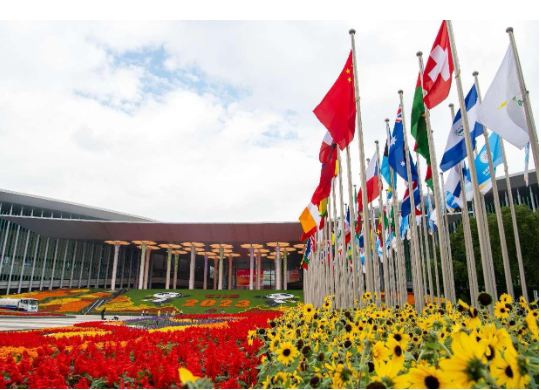
The 7th China International Import Expo (CIIE) will be held in east China’s Shanghai from Nov. 5 to 10. As a major platform for high-level opening up, the 7th CIIE continues to demonstrate China’s continuous efforts to share its market opportunities with the world.

First held in 2018, the annual expo has fulfilled its platform function for international procurement, investment promotion, people-to-people exchanges and open cooperation, becoming a public good for the whole world.

According to Tang Wenhong, China’s assistant minister of commerce, the total exhibition area of the 7th CIIE will exceed 420,000 square meters. It has attracted participants from 152 countries, regions, and international organizations in both Country Exhibition and Business Exhibition. As an important part of the CIIE, the Hongqiao International Economic Forum will include a main forum and 19 sub-forums.

The Business Exhibition will maintain its massive scale of over 360,000 square meters, attracting 3,496 exhibitors from 129 countries and regions. Both the numbers have surpassed those of the previous edition.

A record-breaking 297 Fortune Global 500 companies and industry leaders will be present, with 186 companies and organizations participating for seven consecutive years.

The 7th CIIE will continue to establish itself as a global platform for product debuts, cutting-edge technology launches, and innovative service introductions. It has attracted 39 government procurement delegations and 4 industry procurement delegations, totaling 780 trade sub-groups, achieving a new record.

The innovation incubation zone in the Business Exhibition has achieved improvements in both scale and quality this year. For the first time, it features four major tracks: digital economy, green and low-carbon technology, life sciences, and manufacturing technology, with both exhibition area and number of projects reaching historic highs.

The technology and equipment exhibition area will focus on three main themes: technology, industry, and environmental protection. The technology section will feature a dedicated area for new materials for the first time. The industrial chain in the integrated circuit industry section has been further improved and the artificial intelligence (AI) experience zone further upgraded.

The industrial section is expected to highlight three exhibition areas: upstream industrial systems and basic equipment, midstream industrial control system automation and integration solutions, and downstream end-user applications.

The environmental protection section covers new energy, water treatment, and environmental technologies, and will be joined by four of the world’s major water treatment companies.

The Country Exhibition continues to serve as an important platform for countries to showcase their images and trade and investment opportunities, featuring the participation of 77 countries and international organizations.

France, Malaysia, Nicaragua, Saudi Arabia, Tanzania, and Uzbekistan will be the guest countries of honor. The expo will provide free exhibition booths to companies from 37 least-developed countries, facilitating their participation in the Country and Business Exhibitions. It will also expand the African products zone. This demonstrates China’s commitment to expanding unilateral opening up to the least-developed countries and making its development inclusive and universally beneficial.

The sub-forums of the Hongqiao International Economic Forum will address topics such as AI, new energy storage, new energy vehicles, and sustainable urban development, providing insights for emerging industries.

For the first time, it will host events themed around “sustainable development driven by new quality productive forces,” to explore pathways for businesses to achieve green and sustainable development.

The CIIE, which aims to expand imports of high-quality products and services into the Chinese market, serves to showcase China’s major opening-up measures. By constantly unleashing the dividends of openness, it strives to build a platform that allows the world to share China’s new development opportunities.

The previous six editions saw nearly 2,500 new products, technologies, and services make their debuts, with combined intended turnover reaching over $420 billion. The expo has facilitated precise matchmaking for more than 1,130 foreign enterprises and investment promotion agencies across different regions. Many exhibitors have gone on to open new stores, factories, and R&D centers in China.

Leveraging the vastly huge China market, the CIIE has enabled exhibits to become traded goods and exhibitors to spot more investment opportunities.

As China’s frontier of opening up, Shanghai is seizing the opportunities presented by the CIIE to advance high-level international engagement. According to Hua Yuan, vice mayor of Shanghai, the city has undertaken a series of explorations and practices benchmarked against the highest international standards and best practices.

The China (Shanghai) Pilot Free Trade Zone and its Lin-gang Special Area have shown remarkable progress. In the past five years since its establishment, the Lin-gang Special Area has seen the annual output value of industries above the designated size increase by 34.6 percent on average, and the actual use of foreign direct investment has reached an average annual growth rate of 45.3 percent. The special area has become a new engine for Shanghai’s economic growth.

The city is also innovating new platforms for open cooperation. The pilot zone for Silk Road e-commerce cooperation, the first of its kind in China, has been set up in the city and made steady progress, achieving ten institutional innovations including “single declaration, bilateral customs clearance” and cross-border e-invoice interoperability.

Among the 104 key tasks outlined in Shanghai’s overall plan for building the Hongqiao international opening-up hub, 100 have been implemented.

KANSIEC Awards Certificates of Return Amidst Controversy Over Kano Local Elections

The Kano State Independent Electoral Commission (KANSIEC) has issued certificates of return to the 44 newly elected Local Government Chairmen, all affiliated with the New Nigeria Peoples Party (NNPP). KANSIEC Chairman, Professor Sani Lawal Malumfashi, confirmed the issuance and stated that the new leaders are now officially responsible for their local government areas. Governor Abba Kabir Yusuf is expected to preside over their swearing-in at Kano’s Government House soon.

Malumfashi emphasized the election’s smooth process and the importance of local government autonomy. However, the All Progressives Congress (APC) labeled the election “illegal,” citing a Federal High Court ruling by Justice Simon Amobede that deemed KANSIEC’s leadership biased toward the NNPP. APC chieftain Rabi’u Bichi added that a recent ruling had invalidated all NNPP chairmanship candidates, urging APC members to await the final legal proceedings on the issue.

.

BRICS countries join hands to promote green, low-carbon development

By Xu Lingyuan

In the town of Postmasburg in Northern Cape Province of South Africa, where there are abundant sunshine and vast land, the Chinese-built 100-megawatt (MW) Redstone Concentrated Solar Thermal Power (CSP) Project resembles a giant sunflower, harnessing the sun’s light and heat.

The project, known as South Africa’s largest renewable energy project, was successfully connected to the country’s power grid in mid-September this year, marking the beginning of a crucial phase in the construction of the project.

Once fully operational, the project is expected to contribute approximately 480 gigawatt-hours (GWh) of clean electricity to South Africa’s power grid annually, meeting the electricity needs of over 200,000 households.

While helping alleviate local electricity shortages, the project will also reduce South Africa’s reliance on traditional fossil fuels.

In the desert on the outskirts of João Câmara, a city in the northern Brazilian state of Rio Grande do Norte, State Grid Brazil Holding, a subsidiary of the State Grid Corporation of China, created an oasis of renewable energy – the Gameleira Wind Complex.

The wind power project generates around 360 million kilowatt-hours (kWh) of clean electricity per year, equivalent to saving 129,600 tonnes of standard coal and reducing carbon dioxide emissions by 358,900 tonnes. It has also created over 2,000 job opportunities for the local people.

In recent years, BRICS countries have actively carried out cooperation in green energy development, fully utilizing the unique renewable energy resources of each country, such as solar and wind power, to promote the implementation of clean energy projects, injecting “green power” into the efforts to boost development and improve people’s livelihood.

China has been continuously advancing energy transformation, effectively reducing the technological costs of clean energy cooperation among BRICS countries.

In recent years, China has accelerated the construction of a clean, low-carbon, safe and efficient energy system, and made significant progress in coordinated pollution reduction and carbon mitigation.

So far, China has established the world’s largest carbon emissions trading market, covering an annual carbon dioxide emissions volume exceeding 5 billion tonnes.

The country has also vigorously promoted the development of renewable energy, ranking first globally in terms of the installed capacity of hydropower, photovoltaic, and wind power.

Cooperation among BRICS countries in energy transformation and green, low-carbon initiatives is becoming increasingly close, resulting in the emergence of a good number of exemplary cooperative projects, including the Health Facility Solar Electrification initiative in Ethiopia and the supply of 96 subway cars to the Brazilian city of Belo Horizonte.

The “BRICS Industrial Cooperation Casebook”, a document released at the BRICS Forum on Partnership on New Industrial Revolution 2024 held in Xiamen, southeast China’s Fujian province in September this year, reveals a multitude of exemplary cooperative projects among BRICS countries in new industrial revolution in recent years, covering energy transformation and green, low-carbon initiatives.

The “International Cooperation Initiative on New Industrialization” launched during the forum proposes that BRICS countries expand pragmatic cooperation in industries such as photovoltaic power generation, wind power equipment, and new energy vehicles, to accelerate the green transformation of industries.

Funeka Yazini April, coordinator of the BRICS Research Center at Human Science Research Council, believes that the efforts of BRICS countries to enhance cooperation in green energy development, utilization, and technological innovation, and accelerate green and low-carbon transformation hold significant importance for promoting both their own and global sustainable development.

As the global challenges brought about by climate change intensify, developing countries have become the principal victims of climate change issues.

The BRICS countries have always been concerned about the common future of humanity and have emerged as a crucial force in addressing climate change.

The BRICS countries have initiated the BRICS cooperation to jointly tackle the challenges posed by climate change.

At the 14th BRICS Trade Ministers Meeting held in July this year, relevant parties adopted the Joint Communique of the 14th BRICS Trade Ministers Meeting and the “BRICS Statement on Environmental and Climate-related Trade Measures, emphasizing opposition to unilateralism and green protectionism.

During the meeting, relevant parties reached consensus on enhancing exchanges in green technologies and promoting cooperation on standards for green products, and agreed to compile standards and best practice cases related to green products, which laid a crucial foundation for further strengthening the alignment of standards and cooperation on new energy vehicles, lithium batteries, solar panels, and other products among BRICS countries.

In September this year, the New Development Bank (NBD) and nine other multilateral development banks announced that their global climate finance reached a record high of $125 billion in 2023.

The NBD’s previously released 2022-2026 General Strategy indicates that over the next five years, the bank would provide $30 billion in funding support to member countries, with 40 percent of the funds allocated for climate change mitigation efforts.

Andrey Gubin, an associate professor with Russia’s Far Eastern Federal University, believes that dialogue and exchanges between BRICS countries and more emerging markets and developing countries will promote extensive international cooperation and drive collective efforts to address issues such as imbalanced development and climate change.

NNPC Continues Search for Missing Passengers in Port Harcourt Helicopter Crash

The Nigerian National Petroleum Company Limited (NNPCL) reported on Sunday that no additional bodies have been recovered from Thursday’s Sikorsky SK76 helicopter crash in Port Harcourt, Rivers State. According to NNPCL’s Chief Corporate Communications Officer, Olufemi Soneye, search and rescue efforts are ongoing in collaboration with local authorities.

Soneye confirmed that while three bodies were initially recovered, five passengers remain missing. “The NNPC Ltd wishes to announce that no other bodies have been recovered from the ill-fated helicopter operated by East Winds Aviation,” read the company’s statement.

The Nigerian Safety Investigation Bureau (NSIB) is supporting the operation with additional diving equipment to facilitate the search. The NSIB noted that efforts were temporarily suspended on Friday evening due to low visibility. The investigation and search efforts continue, and NNPCL extended sympathies to the families of those affected by the tragic incident.