China, Africa make fruitful achievements in economic, trade cooperation

By Qiang Wei, People’s Daily

Twenty-five containers of fishmeal weighing 485 tons recently arrived at the Yangshan Port, one of Shanghai Port’s main ports, from Gambia. It marked the first time for the fishmeal produced in the smallest country on the African continent to enter the Chinese market via a port in Shanghai.

Today, China is the largest trading partner of Gambia. The rapid development of trade and economic cooperation between the two countries is exactly a miniature of the constantly deepening China-Africa economic and trade ties.

This year marks the 10th anniversary of the Belt and Road Initiative (BRI) and the principles of sincerity, real results, amity and good faith, and of pursuing the greater good and shared interests in developing China’s relations with Africa.

Over the past decade, China and Africa have cooperated closely with each other and advanced a batch of major cooperation projects in an orderly manner. Both the trade volume between China and Africa and China’s investment in Africa saw steady growth, and the economic and trade cooperation between the two sides has entered a new phase of high-quality development.

The third China-Africa Economic and Trade Expo was held in Changsha, central China’s Hunan province between June 29 and July 2. It was joined by over 1,700 Chinese and African enterprises, chambers of commerce and financial institutions. Nearly 1,600 types of commodities from 29 African countries were displayed at the event, up 166 percent from those in the previous session, including coffee, wine and artifacts. The number of exhibitors jumped 70 percent to reach 1,500.

Mozambique brought its wood carvings to the expo, and Malawi displayed its featured agricultural products such as chilies and soybeans. In the exhibition booth of Madagascar, there was a “tree” inspired by the African baobab.

A total of 120 projects worth $10.3 billion were signed during the expo.

At the expo, China’s General Administration of Customs released for the first time a China-Africa trade index. Between 2000 and 2022, the import and export value between China and Africa grew more than 20-fold to hit 1.88 trillion yuan ($260 billion) from less than 100 billion yuan, with an average annual growth of 17.7 percent. China has remained the largest trading partner of Africa for 14 consecutive years, and the areas of cooperation between the two sides have been extended to digital technology, green development, aerospace, finance and other emerging sectors.

China is the fourth largest source of investment for Africa. As of the end of 2022, the stock of direct investment by Chinese businesses in Africa exceeded $47 billion. Currently, there are over 3,000 Chinese companies doing business in the continent.

Africa is the second largest overseas engineering market of China. Since 2013, the total value of the contracts signed by Chinese enterprises in Africa has surpassed $700 billion, and the contracts completed exceeded $400 billion.

China has signed civil air transport agreements with 27 African countries, built and launched communication and meteorological satellites for Algeria, Nigeria and other African countries. Under the support from the China-Africa Development Fund, Chinese drone technologies have been introduced to many countries in Africa. Drones manufactured by Chinese enterprises such as DJI and XAG are bringing hopes of harvest to farmers in Mozambique, South Africa and Ghana.

E-commerce platform Kilimall headquartered in Changsha is now operational in Kenya, Uganda and Nigeria. It has built a warehouse covering 10,000 square meters in Kenya’s capital Nairobi. Its independently built logistics network allows it to complete same-day delivery and it also has an independently developed online payment system that supports transactions in multiple currencies.

Li Fei, China’s vice-minister of commerce, said that China has inked BRI cooperation documents with 52 African countries and the African Union Commission, and established multiple special work groups focusing on promoting unimpeded trade, investment cooperation, capacity cooperation, e-commerce and other fields.

China actively supports the development of the African Continental Free Trade Area (AfCFTA) and has set up an expert group on economic cooperation with the AfCFTA secretariat for better policy communication and experience sharing on the facilitation of China-Africa trade and investment.

B&B boom fuels demand for managers in China

By Shi Zhipeng

“Hello! Do you still have rooms available?”

“Hello! We have two rooms available. When do you plan to arrive? Do you have any special requests for the room?”

B&B manager Kong Jie picked up the phone and handled a reservation enquiry at a B&B hotel in Jiuru Mountain scenic area in Jinan city, east China’s Shandong province.

After communicating with the guest, Kong and the guest became connected with each other on WeChat, an instant messaging application. She then shared the location of the B&B hotel and its parking lot so the guest would find it easily.

China has more than one million B&B managers. Last year, B&B hotel managers officially became a new profession recognized by the country’s Ministry of Human Resources and Social Security.

By providing customized services including accommodation, dining, and experiencing local natural environment, culture and lifestyles, B&B managers meet tourists’ needs for individualized experiences.

Kong, 37 years old, is from Jining city of Shandong. Before starting to work in the B&B industry six years ago, she had done several odd jobs in different places.

Over the past 6 years, Kong has witnessed the rapid growth of the B&B industry.

“The form and content of tourism in China have undergone tremendous changes in recent years. Tourists no longer satisfy themselves with simple sightseeing, but like to experience in richer ways,” Kong said.

B&B hotels emphasize service and experience, allowing guests to return to nature and feel warm and intimate, comfortable and relaxed.

The booming B&B industry has driven the development of rural tourism and boosted local employment.

Liu Li, a 45-year-old B&B manager, is a villager from nearby Huluyu village. Before doing this job, Liu was a housewife with no source of income.

“After B&B hotels became popular, I pursued training to become a B&B manager, leading to a fulfilling job near home,” Liu said.

Now, Liu’s child has gone away to university. Being a B&B manager allows her to conveniently take care of her elderly family members. Liu said she is very satisfied with her job.

Good B&B managers are often “jacks of all trades.”

According to Kong, the daily work of B&B managers is very comprehensive and not easy to do.

In addition to basic accommodation services such as check-in, reception, cleaning and meal arrangements, B&B managers also plan travel routes for guests and recommend attractions, offering travel tips regarding mountain climbing, water activities, and visiting the scenic area’s experience centers.

B&B managers also need to receive training on many skills, including creating a welcoming atmosphere, reception etiquette, coffee brewing, wine tasting and flower arrangement. Mastering these brings pressure and challenges to Kong, while promoting the hotel on social media is her toughest task.

Social media and short videos provide new channels to promote B&B hotels.

“I’m learning to use Douyin, Xiaohongshu and other social media apps,” said Kong. “I host live-streaming sessions regularly to showcase our hotel’s homey feel. Posting photos and text about our hotel helps more potential guests discover what we offer,” said Kong.

“After a few live-streaming sessions, I’ve received many questions from viewers about our location, pricing, and the surrounding scenic area. This makes me feel delighted,” said Kong.

In the recreation center of Kong’s B&B hotel, laughter rang out as Kong chatted happily with guests Ms. Dong and her family. During the conservations, Kong made coffee for them.

Compared to hotel services, B&B hotels emphasize personalized services with the human touch.

Recently, a guest at Kong’s hotel had a fever in the middle of the night. Since there were no pharmacies nearby in the mountainous region and the guest did not have any medicine, the accompanying family members were very worried. They called Kong for help.

“After we learned of the situation, we immediately drove to town, bought antipyretics and delivered them to the guest,” Kong recalled. At 7 a.m. the next day, the guest texted her on WeChat that the fever was gone and expressed their gratitude.

One guest visited Kong’s hotel and kept coming back, sometimes with family and sometimes for company team building events. Every time before leaving, he would tell the managers what they did well during his stay and what could be improved. He also shared books he was reading with them. Over time, he formed deep friendships with the managers.

Kong has many stories like this from her time as a B&B manager. What she cherishes most are the connections she has made with guests from across the country.

“Everyone has their own story. Communicating with the guests opens my eyes to new possibilities in life,” she said.

“B&B managers becoming a new profession not only means we’ve gained social recognition, but our future lives will have more prospects. In the future, I want to learn more skills such as tea ceremony and making wine, and then get certified,” Kong expressed. The woman has started making plans for her future career development.

Testimonies on Alleged Irregularities Heard at the Nasarawa State Governorship Election Tribunal

In the ongoing Nasarawa State Governorship Election Tribunal, the lead counsel of the People’s Democratic Party (PDP), Ombugadu DR J S OKUTEPA (SAN), presented his case today, August 17, 2023.

The first subpoenaed witness, the HOD of INEC ICT for Nasarawa State, provided documents, notably BVAS screenshots printouts from affected polling units. However, only two out of the expected five copies were presented, with the witness claiming the missing three are unaccounted for.

The second witness, a pivotal figure, PDP’s State Collation Agent Barr Ayiwulu Baba Ayiwulu, took the stand. He highlighted documents originating from the INEC BVAS IREV which were not collated according to the INEC Guidelines for the 2023 General Elections. These documents pertained to various electoral wards and constituencies across the state.

Specifically, Ayiwulu pointed out discrepancies in the collation process, including Form EC8As, EC8Bs, and related documents for both the Governorship and State Assembly results in multiple areas. He further stated that the scores from Form EC8As were inaccurately reflected in Form EC8Bs for certain wards, while results from Form EC8A of Ashige ward were unlawfully nullified.

During cross-examination, the witness, who attested to numerous irregularities and human errors in the last Governorship elections, implored the tribunal to use the original and certified copies to ensure accurate compilation of results. He emphasized the importance of utilizing the authentic Form EC8AS to declare the rightful candidate.

Ayiwulu meticulously analyzed the results of the State Assembly Elections for Lafia Central, pointing out disparities in accreditation.

After the PDP’s presentation, their lead counsel, DR J S OKUTEPA SAN, announced the closure of their case, signaling readiness for the defense from the 1st, 2nd, and 3rd respondents. The first respondent, INEC, represented by Lead Counsel Isiaka Dikko (SAN), expressed readiness for their defense.

The INEC’s defense is scheduled to commence on August 18, 2023, marking another pivotal stage in the proceedings. The tribunal continues to scrutinize and assess the evidence presented, with implications for the outcome of the Nasarawa State Governorship Election. Stay tuned for further developments on this significant legal matter.

Uncovered: Suspected Scheme by Governor Fintiri to Spark Turmoil in Adamawa

As the governorship election petition tribunal sitting in Yola, Adamawa State capital is winding up its assignment, indication has on Tuesday, emerged that the governor, Ahmadu Fintiri, is planning mayhem against the tribunal members, lawyers and litigants ahead of the verdict.

A highly placed political source in the state has confirmed that the embattled governor, who was declared winner in a controversial circumstances being jittery over the outcome of the tribunal verdict slated for 12th September, 2023, has resulted to self help and desperate moves to ensure that he allegedly creates chaos in the state.

According to the source in his words ” It has come to our attention of plans allegedly sponsored by Governor

Ahmadu Umaru Fintiri to procure and print fake face caps and T-Shirts branded with the pictures of Senator Aishatu Dahiru Ahmed (Binani) and give to hired political thugs and ‘miscreants’ to attack gatherings of political meetings, offices of PDP and turn around to claim that it was done by supporters of Binani.

“This is coming on the heels of his disappointment over failure of INEC and PDP  to present witnesses at  the Adamawa State Governorship Tribunal sitting in Yola” he maintained.

Xinmin in NE China sows seeds of success with digital agriculture

By Xin Yang, Liu Hongchao, Hu Jingyi, People’s Daily

Even during the busiest farming season, Wang Shizhong, a major grain grower in Zhongguchengzi Village, Xinmin, northeast China’s Liaoning province was still “taking his cool,” as he knew he got everything under control with MAP Zhinong, a smart farming application on his mobile phone, which enabled him to check the satellite map of his farmland, the real-time weather for the next two hours, and soil moisture.

“Before, we had to manually measure farmland, check irrigation needs, and monitor crop growth ourselves. But now satellites collect that data for us, immediately flagging any problems and pinpointing issue locations. It significantly cuts down on field patrol work,” Wang said.

In recent years, Xinmin has been actively promoting “digital agriculture” development, taking the lead in building a “digital twin agriculture base” for better farming and agricultural production.

At the end of May, Li Baoji, a farmer in Houshahezi village, Xinmin’s Fahaniu township, planted some bitter gourd seedlings in his greenhouse. Afterwards, he took out his phone and scanned a QR code at the entrance of the greenhouse. Then he typed in relevant planting information, including crop type, planting area, planting time and expected ripening time and yield.

This QR code is the unique identity marker for each greenhouse in Xinmin. In addition to planting information updated by farmers, it also contains basic information like the greenhouse’s geographic coordinates, area, and ownership.

Vice director of Xinmin’s agriculture and rural affairs bureau Leng Zhuojian said: “The information is collected by an integrated digital agriculture platform, which not only helps with ownership verification and management, but also offers farmers with industry information and marketing advice through big data analysis.”

“Bitter gourd price is at a low in recent days, so we will adjust the temperature in the greenhouse to delay the time of ripening,” said Li, while pressing a button to lower the shade curtains and open vents, which soon cooled down the greenhouse.

Xinmin currently has 55,000 greenhouses producing close to 1 million tons of facility vegetables annually. It is working to create a QR code for each greenhouse so as to provide digital traceability.

Leng said that big data will bridge data and information gaps for smallholders, offer data support for contract farming and improving the quality of farm produce supply, and thus raise farmers’ incomes.

Shenyang Qiushi Agricultural Sci-Tech Development Co., Ltd. in Xinmin’s Damintun township has a lab-like “plant factory.” Rows of hydroponic vegetables are neatly planted there, soaked in the sunlight shed from above. There is a pipe system that provides water and nutrient solutions for the vegetables around the clock, and the growth of vegetables is shown on labels displaying plant information, including planting dates and expected harvest dates.

“We’re using precision agriculture to guide crop production. Through computer-controlled nutrient solutions, real-time monitoring data, and adjustment of nutrient ratios, we provide plants with exactly what they need 24 hours a day,” said Chairman Luan Bing of the company.

According to him, the “plant factory” covers 5,000 square meters and produces 19 types of leafy vegetables weighing 40 tons each year. Soilless cultivation effectively prevents soil-borne plant diseases and insect pests, and the QR codes can enable full traceability, he added.

Following the example set by the “plant factory,” Xinmin is building a digital twin modern agriculture demonstration park, said Li Shilong, director of Xinmin’s agriculture and rural affairs bureau.

“With government investment, we will create a virtual replica of the park using 3D modeling and internet of things to link all greenhouse data. This will eventually allow integrated, intelligent management of the park and crops from sowing to harvest,” Li said.

By promoting the application of network communication, internet of things, automation, and software technology throughout the agricultural value chain, Xinmin aims to refine agricultural production management and accelerate the transformation of traditional agriculture toward a  modern one.

Akpabana promises electricity, roads, security, others as thousands receive him in Omala

The Gubernatorial ambition of a former Chief of Naval Staff, Admiral Usman Jibrin popularly known as Akpabana on Tuesday received a massive boost as thousands of ecstatic supporters trooped out to receive him at Abejukolo, headquarters of Omala Local Government Area of Kogi State.


Usman, who is the candidate of the Accord Party in the Kogi State Governorship election holding in November, arrived the historical town as part of his Ward to Ward consultations was visibly overwhelmed by the mammoth crowd of supporters.


Addressing them, Admiral Usman promised to restore the glory of the ancient town of Abejukolo by ensuring that the town is reconnected to the national grid, saying that the restoration of electricity will also boost smallholder businesses in the town.


On the deplorable state of the township roads, he said the town deserves more than what it has experienced under the current administration and promised to make the rehabilitation one of his priority projects when he assumes office as Governor.


Visibility touched by the level of insecurity experienced in the local government, the Accord Party candidate also promised to use his wealth of experience to ensure the return of safety and security to enable indigenes to resume their normal social and economic activities, especially farmers who have been displaced by invaders.


On the economic front, Admiral Jibrin Usman, who described himself as an adopted son of Omala Local Government, given his close relationship with many prominent sons of the area, promised to ensure that normal banking activities which were disrupted by insecurity, are restored to the local government.


To the applause of the crowd, the retired Naval Chief announced that on assumption of office as Governor, he’ll commence the construction of the Bagana-Oweto road to connect to the new Abuja Highway.


On rural roads and electrification, he assured the people of Omala that he’ll also resume the rehabilitation of the Abejukolo – Ankpa Road, construction of Abejukolo -Okpotala – Bagaji – Agojeju Odo roads. He also listed Ogodu, Olla, Ibado, Akpacha, Agbenema, Okpotala, Bagaji, Bagana and Agojeju Odo as communities that’ll benefit from his rural electrification programme.


Speaking at the occasion, a prominent indigene of the local government, and retired Assistant Inspector-General of Police, Abdulsalam Iyaji assured the Accord Party candidate of the massive support of the local government during the November election, as he stands head and shoulders above other candidates in the election.


He said Omala Local Government has suffered untold neglect in the last eight years and the people were ready to take their destiny in their hands by voting for a tested and trusted candidate who has identified in Admiral Jibrin Usman.

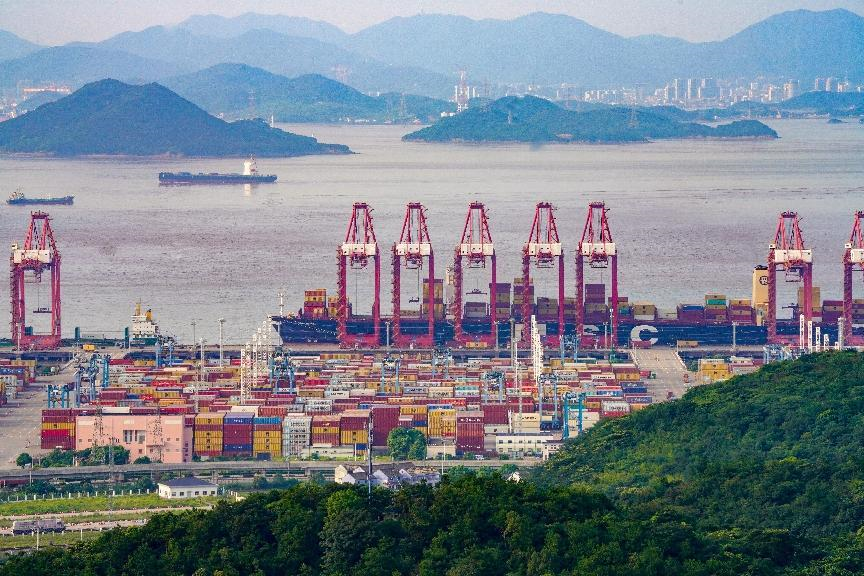
E China’s Ningbo-Zhoushan Port strives to become world-class port

By Zhang Weihao, People’s Daily

Ningbo-Zhoushan Port in east China’s Zhejiang province, the world’s first port to achieve an annual cargo throughput of over one billion tonnes, contributes significantly to the stable operation of China’s foreign trade industrial and supply chains as well as the high-quality development of the Chinese economy.

During the first half of this year, the port saw its cargo throughput climb 6 percent year-on-year to 679 million tonnes, while its container throughput rise 1.2 percent, compared to the same period last year, to 17.68 million 20-foot equivalent units (TEUs), according to data released by the operator of the port, Ningbo Zhoushan Port Co., Ltd., on July 7, 2023.

Burgeoning ports promise booming trade. Ports are considered a barometer of a country’s foreign trade and national economic development. In recent years, cities across China have leveraged smart manufacturing to boost efficient operation of ports, empowered the construction of smart ports with digital technologies, and facilitated green development of ports with sci-tech innovations.

Thanks to these efforts, the country’s key shipping routes have enjoyed unimpeded, efficient, stable, and orderly operations, playing a positive role in guaranteeing the stability of industrial and supply chains. By helping better unleash the potential of the Chinese economy, these ports inject new impetus into global economic growth. 

As China’s busiest port, Ningbo-Zhoushan Port enjoys favorable geographical location and superior natural conditions. It lies at the meeting point of the Silk Road Economic Belt and the 21st Century Maritime Silk Road, backed by the Yangtze River Delta economic circle, and facing the main maritime shipping routes on the Pacific Ocean.

The port is one of the few deep-water ports in the world. The main channels of its core port area are over 22.5 meters deep, allowing 300,000-tonnage vessels to freely enter and depart the port, while 400,000-tonnage vessels can enter and depart the port during high tides.

The port also boasts first-class infrastructure. It has over 200 berths for 10,000-tonne vessels and above and more than 120 large and extra-large deep-water berths for 50,000-tonne vessels and above, making it the port with the most large and extra-large deep-water berths in the Chinese mainland.

Because of its unparalleled strengths, Ningbo-Zhoushan Port has ranked first in the world in annual cargo throughput for 14 consecutive years. Last year, it handled 33.35 million TEUs of containers, maintaining its position as the world’s third largest port in terms of container throughput.

The port is also the second largest port in China in terms of sea-rail intermodal cargo transportation volume. It operates 23 sea-rail intermodal train routes, providing services covering 63 prefecture-level cities in 16 provinces across the country.

The port has opened 122 shipping routes connecting China and countries and regions along the Belt and Road, and has increased its number of maritime shipping routes to Central and Eastern Europe to 14. Last year, the port and five ports in Central and Eastern Europe handled 769,000 TEUs of containers for foreign trade between China and Central and Eastern Europe, up 16.5 percent compared to the previous year. 

On July 5, 2023, 400,000-tonne mining vessel Ore Brasil docked slowly at the No. 1 berth of the Shulanghu ore transfer terminal of the Ningbo-Zhoushan Port with the help of several tugboats. With this, all 68 mining vessels with the largest capacity of 400,000 tons in the world had sailed to the Ningbo-Zhoushan Port, fully demonstrating the port’s advantage of being a comprehensive hub port.

At present, Ningbo-Zhoushan Port is striving to usher in a new phase of growth by advancing smart port construction and promoting green and low-carbon transformation.

The terminal in the Meishan port area of Ningbo-Zhoushan Port has significantly improved operational efficiency through intelligent facilities, such as unmanned container trucks and remotely controlled automated gantry cranes and bridge cranes.

In an effort to enhance energy conservation and cut carbon emissions, the terminal has adopted photovoltaic technology to provide solar power for some of its equipment. Meanwhile, it has achieved 100-percent shore-side power coverage, providing clean energy to ships berthed at the port area.

The busy and thriving scenes and streams of substantive data from the Ningbo-Zhoushan Port inspire confidence and hearten people.

With over 300 container shipping routes linking more than 600 ports in over 200 countries and regions, the port has woven a maritime shipping and trade network that connects China to the rest of the world, contributing to China’s efforts to foster a new pattern of development that is focused on the domestic economy and features positive interplay between domestic and international economic flows.

Nairobi hosts third CMG Media Cooperation Forum

The third annual CMG Media Cooperation Forum was held on Monday in Nairobi, Kenya, under the theme “Deepening communication between Chinese and African civilizations and promoting a China-Africa community with a shared future in a new era”.

The gathering brought together various leaders and media stakeholders from both China and Africa, including Chinese Minister of Culture and Tourism Hu Heping, President of China Media Group Shen Haixiong, who sent a video message, Chinese Ambassador to Kenya Zhou Pingjian, Deputy Principal Secretary in Kenya’s Ministry of ICT Juliana Yiapan, CEO of the African Union of Broadcasting Gregoire NDJAKA, among others.

Speaking at the forum, Hu noted that in recent years, China and Africa have been expanding the scale and fields of their cooperation, with the cooperation mechanisms continuously improved under the framework of the Forum on China-Africa Cooperation.

He stressed that China and Africa shall consolidate consensus and tell stories about the China-Africa friendship.

“It is my hope that the Chinese and African media can work together to deliver more insightful and human-interest content. I also hope they can use accessible and communicative language in telling the stories of friendly communication, mutual benefits, win-win outcomes, and pursuit of dreams between China and Africa, in order to consolidate consensus and provide spiritual support to cooperation,” Hu said.

On his part, Shen called for greater collaboration between Chinese and African media in order to give the world a better understanding of both sides from an objective perspective.

“We will build a global public opinion environment that is fair, objective, positive and healthy so that we bring more stability and certainty to a fast-evolving world. We will promote exchanges and mutual learning between Chinese and African civilizations so that our world blooms with diversity,” he said.

Yiapan, who attended the Forum as the official representative of Kenya’s ICT Cabinet Secretary Eliud Owalo, thanked China for working together with Kenyan media stakeholders to deliver noteworthy media content.

“CMG reporters have worked closely with the Kenya Broadcasting Corporation and we acknowledge the level of exchange of technology,” she said.

CEO of the African Union of Broadcasting Gregoire NDJAKA stressed the need for African media to work in collaboration with partners that allowed them to tell African stories from their own perspective.

NDJAKA affirmed the continent’s readiness to further strengthen media relations with China and to take lessons from China’s experiences over the years.

Other speakers also stressed the need for stronger cooperation between Chinese and Kenyan media stakeholders, with a focus on telling Chinese and African stories objectively.

At the CMG Media Cooperation Forum, CMG also officially unveiled the second edition of the “Great to Meet You” China-Africa Youth Short Video Contest.

The purpose of the event is to collect more excellent short video works, so that China-Africa exchanges can be fully demonstrated through the lens of the younger generation. Selected works will have the opportunity to appear on CMG’s main outlets and other mainstream media platforms in Africa.

China, Thailand see prospering cooperation on green technology innovation

By Yang Yi, People’s Daily

The Green Technology Bank Bangkok Center, located in an innovation and entrepreneurship cluster near Chulalongkorn University in Thailand, was recently inaugurated. The vibrant, energetic cluster exactly reflects the thriving China-Thailand cooperation on green technology innovation in recent years.

As the Green Technology Bank’s first overseas branch, and cooperating with the Chinese Academy of Sciences (CAS) Innovation Cooperation Center (Bangkok), the Thailand-based Green Technology Bank Bangkok Center strives to serve the entire ASEAN. It builds a bridge of international cooperation to better transfer and translate advanced and applicable green technologies.

“Many Chinese companies new to Thailand are unfamiliar with local laws and unclear on registration processes. We provide professional services to quickly get them up to speed,” said Jiang Biao, director of the CAS Innovation Cooperation Center (Bangkok).

According to him, the Green Technology Bank Bangkok Center has been on a tight schedule these days, with many Chinese sci-tech firms coming for cooperation, hoping to implement advanced technologies in Thailand.

In recent years, China-Thailand cooperation on green technology innovation has made continuous progress, and many advanced technologies have already benefited the Thai people.

In March 2020, to combat COVID-19, Thailand’s Siam Cement Group urgently procured a batch of high-end Chinese medical imaging equipment through the CAS Innovation Cooperation Center (Bangkok) and donated them to the Ramathibodi Hospital, Mahidol University. This greatly enhanced the efficiency of the hospital’s clinical diagnosis.

This April, a delegation from the Ramathibodi Hospital visited Shanghai institutions that had previously extended a helping hand, including United Imaging Healthcare.

The first domestically produced proton therapy system left a deep impression on the Thai side. “This year we will accelerate the application of proton therapy at the Ramathibodi Hospital to further reduce equipment and medical costs for local hospitals, and provide patients with cost-effective medical services,” said Jiang.

In November 2022, a deal for building Thailand’s first 5G-enabled smart autonomous driving mining project was signed in Bangkok. According to the deal, five Chinese and Thai companies will leverage 5G, artificial intelligence, autonomous driving, cloud computing, new energy batteries and more to make a mine of Siam Cement Group in Saraburi Province greener, smarter, more efficient, and safer.

“This is the first overseas smart green mining project built by Chinese companies. It will form a complete closed-loop unmanned solution for the mining industrial chain from construction to production,” Jiang explained. This will effectively lower safety risks, enhance productivity, and reduce energy consumption, he added.

Thailand is the world’s largest natural rubber producer and exporter, but it has long relied on traditional manual tapping. Tappers always have to get up at 4:00 or 5:00 AM every day to work, which is arduous but inefficient.

“To improve productivity, we are promoting unmanned automated tapping machines and building solar panel canopies to utilize clean energy and reduce electricity costs,” said Jiang.

The Green Technology Expo 2023 will be held in Bangkok this November. Themed “Towards the Transition to Newer, Cleaner, Sustained Evergreen Technology,” it will exhibit the latest green tech innovations around the world.

As a main organizer, the CAS Innovation Cooperation Center (Bangkok) is actively preparing for the expo.

“In recent years Thailand has strongly supported new energy vehicle development. Some Chinese automakers have confirmed their participation in the expo. Companies from ASEAN countries like Vietnam, Laos, Indonesia, and Malaysia have also expressed interest,” said Gao Kun, deputy director of the center.

Recently, the expo’s second press conference was held in Shanghai, helping Chinese firms reach the Thai market and promoting in-depth China-Thailand exchange on green and low-carbon development as well as energy-conserving technologies.

China boosts in-depth integration of information technology into transportation sector

By Han Xin, People’s Daily

China is making great efforts to promote the in-depth integration of information technology (IT) into its transportation sector. With new products and new business models continuously emerging across the country, people across China are benefiting from improved travel experiences in various scenarios – from city streets to intercity expressways. 

This summer, many people in China have found that map apps can display shaded “sun protection” routes for pedestrians in real-time and automatically recommend a shady route based on user’s destination.

“By leveraging remote sensing technology, our app can intelligently identify the distribution density of trees around roads, and calculate the dynamic light and shadow condition of road sections based on relevant factors of specific locations,” said an executive of leading Chinese mapping service provider Amap. 

Thanks to the application of intelligent mobile terminal technologies, urban transportation services in China have witnessed significant improvement in quality and efficiency.

“There are peaks and valleys in urban travel demand. The waiting time for taxis spike during rush hour,” said Li Xinhua, general manager of the taxi division of Amap’s ride hailing services.

In an effort to improve the supply-demand matching efficiency, Amap has leveraged big data to predict congestion and adjust pricing in real time, according to Li.

IT is penetrating every corner of urban transportation in China, continuously meeting people’s diverse and individualized travel needs.

Data released by China’s Ministry of Transport (MOT) showed that over 300 Chinese cities have ride-hailing services, with over 25 million daily orders; and that a total of 15 million shared bikes have been deployed nationwide, generating over 28 million orders on a daily basis.

“Rapid economic development has stimulated more demand for transportation, while challenges like congestion, accidents and pollution have become increasingly prominent,” an official of the science and technology department of the MOT pointed out.

IT, represented by artificial intelligence (AI), can provide new approaches to enhancing the service capabilities of transportation infrastructure, the official noted.

By building and transforming intelligent facilities, which enable dynamic adjustment of signals based on real-time vehicle flows, at 332 intersections, Beijing Economic-Technological Development Area, also known as E-Town, in China’s capital city Beijing, has achieved remarkable results in addressing traffic congestion.

The intelligent facilities have reduced queue length by 30.3 percent and unnecessary time of green lights by 18.33 percent in relevant areas.

Xiangyang Hi-Tech Industrial Development Zone in Xiangyang city, central China’s Hubei province, has seen autonomous driving services expanding to over 140 application scenarios of the Internet of Vehicles (IoV), 234 intersections, 510 kilometers of two-way roads, and an environment for large-scale city-level application covering an area of 150 square kilometers, according to an executive of a project of the Central and Southern China Municipal Engineering Design and Research Institute Co., Ltd.

On local roads for testing intelligent connected vehicles (ICVs), autonomous shuttle minibuses provide scheduled pickups for passengers, while self-driving sanitation vehicles carry out automated sweeping tasks.

Chengdu city, capital of southwest China’s Sichuan province, has adopted a “transportation brain”  powered by Chinese IT firm Inspur’s storage products and services. Boasting a strong capacity to identify more than 100 million pictures for traffic violations daily and meet other needs for traffic management, the “transportation brain” has helped the city increase its vehicle management efficiency by nearly fivefold and the efficiency of traffic flow by around 15 percent.

Leveraging its extensive road network, China has ramped up efforts to further promote the application of AI technology in transportation systems, striving to accelerate the development of expressways by expanding the application scenarios of AI technology beyond urban areas to intercity routes.

On the Chengdu-Yibin Expressway connecting the cities of Chengdu and Yibin in Sichuan province, there is a pole every 800 meters along the divider. The pole is loaded with various devices, including traditional devices like camera and modern devices including millimeter-wave radar. These devices can help achieve accurate real-time monitoring of road conditions 24 hours a day.

“By utilizing new-generation IT like AI, we can not only intelligently analyze exceptions like speeding, contraflow driving and emergency parking, but also enable vehicles on expressways to obtain beyond line-of-sight information in a timely manner,” said Chen Ken, chairman of Sichuan Digital Transportation Tech Co., Ltd.

According to Chen, since the installation of these devices, 73.8 percent of the accidents that have taken place on the expressway have been proactively discovered by relevant personnel based on alerts sent by an AI-empowered system, and the average response time has been shortened by nearly 34 percent.

The Taihu tunnel on the Suzhou-Wuxi-Changzhou expressway, which is 10.79 kilometers in length, is equipped with an intelligent lighting system that automatically adjusts brightness according to environmental changes. The bright yet gentle lighting from the ceiling of the tunnel creates a relaxed atmosphere, easing driver tension and fatigue from driving for long periods of time in an enclosed space.

Moreover, full coverage of 5G network and the BeiDou Navigation Satellite System (BDS) services enable passengers and drivers to enjoy uninterrupted and high-quality Internet access and travel guidance.

As a key direction for high-quality development of the transportation sector, smart transportation promises broad prospects.

According to an official of the science and technology department of the MOT, smart transportation will show three key features: extensive application of intelligent and automated vehicles, which will significantly reduce the incidence of human error-induced accidents; infrastructure that is more resilient, which will enable safe travel anytime; and highly efficient transportation management based on systems with exponentially improved network capacity.