By He Yin, People’s Daily
Chinese President Xi Jinping will attend the 17th Group of 20 (G20) Summit in Bali, Indonesia, attend the 29th Asia-Pacific Economic Cooperation (APEC) Economic Leaders’ Meeting in Bangkok, Thailand, as well as visit Thailand upon invitation.
This will be the first trip of the Chinese President after the successful conclusion of the 20th National Congress of the Communist Party of China (CPC).
The trip has received high attention from the international community. It is believed that the trip will help all relevant parties work together to tackle global challenges, and build a consensus and boost cooperation in promoting global economic recovery and implementing the UN’s 2030 Agenda for Sustainable Development. It will make new contributions to building a community with a shared future for mankind.
It is said in the report to the 20th National Congress of the CPC that China has always been committed to its foreign policy goals of upholding world peace and promoting common development, and it is dedicated to promoting a human community with a shared future.
China is committed to its fundamental national policy of opening to the outside world and pursues a mutually beneficial strategy of opening up. It strives to create new opportunities for the world with its own development and to contribute its share to building an open global economy that delivers greater benefits to all peoples.
When profound changes unseen in a century are evolving rapidly and global challenges keep popping up, Xi’s participation in the G20 Summit and the APEC Economic Leaders’ Meeting will contribute Chinese insight, Chinese input, and Chinese strength to improving global governance and promoting common development of the world. It will fully show the historical responsibility of China.
The G20 is a major forum for international economic cooperation and an important platform for global economic governance. It shoulders the important mission of stabilizing the world economy and unlocking growth potential.
With rising unilateralism and protectionism, economic globalization is facing headwinds and global recovery remains sluggish. The G20 should enhance cooperation and coordinate macroeconomic policy to jointly promote strong, sustainable, balanced and inclusive growth of the world economy.
As an important member of the G20, China always follows the principles of extensive consultation, joint contribution and shared benefits in global governance and plays a leading role in coping with global challenges, promoting world recovery and improving global governance through cooperation.
Over the recent years, the country has offered, on the G20 platform, a systemic formula pointing out that the international community should work in solidarity to combat COVID-19, take effective measures to promote world economic recovery and adopt long-term policies to improve global governance, which injects stability and positive energy to the world.
Xi’s attendance at the G20 Summit under the theme of “Recover Together, Recover Stronger” will play a constructive role in promoting global recovery, improving global economic governance and promoting sustainable development.
The peace and prosperity of the Asia-Pacific concerns not only the region’s own future, but also that of the world. The Asia-Pacific has succeeded in sustaining fast development for a fairly long period of time. Ultimately, this has become possible because it has endeavored to create an open economic architecture and forge an Asia-Pacific partnership based on mutual trust, inclusiveness and win-win cooperation.
As a staunch supporter and active promoter of Asia-Pacific regional economic cooperation, China closely integrates its own development with that of the region and promotes the opening up of the region with its own opening up, to push for regional economic development, social progress and livelihood improvement. It has contributed its share to promoting Asia-Pacific economic development.
Under the theme of “Open. Connect. Balance.,” this year’s APEC Economic Leaders’ Meeting will be in line with the historical trend of opening up and development.
Xi’s attendance at the meeting will be an important act of China’s head-of-state diplomacy towards the Asia-Pacific. This fully shows the high importance China attaches to Asia-Pacific economic cooperation.
China hopes that all parties will embrace the vision of an Asia-Pacific community with a shared future, adhere to the founding missions of APEC, deepen solidarity and cooperation, advance the implementation of the APEC Putrajaya Vision 2040, and inject new impetus into the economic growth in the Asia-Pacific and beyond.
China and Thailand are close neighbors and connected by blood. China is the largest trading partner of Thailand and Thailand is the third largest trading partner of China among all ASEAN countries. Their bilateral trade exceeded $100 billion in 2021.
Both China and Thailand are staunch advocators of free trade and active supporters of regional cooperation. In July this year, the two sides agreed on jointly building a China-Thailand community with a shared future, which has brought new connotations to the profound kinship between China and Thailand.
Xi’s visit to Thailand coincides with the tenth anniversary of the establishment of the two countries’ comprehensive strategic cooperative partnership, and is of great significance for the development of bilateral ties. Guided by the vision of building a China-Thailand community with a shared future, the two sides will work together to enhance strategic communication and deepen exchanges and cooperation in various sectors, to bring their relations to new heights.
At present, the changes in the world, the times, and history are unfolding in ways like never before. Though human society is facing unprecedented challenges. the historical trends of peace, development, cooperation and mutual benefit are unstoppable. The will of the people and the general trends of our day will eventually lead to a bright future for humanity.
Xi’s trip this time will prove to the world that China will always stand on the right side of history and on the side of human progress, and China is ready to work hand in hand with people across the world to create an brighter future for humanity.
Fadah: Sacked NYSC DG Must Face Consequences – CCF
The Concerned Citizens Forum (CCF) has called for strict punishment for the “disgraced and dismissed” former Director-General of the National Youth Service Corps (NYSC), Brig-Gen MK Fadah to serve as a deterrent to other public office holders.
The group, at a press conference, in Abuja, demanded that Fadah returns all his earnings as NYSC DG and salaries from the Nigerian Army since October 2020.
In his address, Musa M. Attah, National President/Convener, said it stands by the petition written against Fadah to demand his sack.
According to Attah, not only is the Brigadier General unqualified for the job, he displayed gross incompetence in six months in charge.
The Concerned Citizens Forum, therefore, rubished a report by a group, Yobe Elders Forum, which attempted to exonerate Fadah of any wrongdoing.
“We find it shocking that rather than arranging for legal representation to help the disgraced general reduce whatever sentence would come his way from a possible trial in court, the group is alleging that people conspired against him to have him booted out of office,” Attah said.
“For history not to be distorted in favour of law breakers, it is pertinent to remind Nigerians, particularly the Yobe Elders Forum that President Muhammadu Buhari fired Brigadier General M. K Fadah owing to gross incompetence, which we reasonably believe stemmed from his lack of qualification to have occupied the post in the first place.
“In addition, the criminal component of Fadah’s six month in that capacity has to do with his falsification and forgery of credentials, age falsification, evasion of the mandatory one year youth service and misrepresentation of facts as to his competence to be in the Nigerian Army and subsequently occupy the position of NYSC DG.
“Arising from the recalcitrance exhibited by Yobe Elders Group in attempting to paint a man who committed fraud as the victim, the Concerned Citizens Forum, which is the group that wrote the earlier petition to Mr. President to expose Brig. Gen MK Fadah for parading forged credentials, evading National Youth Service as well as age falsification, hereby warns the so called elders to immediately stop ruffling feathers or else we will release even more damaging information that would guarantee their paymaster a long residency in jail.
“They should take it that Brigadier General MK Fadah was responsible for his own downfall as he could have lived a controversy-free life as a storekeeper, herder, artisan, farmer, or any other occupation that does not require advanced credential or mandatory national youth service.
“Even after using the false credentials, falsified age, and non-participation in national youth service to secure a job in the Nigerian Army and attaining the position of NYSC DG, he could have at the very least develop the competence needed to thrive in that position. Instead, Fadah’s performance was so dismal in that position that he sent the scheme into decline in a matter of six months.
“We nonetheless have our demands in the interest of justice and fairness. We demand that Gen MK Fadah be made to refund all earnings and allowances he got as the Director General of NYSC, the same having been obtained fraudulently.
“We further demand that Fadah returns all salaries and emoluments he has received from the Nigerian Army since October 2020 having turned 60 years old at the time since he was born October 1960. The Nigerian Army must similarly adjust Fadah’s rank commensurate with his actual qualifications and compute his due cumulative salary on this basis while asking him to refund the deferential he earned with rank acquired with the forged credentials.
“As we insist that there must be consequences for Fadda’s fraud against Nigeria, the Concerned Citizens Forum shall continue to monitor the situation to ensure that he pays for his crime against Nigerians, especially those who comply with the law of the land. The NYSC Scheme is too central to Nigeria’s unity and social cohesion for a fraud to have led it even for six months”.
China joins rest of world to promote development of digital economy

By He Yin, People’s Daily
Innovation is an important force driving global development and a decisive factor in addressing the common challenges to humanity. It serve as a source of development at critical moments.
Digital technology, a pioneer in global sci-tech revolution and industrial reform, is seeping into every aspect of social and economic development, placing profound impacts on production, people’s life and social governance.
The G20 should shoulder responsibilities in the digital era, quicken the development of new types of digital infrastructure, promote deeper integration of digital technologies with the real economy, and help developing countries eliminate the digital divide, said Chinese President Xi Jinping at the Session I of the 16th G20 Leaders’ Summit.
He also stressed at the 28th APEC Economic Leaders’ Meeting that APEC economies need to commit themselves to innovation-driven development, harness the power of the digital economy as a new growth engine, and spread the fruits of digital technologies to more people in the region.
To eliminate the digital divide is a pressing task facing the whole world.
“The Light of Internet” Expo held at 2022 World Internet Conference Wuzhen Summit displayed how digital technology has contributed to agriculture, industry, governance and social life, and at the fifth China International Import Expo, multinational corporations presented the vitality of the prospering digital economy to the world through a number of new technologies, services and applications.
However, according to the International Telecommunication Union, there are still nearly 3 billion people have no internet access, and most of them are from the developing world.
China, working to implement the Global Development Initiative together with relevant parties and taking digital connectivity as a major field of cooperation, will help enhance the construction of digital infrastructure, narrow the global digital divide and promote common development.
To improve global digital governance is a common aspiration of all parties.
Facing the opportunities and challenges brought about by digitalization, the international community should enhance dialogue and communication, and deepen practical cooperation to build a cyberspace that is fairer and more equitable, more open and inclusive, safer and more stable, and more vibrant.
The vision of building a community witha shared future in cyberspace proposed by Xi conforms to the trend of digital development and that of human society. It responds to cyber risks and challenges, manifests the aspiration of the Communist Party of China to contribute to human progress and world harmony, and expresses the sincere hope of China to enhance cooperation with the rest of the world on cyber development and governance.
China believes that to effectively address the risks and challenges to data security, the world must uphold multilateralism, balance security and development, and ensure fairness and justice. It proposed a Global Initiative on Data Security and actively participates in digital economy governance cooperation under international and regional multilateral mechanisms, winning high recognition from the international community.
China is a major country in digital economy, as well as an important promoter of healthy and orderly development of digital economy. According to a research institute, China’s digital economy reached 45.5 trillion yuan ($6.46 trillion) as of 2021, ranking second in the world for years and accounting for 39.8 percent of the country’s GDP. Besides, China is the largest country in the world in terms of total e-commerce transaction and mobile payment volume.
So far, China has signed memorandum of understanding on building a Digital Silk Road with 17 countries and advanced the Silk Road E-commerce bilateral cooperation mechanism with 23 countries.
It has formulated and is implementing a joint China-Africa Partnership Plan on Digital Innovation in Africa, set up a China-ASEAN Information Harbor, and established dialogue mechanisms on e-commerce cooperation with Central and Eastern European countries and Central Asian countries.
Besides, it offers cloud services for African, Middle East and Southeast Asian countries, as well as other countries participating in the Belt and Road Initiative. It actively promotes cooperation on digital economy under the G20, APEC, BRICS, WTO and other multilateral frameworks.
By joining international cooperation on digital economy and vigorously enhancing information infrastructure, China has made important contributions to the development of the global digital economy.
Internet is shared by all people in this world. Therefore, it is the responsibility of all of humanity to develop, use, and manage the internet well and make it better benefit the world.
China is willing to work with countries around the world to blaze a global digital development path that features joint building and sharing of digital resources, vibrant digital economy, efficient digital governance, flourishing digital culture, effectively guaranteed digital security, and mutually beneficial digital cooperation, so as to accelerate the building of a community with a shared future in cyberspace and contribute to world peace and the progress of human civilization.
China’s cargo spacecraft Tianzhou-5 sets records
By Yu Jianbin, People’s Daily
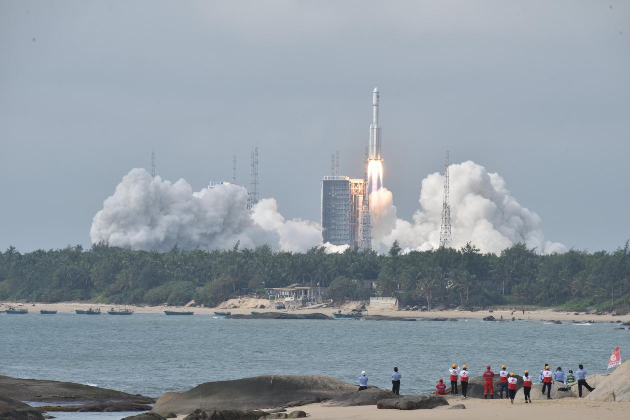
A Long March-7 Y6 rocket, carrying China’s cargo spacecraft Tianzhou-5, blasted off on November 12th from the Wenchang Spacecraft Launch Site in the southern island province of Hainan.
Later, the cargo craft conducted a fast automated rendezvous and docking with China’s Tiangong space station combination. It was the first time that Chinese astronauts witnessed the arrival of a cargo craft in the country’s space station.
It also marked the first delivery of supplies to the space station after the modules of the space station formed a basic configuration in T-shape.
This mission achieved fast automated rendezvous and docking within about two hours, setting a new world record.
The two-hour rendezvous and docking, reduced from 6.5 hours in previous operations, is of great practical significance for the long-term in-orbit operation of the Chinese space station.
The shortened delivery time makes it possible to send fresh products to space, and also enhances space rescue responding to emergencies. It indicates that China’s rendezvous and docking are more functional with maturer technology.
Tianzhou-5, the fifth mission of the Tianzhou-class unmanned cargo spacecraft, is fully sealed. As a “supply center” for China’s space station, the spacecraft can also change into semi-sealed and open modes to meet the demands of different missions.
It is currently the cargo spacecraft in service with the most powerful transport capability in the world, and also the most versatile craft of its kind in terms of in-orbit supporting capabilities.
It is reported that Tianzhou-5 is loaded with six months of supplies for the Shenzhou-15 crew of three astronauts, including food, medicines, propellant, experiment equipment, a science education satellite, hydrogen and oxygen-based fuel cells, and high energy particle detection facility.
It carries a total of 6.7 tons of supplies, including about 5.3 tons of life supplies and equipment, as well as 1.4 tons of propellant for the crew’s life support in space and the construction of the space station.
The successful launch of the Tianzhou-5 from the Wenchang Spacecraft Launch Site, which is under the Xichang Satellite Launch Center, marked the 200th launch mission for the center. It makes the center the first one in China to have completed 200 launches.
It took the center 32 years to finish its first 100 missions, while the last 100 were completed in just six years.
The Xichang Satellite Launch Center, established in 1970, manages two launch sites in Xichang and Wenchang. No launch failure has happened at the Wenchang site since 2021, which completed missions of all three modules of China’s space station and four major cargo spacecrafts.
The Wenchang site has gradually enhanced its launching capacity for new-generation heavy-lift launch vehicles over the recent years. It has achieved a huge leap in China’s near-Earth orbit launch capacity from 10 tons to 25 tons and geosynchronous orbit launch capacity from 5.5 tons to 14 tons.
NYSC: May Nigeria never see another Brig Gen Fadah

By Kolawole Anthony
On Thursday, November 17th, the reported dismissal of Brigadier-General Muhammad Kukah Fadah as the Director-General of the National Youth Service Corps floated the air. After six months of mediocrity, stagnancy, and incompetence, this could ultimately be the watershed moment for the Scheme.
Established in 1973 by the Federal Military Government of Gen Yakubu Gowon, the NYSC has evolved into a beacon of national unity and integration, designed to drive the process of carving a nation out of the multiplicity of ethnic nationalities making up the entity, Nigeria.
Over the past 49 years, the Scheme has pursued vigorously the lofty objectives of the founding fathers. The NYSC has grown exponentially, mobilizing over 350,000 Nigerian youths for service every year. It refocuses their mindsets, making them more patriotic, and amenable to be mobilized for national causes such as elections, census, polio eradication, and HIV/AIDS campaigns, among others.
Through the Scheme’s Skill Acquisition and Entrepreneurship Development program, thousands of young Nigerians are trained to set up businesses, employing others and contributing immensely to the country’s economic development.
Over the years, some great minds have led the NYSC. Col (Dr.) Ahmadu Ali, a brilliant medical doctor laid the foundation of the Scheme upon which his successors have continued to build. Col Ali, Col Edet Akpan, Col SA Sofoluwe, Brig Gen Samson Dule, Brig Gen Yusuf Bomoi, Brig Gen Maharazu Tsiga, Brig Gen NT Okore-Affia, Brig Gen Olawumi, and Major Gen Shuaibu Ibrahim all made varying degrees of outstanding contributions to the progress of the Scheme as Chief Executives, for which posterity will remember them.
However, nearly half a century of progress was hampered by Fadah. Appointed in May, the Brigadier General negates the philosophy of the Scheme with a controversial antecedent, lacking the requisite qualification and persona. It was similar to picking a neophyte for a top management job.
Fadah is a representation of all that is wrong with Nigeria. It is very surprising how the character rose to the rank of General in the Nigerian Army that has produced the likes of Gen Muhammadu Buhari, Gen Joe Garba, Gen Dambazzau, Gen Domkat Bali, Gen Tunde Idiagbon, Gen TY Danjuma mention just a few.
Even more shocking is the aberration that a man who evaded national service was rewarded as NYSC Chief Executive. One wonders how he got commissioned into the Army without the presentation of the Certificate of Service; without passing through the Scheme when he was officially within the age of service at the time he purportedly graduated.
Fadah who reflects a poor image of the Army, particularly the Education Corps took over the headship of the institution without any iota of agenda. Disappointingly, it was learned that days after he assumed office, some members of staff were able to articulate a 5 — point agenda for him, but he couldn’t elucidate it to staff and members of the public.
It is a shame that a man who can hardly string a sentence in English, a man who cannot reason properly, let alone critical reasoning was dumped to preside over the fate of millions of youths upon whose shoulders the destiny of Nigeria lies.
His main interest was to patronize marabouts whom he has in abundance virtually in every State of the Federation, whom he regularly doles out cash running in millions of Naira. This same character always sat on the floor in his office with dirty-looking marabouts eating food with his bare hands as NYSC staff members and visitors watch him in abject disappointment and disgust.
Fadah whose office became a harem of sorts for women of easy virtue from 8 pm debased the position of NYSC Director-General. His vulgarity is indescribable. A Corps Member of Zamfara origin once expressed shock at Fadah who had asked him to validate what he, Fadah heard about women of his tribe whom he said are highly promiscuous. That was a discussion that a Director-General who should be on a moral high ground had with a Corps Member whom he is supposed to be a moral compass.
He regularly brought contractors into his office, one after the other to personally negotiate his pecuniary interest on contracts already or about being executed is his past time; while staff welfare, particularly their statutory entitlements was negated.
For instance, it was learned that he once approved that some staff embarks on official assignments to as far as Bayelsa, Lagos, and Rivers, among others with a duty tour allowance of fifteen thousand Naira — covering the cost of transportation to and fro Abuja, feeding, as well as accommodation. On the other, he spent millions of Naira in contravention of the Financial Regulations junketing around the country on journeys that do not add any value to the Scheme.
There were reports that he once had issues with mental health which hitherto remained in the realm of conjecture. However, his mannerisms, for which we sympathize with him give credence to the fact that he must have had that issue.
Otherwise, how can one explain the situations the Director-General will be walking around the office in military uniform, wearing bathroom slippers; going to the NYSC Mosque to sleep in his military uniform, going to NYSC camps in uniform to sleep in the daytime, when Orientation program is not on, sitting down on the dirty floor of NYSC Lift, because of tiredness, according to him!
NYSC Chief Executive should inspire confidence in Staff and Corps Members; be in full grasp of the NYSC Act, among others. Fadah does not even know why he was in NYSC as Chief Executive.
Thankfully, President Muhammadu Buhari has acted to save the nation from more embarrassment. The process of rebuilding the monumental damage that he has inflicted on the Scheme will begin. May we never suffer another Fadah.
Kolowole PhD wrote this piece from Abuja.
Soludo: Anambra group denounces Peter Obi, demands refund of stolen treasury
The Anambra Concerned Citizens (ACC) has distanced itself from the presidential aspiration of former Governor, Peter Obi.
The group said, fresh revelations made by incumbent Governor, Charles Soludo, confirmed that the Labour Party candidate defrauded the state to assuage his ego and greed.
In a statement co-signed by its president, Mazi Chijioke Ude and secretary-general, Dr Andrew Young, the group further said Obi’s supposed investments aren’t just a scam but stolen funds used to shore up his family business.
“Professor Soludo properly exposed how Mr. Obi impoverished Anambra people while parading himself as the best thing that has ever happened to the state. The incumbent Anambra State Governor’s explanation has now made us know that the so-called investment Mr. Obi purported to have made is worth next to nothing, which implies that the Labour Party presidential candidate defrauded the state to assuage his ego and greed,” the statement said.
“Being a renowned economist, who has had the benefit of managing Nigeria’s monetary policy as governor of the Central Bank of Nigeria (CBN), Professor Soludo is in the best position to analyze the shady investment that Mr. Obi made. It is tragic that in addition to being scammed, the investments translated into the Labour Party presidential candidate using Anambra State funds to shore up his family business. The funds Mr. Obi claimed he saved were yielding interest into his personal and family accounts.
“We, therefore, agree with the Anambra State government that the money Mr. Obi poured into his family business should have gone into stimulating the economy for the benefit of citizens. We could imagine if the funds went into building infrastructure that supports businesses and provides employment like rail, roads and industrial parks that would have stimulated the economy.
“Anambra Concerned Citizens hail Professor Soludo for his boldness to speak out on the purported achievements of Mr. Peter Obi at a time when the latter has turned himself into a demagogue that bristles at criticism. Professor Soludo has proven that he is nationalistic to the point of exposing Mr. Obi at a time when political and ethnic correctness has forced people to ignore the lies of this failing presidential candidate.
“We warn Mr. Obi and his supporters that Anambra Concerned Citizens will not hesitate to expose him if he dares to utter any further words on the exposure of how he defrauded the state. We issue this warning knowing that he has been relying on his lynch mob that he calls his supporters for intimidating and silencing those that dare expose his fraudulent rule in Anambra state”.
The Anambra Concerned Citizens, therefore, denounced Obi, adding those who currently support him are on their own and risk the same fate as Anambra.
The group, however, demanded a refund of state funds “fraudulently cornered into his pocket under the guise of savings or investment failing which we shall initiate steps to compel him to”.
The statement added: “He must as a matter of honour, if he is capable of such, halt his presidential campaign until he can refund what he took from the state through the failed investment and saving. It is in Mr. Obi’s interest to comply with our demand before continuing with his failed presidential bid as we will not relent in exposing him as the con artist that he is.”
Evaluating NEDC’s efforts in flood response
By Nkechi Odoma
The impact of flooding in communities in Yobe and Adamawa states in North East Nigeria cannot be over-emphasized. People were displaced, and farmland was submerged in what could be regarded as one of the worst floodings in North East Nigeria.
This is a trying time for communities that have experienced the effect of the Boko Haram insurgency for several years. Now that life is beginning to return to normal, the floods came in torrents, displacing many and with the potential to cause a humanitarian crisis, but for the swift intervention of the North East Development Commission (NEDC).
It is a statement of fact that since the establishment of the NEDC, among other things, to receive and manage funds from allocation of the Federal Account and international donors for the settlement, rehabilitation and reconstruction of roads, houses and business premises of victims of insurgency as well as tackling the menace of poverty, illiteracy level, ecological problems and any other related environmental or developmental challenges in the North-East states. The NEDC has so far lived up to expectations in fulfilling this mandate.
The various intervention of the NEDC in North East Nigeria has been noteworthy. The flooding in Yobe state and other parts of North East Nigeria provides us with that where the NEDC has been relentless in ensuring that life returns to normal in the region. I marvelled at the response rate of the NEDC in this regard.
It is on record that disaster victims were identified with swift and relief materials distributed to mitigate the effect of the flooding in affected communities. This is a plus for an interventionist agency working round the clock to rebuild the region to bring about a return to normalcy after the devastating effect of the Boko Haram insurgency.
Those of us in the know of the efforts of the NEDC would attest to the fact that its various activities have been notable in the North East region. This is where I rate the agency’s leadership highly concerning understanding what matters most in affected communities and the urgency with which laudable policies and programmes are implemented.
Another strong point of the NEDC is its seamless collaborations with the various state governments in North East. This is strategic and little wonder the many gains recorded so far. Also, the emphasis on timly and effective interventions, especially in crises, indicates that the agency is alive to its responsibilities.
If the tempo is sustained, humanitarian crisis will be averted promptly. I commend the leadership of the NEDC for this laudable drive, as in the case of Yobe state and other states in North East. And the commendation has not been in short supply from stakeholders, members of affected communities, and development partners.
For example, The Good Governance Watch in Africa recently applauded the North East Development Commission over its reconstruction and rehabilitation efforts in the sub-region. It also commended the 10-year North East Stabilisation and Development Master Plan (NESDMP), adding that it will facilitate transformative growth and further lift citizens in the sub-region out of poverty.
Similarly, The North East Peace Foundation commended the North East Development Commission for its laudable intervention initiatives introduced in the region. According to the group, the Commission’s impact has been visible in the rehabilitation and reconstruction of roads, houses and business premises of victims of insurgency, as well as tackling the menace of poverty, illiteracy, ecological problems and any other related environmental or development challenges. It emphasized that the NEDC has shown the capacity to undertake humanitarian activities with its record of excellent service delivery.
The testimonies for the efforts of the NEDC have been that of an outpouring of appreciation for an agency that, in record time, has impacted positively in North East Nigeria. This again brings to the fore the leadership question and how sound leadership could guarantee sustainable growth and development in the country.
The NEDC example is worthy for other interventionist agencies in the country to emulate. It has entrenched transparency and accountability in its operations by giving a good account of its utilization of funds for developmental projects, which indicates an agency that means business.
The Mohammed Goni Alkali-led management team at the NEDC deserves commendation for hitting the ground running through the development and implementation of policies and programmes that address the socio-economic challenges in North East Nigeria occasioned by the Boko Haram insurgency.
It must be noted that, indeed, other communities outside Yobe state were affected by flooding and the NEDC response in this regard ensured that those affected were adequately taken care of through the prompt provision of search and rescue operations and the delivery of relief materials, and the provision of shelter to those displaced.
This is NEDC at work in North East Nigeria, and the cheering news is that it has continually elicited support from host communities who are ever appreciative of their efforts towards addressing the myriad of challenges in the region.
There is no doubt that the NEDC is one of the best interventionist agencies in the country. It has redefined the concept of addressing challenges occasioned by conflict and disasters. We must admit this was brought about by the provision of sound leadership by Mohammed Goni Alkali and his management team.
The NEDC intervention in the flooding in parts of North East is the tip of the iceberg compared to other areas the agency has been involved in North East Nigeria. I salute this rare feat and wish to encourage the NEDC not to rest on its oars. I also encourage other government agencies to emulate the NEDC example in service delivery.
Odoma is a public affairs analyst based in Abuja.
China-Indonesia win-win cooperation to yield fruits of long-term common development
By Li Qiang, People’s Daily
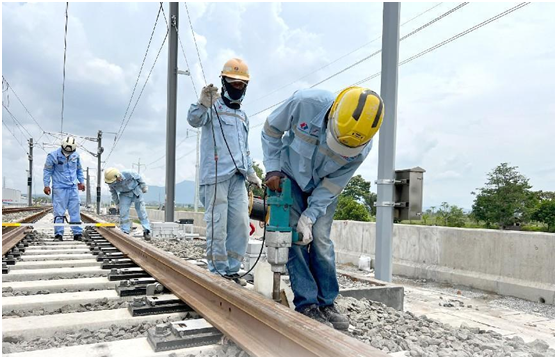
Veiled in drizzle, the Tegalluar station in Bandung, Indonesia’s West Java province, saw the first bullet train of the Jakarta-Bandung High Speed Railway (HSR) pull into itself a few days ago.
Several young men were livestreaming this moment outside the construction site. Apart from construction workers, these video content makers were the busiest people in the recent days.
Eko Azza was one of them. He started recording the construction progress of the Jakarta-Bandung HSR six months ago, and has so far uploaded over 380 relevant videos, with the most popular one receiving nearly a million views.
His videos clearly present the development of the major engineering project – the erection of piers, box girders being hoisted, the pavement of crossties and rail tracks …
These videos earned Azza a huge number of followers. There are people waiting for him to update and leaving comments on his page every day.
The Jakarta-Bandung HSR is the first high-speed railway in Southeast Asia. It has attracted huge attention from the Indonesian people and become one of the hottest topics on Indonesia’s social media platforms.
Painted in silver and red on the outside with the abstract pattern of Komodo dragon, the heaviest lizard species on Earth and a treasure of Indonesia, the carriages of the Jakarta-Bandung HSR are nicknamed “Red Komodo” on the internet.
Many Indonesian internet users have left comments on Azza’s page, saying they are proud that the first “Red Komodo”HSR of Southeast Asia is in Indonesia and they can’t wait to board it.
Friendship, which derives from close contact between the people, holds the key to sound state-to-state relations. The heated discussion over the “Red Komodo” fully mirrors the profound significance of the Jakarta-Bandung HSR. The railway not only shortens the trip between Jakarta and Bandung, but also brings closer the Chinese and Indonesian peoples. It reflects the strong appeal and cohesion of the Belt and Road Initiative (BRI).
China seeks not only its own development, and the BRI aims to achieve development that brings win-win outcomes to all countries that are willing to cooperate with China and finally realize harmony for the entire humanity.
It was during a state visit to Indonesia in 2013 that Chinese President Xi Jinping proposed to build the 21st Century Maritime Silk Road. The two countries jointly promoted synergy between China’s BRI and Indonesia’s “Global Maritime Fulcrum” Vision, pushed forward major cooperation projects such as the Jakarta-Bandung HSR, the Regional Comprehensive Economic Corridors and the “Two Countries, Twin Parks.” Together, they have set a good example of major developing countries seeking to strengthen themselves through win-win cooperation.
From the China-Laos Railway to the Jakarta-Bandung HSR, from the Port of Piraeus to the Haifa Port, and from the China-Pakistan Economic Corridor to the China-Indochina Peninsula Economic Corridor, the BRI has brought tangible benefits to participating countries over the past nine years and become a popular global public good.
Now, “Red Komodos” are standing by to welcome Indonesian passengers. This high-speed railway of win-win cooperation and long-term stability signifies the friendship between China and Indonesia. The two peoples will keep working together to build a more prosperous future.
Head-of-state diplomacy charts course ahead for China-U.S. relations
By Zhong Sheng, People’s Daily
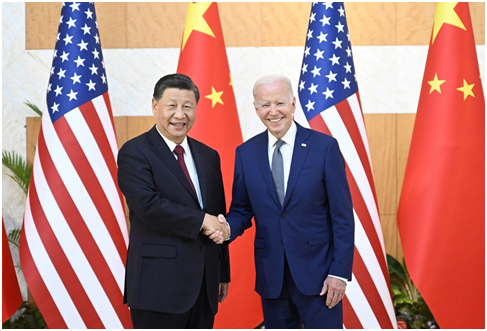
Chinese President Xi Jinping met with his U.S. counterpart Joe Biden in Bali, Indonesia, on Nov. 14, local time.
The two heads of state had an in-depth exchange of views on issues of strategic importance in China-U.S. relations and on major global and regional issues.
They highlighted the global significance of China-U.S. relations. Both stressed the importance of working out the guiding principles for China-U.S. relations. Both expressed the hope to put bilateral relations back on a steady and upward trajectory. They agreed to strengthen communication and exchanges, and advance practical cooperation. This has charted the course ahead for China-U.S. relations.
Head-of-state diplomacy is the compass and anchor of China-U.S. relations, and it plays an irreplaceable strategic role in guiding the growth of the relationship.
The meeting was very important. It featured three “firsts” for the two leaders – the first face-to-face meeting between Xi and his U.S. counterpart over the past three years, their first face-to-face summit since President Biden took office, and their first interaction after China and the U.S. completed their respective major domestic agendas this year. It was closely watched by the international community.
Their exchanges were comprehensive, profound, and candid, as well as constructive and of strategic importance. The meeting covered the most important aspects of the bilateral relations and the most pressing regional and global issues at the moment.
It has achieved the intended purpose of having in-depth communication, clarifying intentions, making clear where the red lines are, preventing conflicts, setting the direction, and exploring cooperation.
As two major countries, China and the U.S. should enhance their sense of responsibility when handling their relationship, which helps prevent China-U.S. relations from getting derailed or out of control and helps the two countries play their due roles in coping with global challenges.
The world is at a major inflection point in history. Countries need to both tackle unprecedented challenges and seize unprecedented opportunities. This is the larger context in which China and the U.S. should view and handle their relations.
Xi stressed that China and the U.S. need to have a sense of responsibility for history, for the world and for the people, explore the right way to get along with each other in the new era, put the relationship on the right course, and bring it back to the track of healthy and stable growth tothe benefit of the two countries and the world as a whole.
Biden said the U.S. and China have a shared responsibility to show the world that they can manage their differences, and avoid and prevent misunderstandings and misperceptions or fierce competition from veering into confrontation or conflict.
Both the history and reality of China-U.S. relations show that forming a correct perception of each other’s domestic and foreign policies and strategic intentions is a precondition for the two countries to handle their relations well.
The domestic and foreign policies of the Communist Party of China and the Chinese government are open and transparent, with clearly stated and transparent strategic intentions and great continuity and stability.
China is advancing the rejuvenation of the Chinese nation on all fronts through a Chinese path to modernization, which heralds bright prospects of development and brings opportunities to the rest of the world.
China remains firm in pursuing an independent foreign policy of peace. It is committed to safeguarding the international system with the United Nations at its core and the international order underpinned by international law. Adhering to peaceful development, open development and win-win development, the country will always contribute to the peaceful development of the world.
The U.S. regards China as “the most consequential strategic competitor” and “the most consequential geopolitical challenge.” It is a misperception of China-U.S. relations and a misunderstanding of China’s development. It will only mislead the two peoples and the international community.
It would be problematic if two major countries like China and the U.S. do not have overarching principled common understandings. Only with principles can there be a direction, and only with a direction can the two sides properly handle differences and expand cooperation. It is exactly out of this consideration that the Chinese side proposed that China and the U.S. should respect each other, coexist in peace, and pursue win-win cooperation, to ensure that their relations move forward on the right course without losing direction or speed, still less having a collision.
China always believes that China-U.S. relations should not be a zero-sum game where one side out-competes or thrives at the expense of the other. The successes of China and the U.S. are opportunities, not challenges, for each other. The world is big enough for the two countries to develop themselves and prosper together. Under the current circumstances, China and the U.S. share more, not less, common interests. It is in their mutual and fundamental interest to prevent conflict and confrontation and achieve peaceful coexistence. The two sides need to respect each other, pursue mutual benefit, focus on the larger picture, and nurture a sound atmosphere and stable relations for cooperation.
The U.S. side should put into practice the “five noes” (i.e., not seek a new Cold War; not seek to change China’s system; the revitalization of its alliances is not against China; not support “Taiwan independence”; not look for conflict with China) proposed by PresidentBiden, and fulfill its commitment not to seek decoupling from China, not to halt China’s economic development, and not to contain China.
As Xi said, observing the basic norms of international relations and the three Sino-U.S. joint communiques is vitally important for the two sides to manage differences and disagreements and prevent confrontation and conflict; indeed, it is the most important guardrail and safety net for China-U.S. relations.
The Taiwan question is at the very core of China’s core interests, the bedrock of the political foundation of China-U.S. relations, and the first red line that must not be crossed in China-U.S. relations.
Resolving the Taiwan question is a matter for the Chinese and China’s internal affair. China urges the U.S. side to match its words with action, abide by the one-China principle and the three China-U.S. joint communiques, fulfill its commitment of “not supporting ‘Taiwan independence'”, stop fudging and hollowing out the one-China policy, restrain and stop “Taiwan independence” separatist rhetoric and activities, and prevent the situation from moving to a point of no return.
On issues of democracy and human rights, and social systems and paths, China and the U.S. must respect each other and avoid ideological confrontation and bloc confrontation. It represents the trend of the times and the common aspiration of the international community.
China-U.S. economic and trade relations benefit both sides. Starting a trade war or a technology war, building walls and barriers, and pushing for decoupling and severing supply chains run counter to the principles of market economy and undermine international trade rules. Such attempts serve no one’s interests.
The Chinese nation has the proud tradition of standing up for itself. Any suppression and containment will only strengthen the will and boost the morale of the Chinese people.
China has its own principles and red lines that it has long upheld, and has legitimate and lawful interests that must be firmly protected. China will not yield to any acts of hegemonism or bullying.
Managing and stabilizing China-U.S. relations is an ongoing process to which there’s no end. The Bali meeting will not only provide important, practical guidance for China-U.S. relations at the current stage, but will also have a major and far-reaching impact on the relationship in the next stage and even beyond.
In accordance with the priorities identified by the two heads of state, the two teams will maintain dialogue and communication, manage tensions and differences, and advance exchanges and cooperation, so as to add positive energy and a safety valve to China-U.S. relations, and bring about stability and certainty to this turbulent and changing world.
(Zhong Sheng is a pen name often used by People’s Daily to express its views on foreign policy and international affairs.)
Entrepreneurial skills a viable career path, Dr Kamsi told Corp Members


In the face of the growing unemployment rate in the country especially among the youth demographic, Nigerian undergraduates have been enjoined to embrace entrepreneurship as a viable career option.
The lead consultant for the world bank sponsored (Youth enterprise with innovation in Nigeria) YouWIN Connect, Dr. Kamsi Oby Onyeuche,made the call at a one day capacity building workshop for the 2022 Batch C Corp members.
The program is a multi media based program of the Federal Government of Nigeria implemented by the Federal Ministry of Finance, Budget and National Planning. The objective of the training is to inspire, motivate and spur an entrepreneurial mindset within the youths. Trainings are carried out in NYSC Permanent Orientation Camps and tertiary instustutions all over the country.
Dr. Kamsi who tasked the Corp members to take advantage of the many opportunities government has put in place to help entrepreneurs, urged them to start small within the boundaries of their available resources.
While delivering a keynote lecture on the topic ‘What a would-be Entrepreneur should know before venturing into business’, Dr. Kamsi stated that a good vision is a vital guideline for achieving goals in business.
According to her, “to be successful in business, you need to solve a problem for somebody, to help them cope with something they are struggling with.
“The way to properly identify a business opportunity is to look for an unmet need. Are there enough people in that area or sector facing the same challenges to form a market for you? Can you profer a cost-effective/affordable solution to that challenge they have? Can you provide these solutions efficiently and effectively? If you can answer all the questions above, then you have a good business opportunity.
“Knowledge is the next thing you need. You need to know how to provide this solution. You also need a very solid business plan. Everybody thinks their idea is great until it is subjected to rigorous analysis. Somebody else needs to vet your ideas, probe/test it and say, ‘Yes, this is good’.
“We also trained graduate interns in the same World Bank sponsored Graduate Internship Scheme (GIS) on career development and employability skills. We’ve been doing the YouWIN trainings since 2016 till date. Every year we train at least 10,000 youths”, Dr. Kamsi stated.
The head of lecture Abia state NYSC camp,Mrs Gift Candid while thanking the team said the Enterprise Education for the youths is really needed at such a time as this.