#EndSARS: Give Room For Constructive Dialogue, Coalition Urges Protesters

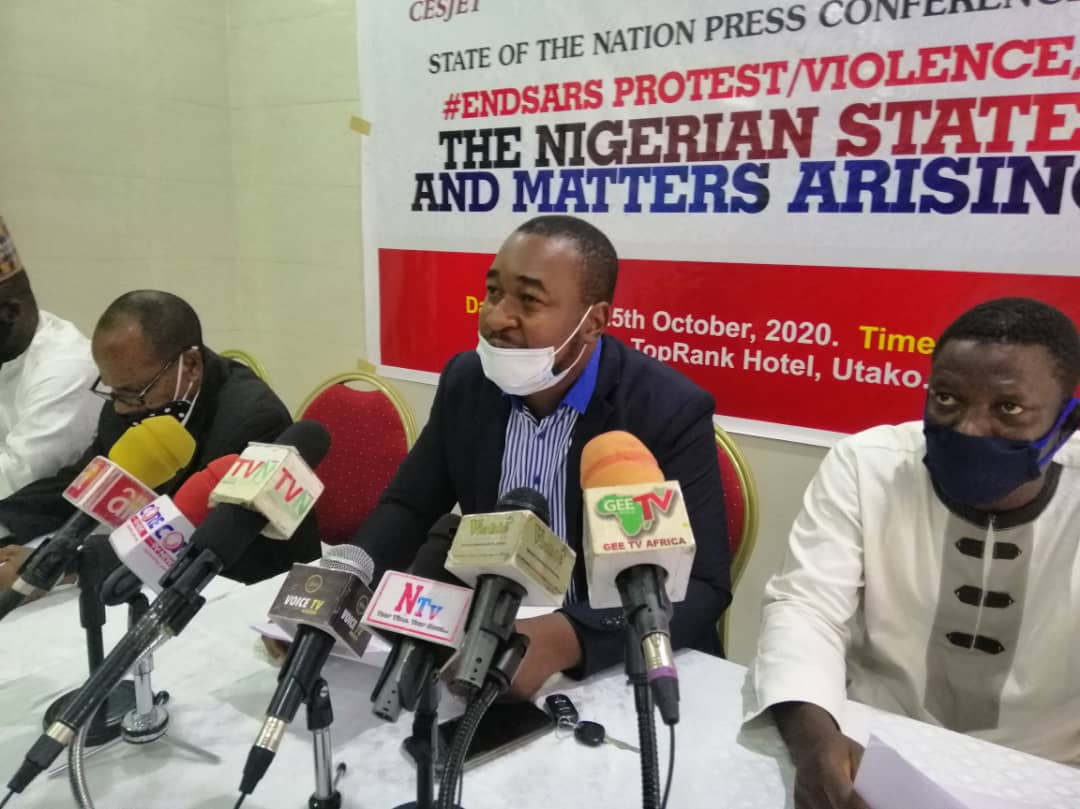
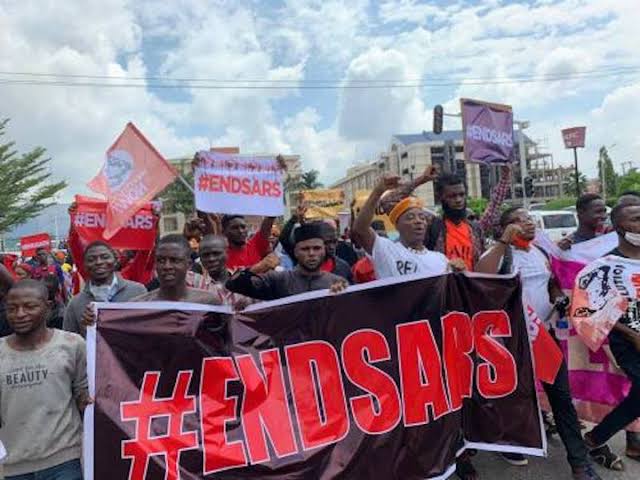
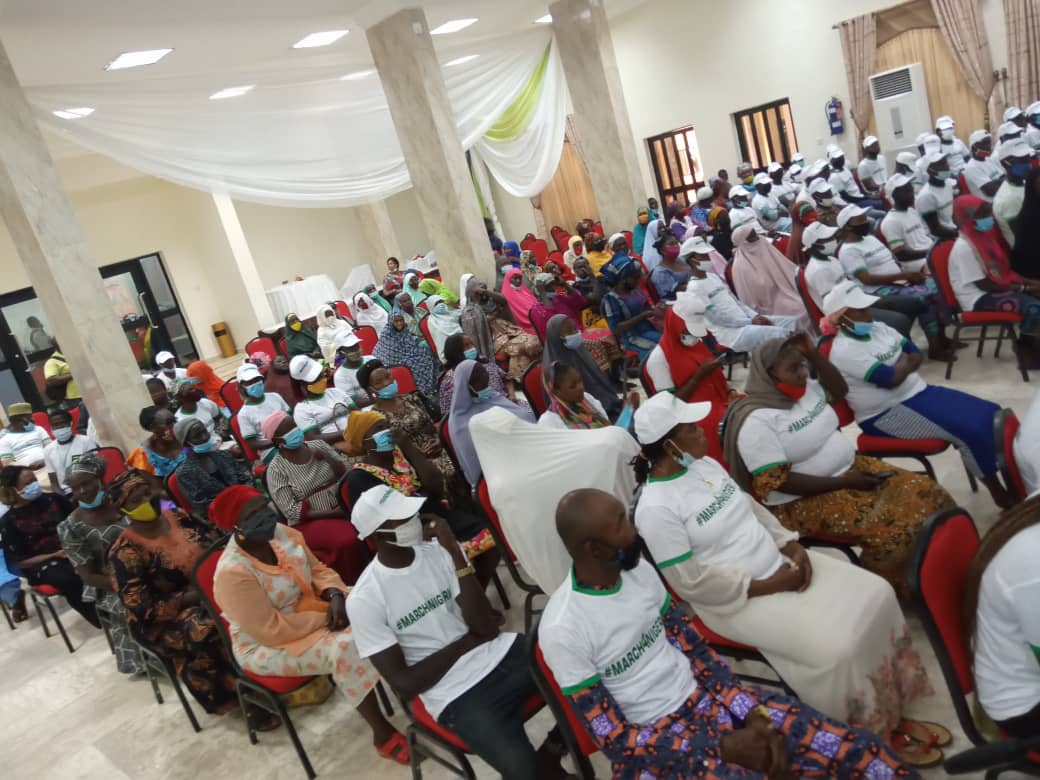
A Coalition of multiethnic groups in Nigeria has called on the Nigerian youths to halt the on-going protest and give peace a chance.

The group, under the umbrella body of the Nigeria Youth Organisation, NYO, at a press conference in Abuja, urged the protesters to be involved in constructive engagements with

the Nigeria Police Force and the Federal Government of Nigeria.

The group said President Muhammadu Buhari’s led Government is ready  to provide solution to the demands of the #ENDSARS protesters.

Ambassador Abdullahi Abubakar Wali, NYO President, who addressed the media on behalf of 19 other affiliates said it is worried that the protest may degenerate into anarchy.

”In particular, we the youth should rather open a window of dialogue with the office of the Attorney General of the Federation and minister of Justice, Mallam Abubalkar Malami, SAN, Inspector General of Police, IGP Muhammed Adamu and other well-meaning, political leaders and interested stakeholders in order to build trust, confidence and continuously engage the government, while we interface with our colleagues (youths).

”In the interim we shall be proposing to the Federal Government to establish as a matter of neccessity a  National Youth Development Commission, wherein all issues of, major concerns bedeviling the Nigerian youths shall be jointly addressed by all tiers of govemment.

”We hereby reiterate our views on the need for the 9th National Assembly to ensure the passage of the youth right bill, whereby the Nigerian youths are given voice as a panacea towards ensuring youths rights and privileges are protected with a view to providing an enabling environment for our youths to thrive and progress.

”We are using this opportunity, to put forward a fundamental solution to the inspector general of police on issues of demand for police reformation, with a mandate to establishing The Police and Youth Relation Committee (PYRC), wherein all fundamental demands and solutions to police brutality and corruption shall be addressed by the PYRC at all formations and units nationwide, after all POLICE IS OUR FRIEND.

”We further vehemently demand that the President Muhammadu Buhari’s led administration should capitalize and see these clarion calls by the Nigerian youths to improve on critical areas of youth unemployment, women empowerments and social welfare of her citizenry”.

The NYO also condemned the activities of bad eggs in the Nigeria Police who perpetrate brutality against innocent citizens adding that it welcomes necessary reforms that will bring about modern Policing with human face. 

”As national youth bodies, we acknowledge the genuine feelings of the youths over issues of unemployment. However, we implore the youths to take advantage of the ongoing programmes oo youth empowerment such as the Nigeria Youth Investment Fund (NYIF), established by President Muhammadu Buhari’s Administration.

”We implore all our youths to abate further protests, since the ongoing protests has been hijacked by perceived agent provocateurs and self centred elements, who are hell bent to run aground the fragile peace in the country.

”In particular, we the youth should rather open a window of dialogue with the office of the Attorney General of the Federation and minister of Justice, Mallam Abubalkar Malami, SAN, Inspector General of Police, IGP Muhammed Adamu and other well-meaning, political leaders and interested stakeholders in order to build trust, confidence and continuously engage the government, while we interface with our colleagues (youths)”, he said.

SARS: Between Gov Zulum and Hypocrisy

By Idoko Ainoko

Yesterday, it was reported that the Borno House of Assembly honoured the State Commander of the now disbanded Special Anti Robbery Squad, SARS, police unit, CSP Ibrahim Mohammed. The SARS Commander was honoured with a plague for what the House of Assembly said was for his gallantry in the fight against insurgency in the state.

Members of the Borno Assembly from reports gleaned, said they were impressed with the way the Commander and his team had on three different occasions, 13th, 14th  and 21st July, encountered the Boko Haram terrorists at Mainok in Kaga LGA,  Auno -Jakana- Damaturu road and on the  Maiduguri-Damaturu road and engaged the terrorists in fierce battles while recovering several arms from them.

It is a good thing that the people of Borno have started acknowledging the efforts of security agencies in fighting terrorism and honouring those who have put in efforts to secure the nation. In the past, they had, save for the occasional commendations, carried on as if such efforts don’t matter. 

But still, one cannot fail to notice the of hypocrisy in the so called honour given to the boss of the defunct SARS in Borno State. The honour coming at the time it did and the manner it was presented suggests there is more to the issue of the award than meets the eye. The first is the timing. Military operations have been going on in Borno State and other parts of the Northeast for more than 10 years, but no arm of the state government has deemed it fit to honour all the gallant men that have sacrificed their lives to ensure their safety until now.

Curious still, is the fact that the latest of all the three instances sited by the Borno House of  Assembly where it says the SARS encountered Boko Haram happened almost three months ago but the Borno Assembly which has been  in session all these days did not see the need to hoounur the police unit until a groundswell of opinion has been established  about their unprofessional conducts and protesters rose in their thousands and succeeded in getting the government to disband the outfit.

Another thing is that the SARS team has not been the only security agency operating in the Northeast that has done creditably well in securing the territorial integrity of the nation.
If the award does not have political undertone, other heads of agencies that have done well on fighting terrorism would have equally been honoured alongside the Commander of the defunct SARS.

It is well known that the Nigeria Armed Forces with all its components of the Army, Airforce and Navy have been engaged in military operations in the Northeast and have more than 300 instances of where it had either repelled, killed, captured or destroyed the camps of the terrorists. 

The military it was that entered Sambisa Forest and pummeled the base of the insurgents and they fled leaving their weapons and emblems which were recovered and presented to President Muhammadu Buhari. 
This year alone, between April and May, Nigerian troops, using both aerial and surface tactics killed over 3,000 of the insurgents, captured their weapons, arrested their top commanders and informants as well as rescued captives. But all these seem to have been lost on the Borno State Government. 

Added to that, the Borno State governor, Prof. Babagana Zulum had on two occasions being saved from harm by the military yet no arm of the state government has yet deemed it fit to honour the military for its efforts. 
Other agencies like the Nigeria Civil Defence Corps, NCDC, the Department of State Security Services, DSS, and many others have also made their contributions towards defending the territorial integrity of the nation as well, but at no time did the Borno State government considered them worthy of such an honour.

It would appear that since there is a nationwide protest against SARS and the Borno State Government had in the past used the unit to portray the military in bad light, all it wants to achieve by honouring the police unit is to downplay the sacrifice of the military and the other security agencies in Borno. 

Otherwise, it is difficult juxtaposing how the rescue of two soldiers by the SARS would be hyped and overblown over the many instances the military had equally rescued and defended policemen.

When the insurgents overran the Mobile Police Training Camp at Gwoza, Borno State, it was the military that went in and took it back; when the terrorists sacked the police barracks at Bama, it was equally the military that recaptured it. Yet no arm of the Borno State Government ever remembers that. Rather, the Borno State Government have done the contrary, by making disparaging remarks about military operations in the Northeast.

Under the administration of President Goodluck Jonathan, elders in Borno State outrightly demanded that troops be withdrawn from the state.
The current governor of Borno State, Prof. Babagana Zulum and other state government officials even made worse allegations on the military by accusing  the military of extorting money from motorists plying the Maiduguri- Damaturu road, accusing the military of abandoning their posts at Auno, when some travellers were killed on that route and also accusing  the military of being behind the attack on his convoy at a small town near Baga.

The  Borno State Commissioner for Information,  Alhaji Babakura Jatau, had at a time also accused the military of profiting from the war against insurgency. 

It is my view that since the Borno State Government or any of its agencies have  not been forthcoming in rewarding excellence, this so called honour might have been  aimed at mocking the Military. If not then what is the motivation for the award?

Since the SARS has been disbanded, the award cannot be said to be to encourage them to do more. Since the award is selective it is viewed as discriminatory on the other agencies.

Hence one cannot really fathom the motive for giving such an award at this time. More worrisome is the fact that this kind of selective treatment is capable of demoralizing the gallant troops, that have continued to make sacrifices in defence of the fatherland.
The Borno State Government and its agencies need to be more circumspect in handling issues related to security in the state. 

Ainoko is a public affairs analyst and wrote from Kaduna.

Anti-Banditry: Northern group scores Nigeria Army high

Following a three-month appraisal exercise, the Northern Patriots (NP) have passed a vote of confidence on the Nigerian Army, rating its Operation Sahel Sanity as a success. 

The Northern Patriots gave this commendation at a media interactive session on Thursday in Abuja. 

Presenting the report on behalf of the group, National President, Alhaji Nuruddeen Dodo said sanity has been restored to the Sahel since the introduction of the exercise. 

Launched in July, the operation was aimed to tackle banditry, kidnapping, cattle rustling and other crimes in the North-West and parts of North-Central. 

Barely two months after, Chief of Army Staff, Lt. Gen. Tukur Buratai extended the exercise to sustain the progress achieved within the period and enable troops to wipe out remnants of criminals from the zone.

In its report covering July 6 to October 10, 2020, the Northern Patriots said within a month of launching the operation, the people of the North-West witnessed a sigh of relief. 

The report revealed that thousands of people that ran away from their communities after the bandit attacks immediately returned home.

It added that troops eliminated a good number of armed bandits, recovering a large cache of arms and ammunition. 

The Northern Patriots, therefore, commended the COAS for extending the Operation Sahel Sanity to December as that will give it ample time to deal with the criminals in that region.

It, however, urged authorities to extend the exercise to other zones to sustain the successes achieved within the period.

Read the full report below:

Introduction:

You will recall that as military operations focused on Boko Haram and ISWAP terrorist activities in the Northeastern part of the country, there were pockets of disturbances in some parts of the country especially the Northwest and  Northcentral parts of Nigeria. 

Military operations in the Northeast became intense because the terrorists were killing people at random, abducting persons,  blowing up buildings to the extent that they were threatening the territorial integrity of the country.

As the military clamped down on the terrorists killing many of them and sending the remaining fleeing out of Nigeria, certain criminal elements thought they could take advantage of the situation to ply their heinous trade in other parts of the country. 

They assumed that since the Chief of Army Staff, Lt.Gen Tukur Yusuf Buratai had relocated to the Northeast and was dealing ruthlessly with the terrorists by leading troops from the front, other zones would be safe to terrorise and be visited with mayhem as they may be off the radar for the military. 

Within a short period, therefore, what started as hit and run attacks on distant and separate communities in the Northwest began to assume another dimension.

Criminal elements in no time invaded the spaces in the Northwest states of Katsina, Sokoto, Zamfara and Kaduna, moving up to the Northcentral state of Niger and began to terrorize communities in no less proportion than what Boko Haram was doing in the Northeast. 

Scores were being killed and abducted daily, entire villages were sacked, people were being abducted and abused, houses were touched and valuables forcefully were taken away.

These acts of criminalities stagnated economic growth as it crippled the agricultural, social and economic activities of the people of the region. 

Anarchy was fast descending in that part of the country despite other security arrangements in place.

When the bandits in a similar fashion, attacked several communities in Katsina and Sokoto States almost on the same day and killed hundreds of people which led to an explosion in the number of victims of terror attacks and several displaced persons in the country, the military realised that if it did not adopt a method that was beyond reactionary, Nigeria may soon have another problem of equal proportion with Boko Haram in the Northwest.

Operation SAHEL SANITY:

On the 6th of July 2020, the Chief of Army Staff, Lieutenant General Tukur Yusuf Buratai, flagged off Operation SAHEL SANITY in Katsina as part of activities of the Nigerian Army Day Celebration 2020.

The operation is meant to support Operation HADARIN DAJI in stemming the tides of the activities of armed bandits, cattle rustlers, kidnappers, incessant killings and other crimes in the North-West zone of the country. 

The Army Chief also flagged off military operation in Faskar, and explained that military operation, was meant to comprehensively tackle banditry and other crimes in the Northwest and parts of Northcentral to restore peace in the affected states and Nigeria.

He said the Nigerian Army will be conducting the operation with the support of other sister security agencies, including the police, the Department of State Services and the authorities of the affected states and to show the seriousness of the operation, launched the newly acquired 10 Mines Resistant Ambush Protected vehicles (M-RAP) as part of the military hardware for Operation SAHEL SANITY.

Appraisal:

Within a month of launching the operation, the people of the North-West Zone began to heave sighs of relief.

Thousands of people that ran away from their communities after bandit attacks, began to return.

Markets and hospitals closed at the height of the attacks began to reopen.

And people began to travel on roads leading to such communities thereby reconnecting them with the rest of the country. 

This is consequent on the success of the military operation launched by the Army Chief which overwhelmed the bandits. 

Before the end of July, The gallant troops of Operation SAHEL SANITY carried out series of clearance operations, ambushes and other aggressive and confidence-building patrols within Sokoto, Katsina and Zamfara States which led to the rescue of kidnapped victims, recovery of rustled cattle, the arrest of suspected armed bandits, the arrest of bandits informants and collaborators. 

The troops also recovered a large cache of arms and ammunition as well as motorcycles and other bandits logistics.

In less than a month, troops of the Operation SAHEL SANITY eliminated armed bandits, recovered 943 cows, 633 sheep/rams recovered; 33 suspected bandits arrested; 7 AK47 Rifles, 1 GPMG and 16 Dane guns captured.

The troops also rescued 17 kidnapped victims and arrested 14 bandits informants and collaborators. 

The troops did not stop at that but penetrated several bandits camps including the notorious Dangote Triangle and destroyed their logistics bases.

Troops also mounted sentry in areas hitherto occupied by bandits making it impossible for them to regroup or launch fresh attacks.

Our Position;

We, therefore, commend the Nigerian Army and other security agencies for their resilience, doggedness and braver which has led to the success of the operation. 

We also commend the Chief of Army Staff, Lt.Gen Buratai for the tactic he brought into the exercise by introducing the Super Camp Strategy which has produced results.

We commend the Nigerian Army for extending Operation Sahel Sanity to December as that will give it ample time to deal with the criminals in that region.

Our Recommendations;

Given the enormity of the problem in the Northwest, we believe the authorities must extend the coverage of the exercise to other zones especially the Northcentral to sustain the successes achieved within the period.

This will also enable troops to avert a situation where the criminals can overlap to cause havoc in other territories and ensure peace in all parts of the country.

We call also call on host communities of Zamfara and Katsina to continue to support and cooperate with the military especially in the area of information sharing and intelligence gathering.

Communities in the NNorthwestmust be ready to report criminal element in their midst while political leaders must step up their games to provide support for troops.  

We believe that if these measures are taken, the entire Northwest, Northcentral and Nigeria would be free from criminal activities as well as benefit more from the military operation. 

Nigerian Army as Bastion of Human Rights

By Abraham Ochayi

The recent events in the country have indeed brought to the fore some salient issues that have long been neglected by the generality of Nigerians. In my opinion, Nigerians didn’t take note of the renewed conduct of officers and soldiers of the Nigerian Army in the discharge of their duties, especially in the past five years. The emphasis has been on the activities of terrorist, militants and other non-state actors that have wreaked havoc in the polity.

In some quarters, it was also stated that the Nigerian Army is not living to expectations in addressing the spate of insecurity in the country, clearly forgetting that the interventions of the Nigerian Army in internal security operations is not a core responsibility, but an added responsibility and it was expected that the Army should have gone for the jugular, clearly forgetting that there are rules of engagement that must be adhered to in the enforcement of peace in the country.

That the Nigerian Army has lived up to expectations with regards to the respect for human rights of every Nigerian citizen is indeed commendable. This is where I give credit to the Chief of Army Staff, Lt. Gen. Tukur Buratai for this rare display of foresight. Come to think of it, if the Nigerian Army had been indiscriminate in its operations, I am sure the country would have gone up in flames because the Army is traditionally trained to kill. This is the starkness of the reality that we must come to terms and indeed appreciate the conduct of officers and soldiers in its civil-military relationship.

I must not fail to commend the Chief of Army Staff, Lt. Gen. Tukur Buratai. I won’t be wrong if I liken him to Nostradamus, the man who saw tomorrow that a day would come where the citizens would revolt against brutality by law enforcement officers. That the Nigerian Army established human rights desk in all its formations to investigate allegations of human rights abuses perpetrated by military personnel, and also work to strengthen the Army’s capacity to protect human rights and report annually on progress was essentially to avoid protests such as this.

According to available information, the concept note for the efforts of the Human Rights office is as a result of the increasing interest of local and international Human Rights organizations and institutions in the Nigerian Army human relations footprints but specifically in areas of operations in North East.

The strategic importance of this action cannot be overemphasized in the sense that it has proven to be that effective tool towards keeping the officers and soldiers of the Nigerian Army under check in the discharge of their duties. While it is understandable that Nigerians have not come to terms with this initiative, it can’t take away the fact that the leadership of the Nigerian Army has indeed displayed an unalloyed commitment towards the protection and preservation of human rights in its operations.

This is indeed a masterstroke that should elicit commendation from all concerned stakeholders in Nigeria because if not for anything, it indeed kept officers and soldiers of the Nigerian Army in check in the discharge of their duties and significantly reduced incidences of human rights abuses and brutality that has become the focus of the recent protests across the country.

It is thus my considered opinion that indeed the Chief of Army Staff. Lt. Gen. Tukur Buratai saw tomorrow and did all within means to ensure that officers and soldiers of the Nigerian Army do not abuse the rights of citizens of the country even in the face of provocation. I am glad; if not for anything, the Nigerian Army has evolved into a professional force that is conscious of the rules of engagement in warfare in line with the International Humanitarian Law. The Nigerian Army is regularly liaising and facilitating interaction with the human rights organizations to strengthen its capacity at promoting human rights; and as well as developing a network of contacts of human rights offices in Nigeria. This is also commendable.

Lt. Gen. Tukur Buratai has indeed set worthy examples that ought to be emulated by the bulk of those occupying positions of authority in the country. This is indeed a product of critical thoughts that centres on the dynamics of a plural country like Nigeria. The conduct of officers and soldiers of the Nigerian Army has also given hope to the ordinary man and woman on the streets and entrenched a regime of transparency and accountability.

Some would say in the Nigerian Army that the fear of Buratai is the beginning of wisdom. This is not because he is fierce-looking, but the fact that he has enthroned a regime of respect for the rule of law and conformity to the rules of engagement in the prosecution of the war against terrorism and other acts of criminalities in the country.

When one makes some comparison with what the Nigerian Army was before 2015, it would indeed be realized that a lot has changed and all thanks to the proactive leadership provided by the Chief of Army Staff, Lt. Gen Tukur Buratai in repositioning the Nigerian Army for greater effectiveness. The flagrant disregard for the rule of law is now a thing of the past as far as the operations of the Nigerian Army is concerned. Officers and soldiers of the Nigerian Army are constantly reminded that there are consequences for their actions should they go overboard and violate the rights of citizens. You also hardly find military personnel engaged in acts of oppression, extortion or harassment. That used to be the case in times past, but not under the leadership of Lt. Gen. Tukur Buratai.

It is on this premise that I have long advocated that indeed the challenge with Nigeria is that of credible leadership and nothing more. The Tukur Buratai example is indeed demonstrative of a commitment to set Nigeria on the path of greatness’ consequently; it won’t be out of place if Lt Gen. Tukur Buratai is regarded as a leader with foresight and a lesson in history.

Leadership in Nigeria must tow this example for Nigeria to sustain its present drive towards sustainable development. We must also be reminded that indeed for Nigeria to make progress, our crop of leaders must think strategically and outside the box. The Lt. Gen. Tukur Buratai example says it all and should serve as a reference point in leadership in Nigeria.

Ochai wrote this piece from Ibadan.

Boko Haram: Group condemns calls to redeploy defunct SARS to Borno

The Arewa Citizens for Peace (ACP) has condemned the call for the redeployment of operatives of the defunct Special Anti-Robbery Squad (SARS) to the North-East to fight Boko Haram terrorists, describing it as “misplaced, senseless and capable of throwing the country into turmoil”. 

While welcoming the disbandment of the anti-robbery unit of the Police, the ACP noted that such a move is capable of worsening the security situation in the country.

Inspector-General of Police, Mohammed Adamu, had on Tuesday, announced the creation of Special Weapons and Tactics (SWAT) Team to replace the SARS unit. 

The IGP assured that operatives of the defunct anti-robbery squad will not be part of the new formation as they will be redeployed into mainstream policing duties.

Some Nigerians, though, have maintained that the officers be sent to the North-East. 

However, in a statement signed by its National President, Comrade Nazir Ibrahim, on Wednesday, the Arewa group said SARS operatives were not trained for warfare and if deployed may ultimately turn against Nigerians they are supposed to protect. 

“The Arewa Citizens for Peace (ACP) is pleased with the dissolution of the erstwhile Special Anti-Robbery Squad (SARS) across the country over the high handedness and right abuses by the policemen that operated under the squad. We are however appalled by the misguided calls for deploying the personnel of the defunct SARS to fight Boko Haram in the northeast of the country,” Comrade Ibrahim said. 

“It is our view that the calls are misplaced, senseless and capable of throwing the country into turmoil by further worsening the security situation that has so far been creatively managed in the face of the diverse factors militating against peace and security in Nigeria. Those came up with the har-brained idea failed to properly evaluate the situation. The calls by some disgruntled individuals and elements are therefore totally misplaced, unacceptable and in bad light. 

“They failed to realize that the SARS operatives were not trained in warfare but in policing with specific focus on taking on armed robbers and violent crime, an assignment they failed in and rather diverted to exploiting the youth under the guise of going after cyber criminals. Deploying these same persons to fight Boko Haram will see them again turn their weapons on the Nigerians they are paid to protect. Even the Counter-Terrorism Unit (CTU) of the Nigeria Police Force has not been deployed to fight Boko Haram in the north east so there is no point sending in personnel that have been relieved of their assignment in disgrace.

“ACP is worried that those making these calls have forgotten so soon that the Nigerian Army would not have been deployed to clean up the mess created in some parts of the country owing to the failure of civil policing that SARS was part of. Had SARS been able to deal with the problem of banditry, killer herdsmen and kidnappers as envisaged for its role then the Army would not have been stretched thin by deploying to areas that have these violent crimes.

“While sending the ex-SARS operatives, as damaged goods, to die at the hands of Boko Haram may appear like an attractive or workable option, the potential downsides are too high and they pose risks that the country can ill afford”. 

According to the ACP, the intensity of the battles waged by the Army against Boko Haram in the North-East is such that operatives of the defunct SARS will simply desert if they were assigned to fight the anti-terrorism war. 

It reasoned that since these operatives will flee the battleground with their weapons and would be unable to return to their organizations, Nigeria will be flooded with armed and trained killers who will end up becoming the new criminals that the system must deal with.

Ibrahim added: “Even in instances where the military handed liberated areas to the Police to resume normal civil policing, the areas usually get infested with Boko Haram in the shortest time possible even with the defunct SARS being active at those times. There is therefore more than enough evidence to prove that there is no unit of the police that is well suited for fighting Boko Haram terrorists. 

“We restate that the genuine concerns raised by all Nigerians for enduring reforms in the Nigeria Police Force should not be trivialized or converted into a farce by throwing up puerile suggestions like asking the rested SARS operative be drafted to fight Boko Haram. We believe there should be an independent panel of inquiry that hear testimonies of those that have documented instances of SARS abuse and brutality so that culpable operatives of the disgraceful institution would be held to account. This would go a long way in bringing closure to individuals and families while also serving as a warning to law enforcement agents that their position should not be abused”

The ACP, however, urged the Nigerian Army to continue excelling at what it does and not be drawn into the distraction constituted by these calls for the posting of the personnel of the defunct SARS to any part of north-east, especially Borno State in the name of fighting insurgency.

The group warned those behind the ill-informed call to desist from such going forward.

General Buratai and his golden principle on war

By Thomas Uzah PhD 

Sometime in June 2015, barely 10 days after the inauguration of President Muhammadu Buhari as Nigeria’s democratically elected leader, a BBC Africa Security Correspondent, published an analysis, captioned; “Will moving Army to Maiduguri help Nigeria against Boko Haram?” The report captured President Buhari’s earliest decisions and actions in office to stymie the raging and devastating Boko Haram insurgency in the country.

Though the analysis encapsulated different conditions of the subsisting insecurities in Nigeria, a phrase was catchy. He wrote about the Service Chiefs perception and response to the Presidential order to relocate the Military Command and Control Centre from Abuja to the Northeast, the hotbed of the insurgency. President Buhari issued the order to centralize operations nearer the heart of the insurgency, ease bureaucratic bottlenecks and speedy decision-making on the field combats.

But some Military Chiefs loathed this directive. They preferred the comfort of cosy offices in Abuja, then shadow anywhere near the theatre of war. Therefore, they were hesitant, silently grumbled and clandestinely remonstrate. Eventually, though, they bowed to the supremacy of Military creeds, as the BBC report later exposed.  

The catchy phrase in the report chanted defiantly on the relocation of Military Command and Control Centre to the Northeast epicentre of Boko Haram terrorism stated; “However,  the new strategy has not gone down well with some top military men, who view it as a symbolic, populist move by President Buhari, attempting to set himself apart from the previous administration under Goodluck Jonathan.”

Time explains seemingly complex mysteries. The phrase made it abundantly clear the phobia of some senior military officers under the previous administration in leading troops to dismantle the dreaded Sambisa Forest, Boko Haram’s most secured fortress. It was a forest where insurgents hid and persistently emerged to bloodily strike the heart of Borno State and other parts of the Northeast.

Formerly, Sambisa was Boko Haram’s centre for training recruits. It served as a venue for plotting their heinous atrocities and recuperation ground after strikes of violence on communities and villages. Boko Haram’s factional leader, Abubakar Shekau and top commanders of the sect had their most vaulted “mansion,” in the forest’s “Camp Zairo.” Some refer to it as Camp Zero from where they easily coordinated their atrocious acts. The natives called Camp Zairo “Sabil Hida”, meaning the “righteous place,” but insurgents renamed it after they annexed it.

However, the face of the counter-insurgency operations changed with the arrival of Gen. Tukur Yusuf Buratai, as Chief of Army Staff (COAS) and ombudsman of the anti-insurgency operations. He started commanding the battle from the front and not the back seat, very fruitfully and rewardingly. The crack Infantry Combatant never faltered nor dreaded the trenches or waterfront any day. Even the ambush and attack on his convoy by Boko Haram terrorists didn’t scare or dissuade him.

Gen. Buratai studied the minutiae of the insurgency and discovered a huge concentration of terrorists in Sambisa. He vowed they must not be allowed to possess the forest and then planned several months to capture it. 

And when Gen. Buratai and other Commanders led troops to strike in December 2016, Shekau, his top commanders and foot soldiers sheltered in this enclave were massively dislodged. Some insurgents met their waterloo in the encounter with troops; while a few others escaped, including the factional terror leader.

But from the historic capture of the Sambisa Forest on December 22, 2016, Gen. Buratai brought back to Abuja relics of the demystification, penetration of Camp Zairo and subjugation of Shekau’s empire. The Shekau’s personal effects obtained by the Army were a copy of the Holy Quran and Boko Haram jihadi flag among others.

However, the battle to free Sambisa Forest and entrapped communities in the area had just started. It was clear Boko Haram insurgents were pained to lose their fortified fortress of shelter. Being a vast forest, the insurgents again regrouped and reoccupied other parts. In his customary fashion, Shekau sneaked and reoccupied Camp Zairo from where he organized his foot soldiers to launch pockets of attacks on obscure communities.

Regardless, Gen. Buratai never flinched. Throughout 2017, the leader of counter-insurgency operations turned the Northeast into his permanent home and intensified clearance operations in enclaves within Sambisa Forest to flush out remnants of insurgents.        

Gen. Buratai eventually pulled down the final walls of the forest; cleared all the areas re-possessed by insurgents, confiscated their weapons, again dislodged Abubakar Shekau from Camp Zairo and recaptured it by end of 2017. The second military raids on Sambisa were more deadly on terrorists. 

In a video later released, the factional Boko Haram leader confessed to suffering heavy casualties and expressed frustration with the war, preferring to die than live. Still hotly trailed by troops, Shekau disguised into a woman, dressed in hijab and sneaked out of the Northeast. He remained in the cooler and silent for months.

At the start of January 2018, Gen. Buratai sojourned back to Sambisa on an operational thank-you visit to troops and to convey the President’s appreciation to soldiers stationed in different locations of the forest who performed the feat.

The helicopter conveying the COAS from Maiduguri first landed in Bitta village, a small settlement in Sambisa. Thereafter, he proceeded to Tokumbere and then, drove in an MRAP vehicle with his team to  Camp Zairo. He arrived at the spot by 4:15 pm. There, Gen. Buratai was conducted round the Battle Groups 1 and 2 locations and addressed troops. He also inspected the armoured fighting vehicles and equipment captured from Boko Haram terrorists.

It was right inside the darkest belly of Camp Zairo that Gen. Buratai issued the order to troops on the capture of the escapee factional leader of Boko Haram, Abubakar Shekau “red-handed.”  “We must move across wherever this criminal is to catch him red-handed. I want you to get him by hand,” he said. 

The display of courage by Gen. Buratai was confounding. Those naturally passionate about the Army fear or dread nothing. They are not scared by the possibility of death or quake at the prospects of danger. The COAS embodies these virtues in abundance. He is more excited in the trenches than swirling on a chair in an air-conditioned office.

This can be gleaned from an axiom in the interview he granted reporters while in Camp Zairo;   “I see all operations in the field as adventurously, a thunderous conquest of the enemy. I always want to explore new tactics, new manoeuvres and approaches to achieving tactical and operational objectives. Fighting wars should be seen as fun with serious, bold, decisive and aggressive approaches to dealing with the adversaries in an unconventional military environment. It is what excites me deeply.”

No wonder, Gen. Buratai is infinitely irritated when a soldier becomes hysteric at the sight of the battle. Not long ago, at the workshop on Transformational Leaders in Abuja,  the COAS voiced a directive to all commanders to flush out lazy soldiers as  “The NA will do all that is necessary to fish out any bad eggs whose willingness to lead or follow as required has waned…Transformational leaders should not wait for them to get out of the way, you must kick them out of your way.” 

Dr Uzah is head of department, Mass Communication, Kwararafa University Wukari.

Northern Borno: Group blames poor infrastructure for Boko Haram attacks, presence

A special rapporteur has blamed poor infrastructure for the continous presence of Boko Haram terrorits in northern Borno and recent attacks on the convoy of Governor Babagana Zulum.  

Professor Philip Daheeda of the Department of Public Administration, University of Abuja, made this revelation in a detailed report on behalf of the Save Humanity Advocacy Centre (SHAC). 

Daheeda said it uncovered the actual circumstances surrounding the attack after leading the SHAC together with other credible non-governmental organizations and civil society organizations on a fact-finding mission to Northern Borno. 

Speaking at a press conference on Tuesday in Abuja, Prof. Daheeda said the troops have made substantive progress in the north of Borno, particularly the Kukawa/Baga axis once regarded as the epicentre of the Boko Haram insurgency due to its proximity to the Lake Chad Basin.  

He further disclosed that the radical sect has been significantly incapacitated and have now turned to guerrilla tactics, planting Improvised Explosive Devices (IED) on routes frequently used by IDPs returning to their communities. 

Daheeda, however, admitted that the poor state of roads has made it possible for the terrorists to plant the IEDs, plan attacks and unleash mayhem on citizens, such as the governor.

The special rapporteur, therefore, urged the state government to compliments the efforts of the military through the provision of necessary infrastructures such as road constructions, provision of electricity and other facilities that would aid their operations.

Read the full report below:

Introduction:

In light of the recent attacks on the convoy of the Governor of Borno State in Northern Borno state, the Save Humanity Advocacy Centre (SHAC) in collaboration with some credible Non-Governmental Organizations as well as some Civil Society Organizations commissioned an investigative panel to unravel the circumstances that led to the attacks to put issues in proper perspectives.  

The investigative panel consisted of a special rapporteur and other representatives with a mandate to physically visit Borno State and collate information on a first-hand basis. The core area of assignment includes but not limited to close interaction with citizens in Borno state, stakeholders, state actors and the media on the activities of the Boko Haram insurgents in Northern Borno state.

The investigative panel consequently visited Northern Borno, especially the Kukawa/Baga axis where it was alleged that the attacks on the convoy of the governor took place.

The findings from the investigative visit are reproduced after extensive scrutiny of the facts presented through a multiple channel mechanism put in place to ensure objectivity and accuracy in fulfilment of its overarching objective.

The Issues:

The governor of Borno State, Babagana Zulum in its efforts at assessing the relocation of Internally Displaced Persons back to their communities have been visiting liberated communities in various parts of Borno state. On a couple of occasions in recent times, the convoy of the governor was attacked, which indeed ignited rounds of commentary in the country with regards to the efforts of the Nigerian Military in its efforts towards ridding Borno State of Boko Haram elements, especially in Northern Borno state.

There were also allegations that indeed the Nigerian Military have not done enough to investigate the various incidences where the governors’ convoy was attacked thereby fueling the suspicion that the Nigerian Military was complicit in the whole saga.

The investigative panel as a result of the aforementioned undertook a trip to Baga and environs, wherein extensive consultations and interactions were made with all stakeholders in the theatre of operations.

Findings:

The investigative panel was able to glean on the first-hand basis that indeed the narrative making the rounds in the media with regards to the attacks on the convoy of the governor is in contrast with the events surrounding the attack on the convoy of the governor.

It was clear from all that was gathered that the Nigerian Military has made substantial gains in addressing the Boko Haram threats in Borno state as a whole, and specifically in the Kukawa/Baga axis which is regarded as the epicentre of the Boko Haram insurgency due to its proximity to the Lake Chad Basin region where Nigeria shares boundaries with Chad and some francophone counties.  

This fact was enforced with a strong presence of security operatives which were seen on constant patrol of the region and making advancement towards the fringes of the Lake Chad Basin region where it is believed houses a seizable number of Boko Haram insurgents after their displacement from their operational headquarters in Sambisa forest, as well as other areas in North-East Nigeria where they hitherto held sway.  

It is indeed a statement of the fact that the Boko Haram group has significantly been incapacitated and they have consequently employed the use of guerrilla tactics that involve the planting of Improvised Explosive Devices (IED) on routes frequently used by IDPs returning to their communities as against their known strategy of engaging the Nigerian Military in exchanges of gunfire.

This new plot by the Boko Haram insurgents was indeed responsible for the attack on the convoy of the governor and not a confrontation with security operatives in the convoy of the governor. This much was also confirmed by on the spot assessment of the areas where the governor’s convoy was attacked. There were visible signs of craters that came about as a result of the impact of the IEDs detonated. It was stated further that as a result of such explosions, the security operatives in the convoy of the governor returned gunfire in various directions as a reflex action.

There was also an absence of infrastructures in Kukawa/Baga axis as virtually all roads were impassible due to years of neglect which inturn emboldened the Boko Haram insurgents to freely plant IEDs as they made their way towards the fringes of the Lake Chad Basin region.

It was also revealed that the state of the roads indeed enhanced terrorist activities in Northern Borno as a whole where pockets of Boko Haram activities still thrives. There was also a dearth of other infrastructures such as communication masts, electricity water and other necessities in most parts of Northern Borno state, which the Boko Haram group has taken advantage of in the furtherance of their nefarious activities.

The investigative panel also discovered that the bulk of the casualties recorded during the attacks on the governors’ convoy were mainly as a result of IED explosions and not gunshot injuries as widely reported in the media. And the bad road network in Baga and environs is indeed responsible for the casually figures as commuting the injured to the nearest medical facility was as well daunting the number of deaths recorded.

Conclusion:

The efforts of the Nigerian Military in addressing the Boko Haram threats in Northern Borno state cannot be overemphasized. The Boko Haram group have significantly been degraded with the Military constantly on their trail into the fringes of the Lake Chad Basin region.

It must be noted that the terrain in the Kukawa/Baga axis is impassible, thereby making some of the operations of the Nigerian Military difficult. However, there seems to a collective resolve by the officers and soldiers in the theatre of operations to bring the activities of the remnants of the Boko Haram insurgents to an end as soon as possible. This much was gathered from interactions with officers and soldiers in the theatre of operations, especially in Doron Baga.

Recommendations:

It is therefore reasonable that the state government compliments the efforts of the Nigerian Military through the provision of necessary infrastructures such as road constructions, provision of electricity and other facilities that would aid the operations of the Nigerian Military.

The state government also has a responsibility to the task to various stakeholders in Borno state and Northern Borno to be precise on the need to galvanize support for the operations of the Nigerian Military in the quest to rid Northern Borno of the activities of Boko Haram insurgents.

IPOB and the rest of us

By Charles Ibekwe

The activities of the Indigenous People of Biafra have generated some controversies in recent times, and this has led to scores of deaths that if care is not taken might escalate into an unimaginable proportion. IPOB, as it is fondly called, is not new to such controversies. As a fact, IPOB has thrived on disputes that often times not leads to the escalation of violence in South-East Nigeria and other parts of the country. And the recent happenings in South-East Nigeria occasioned by the systematic escalation of killings led by IPOB indeed calls for concern.

I have long stated in numerous forums that the activities of IPOB might sooner or later escalate into a monster that would ultimately consume South-East Nigeria if the relevant authorities do not take urgent and proactive steps towards address this challenge. I did specify at the national level for the simple fact that some governors of states in South East seem to be concerned about their political relevance that they have elected to turn a blind eye to the nefarious activities of IPOB.

The reason is simple. They do not want to be seen as anti-Igbo, which by and large, would affect their political fortunes. For them, it makes more sense, politically and economically, than protecting the interest of the commoners who would ultimately bear the brunt if things get out of control.

That IPOB is waiting to assume a more dangerous dimension is an understatement. That IPOB would also be the albatross of the Igbos in the buildup to the 2023 general elections is also an understatement. The indices are clear, and the pointers are also indicative that South-East Nigeria would experience a situation that would be worse than the Boko Haram crisis in North-East Nigeria.

I am sad that if not for anything that the activities of IPOB is gathering momentum and the political leaders in South East have not seen the need to make strategic interventions that would protect and preserve the relative peace and tranquillity in the region. Instead, they are playing to the gallery. For example, I find it worrisome that IPOB would issue a sit-at-home order in all parts of South East. Whether it was successful or not, remains another topic for discussion. But the fact that there was a display of such effrontery leaves more to be imagined.

I stand to be corrected. I am not aware if there was a counter-order to that order issued by IPOB whether from the political elites or the traditional institutions in Igbo land. What does this tell us? Your guess is as good as mine.

Those that still think that IPOB does not have ulterior motives in South-East Nigeria ought to have a rethink and come to terms with the starkness of the reality that the activities IPOB has posed to not just the entrenchment of democracy in the region, and also the socio-economic wellbeing of the Igbo people as a whole.

Ironically this is what is playing out in South East, and we have not deemed it necessary to speak in one voice in total condemnation of its nefarious activities. As they say, all politics is local, as well as happiness is also local. The implication of the above is that should the Igbos elect to turn a blind eye to the gradual disintegration of the South East by the activities of IPOB, then we would have ourselves to blame.

This is also instructive when we view critically how the Boko Haram insurgent group evolved and destabilized the North East region in Nigeria in the past ten years. Boko Haram was not imported into the North East, it was a creation of the North East, and it eventually succeeded in causing the destruction of lives and properties in unimaginable quantum. With due respect, the political authorities didn’t act when they were supposed to and today what is being experienced in the region is as a result of that inaction.

I am not convinced that the South East region can cope should IPOB translate into a monster like the Boko Haram group. Some would say that there is no basis for comparison, but that in my opinion is a gross and inept thought line which would ultimately consume us as a people. I am not convinced we need a soothsayer to tell us that should IPOB allowed to thrive unabated; the South East region would be doomed.

Today, IPOB is posturing as an organization for the interest of the Igbos. Tomorrow it would turn its fangs to the very people it claims to be protecting their interest when push comes to shove, and the chicken would come home to roost.

The activities of IPOB must be addressed adequately in the interest of peace in the South East region, which is arguably the most peaceful part of the country. It consequently behoves on all well-meaning Igbo sons and daughters to do all within their means to ensure that IPOB does not cause a crisis of unimaginable proportion in South East.

We must also realize that indeed we would bear the brunt and we would all have ourselves to blame. It thus remains my firm conviction that indeed IPOB has something sinister up its sleeves, and it is not in the best interest of the South East region. Indeed the time to speak is now. For if we don’t and allow Nnamdi Kanu to get away with this great disservice to the Igbos, posterity won’t be kind to us. It is hoped that this piece would elicit the much-needed reawakening of the true Igbo spirit in all of us in the preservation of peace in South-East Nigeria. This is my two cents.

Ibekwe is a public affairs analyst and wrote from Enugu.

APC makes case for breast-feeding, extended maternity leave

States controlled by the All Progressives Congress (APC) have proposed to implement six months maternity leave as well as exclusive breastfeeding in a move to promote a framework for promoting child nutrition.

The proposal was contained in a communique issued Thursday in Abuja at the end of a virtual meeting of Secretaries to State Governments of APC-controlled states held under the auspices of the Progressive Governors’ Forum (PGF).

The meeting which had as its theme, ‘Developing Common Policy Initiatives on Maternal & Child Nutrition Promotion in APC States’, had the overarching objective of identifying salient and common initiatives of Maternal and Child Nutrition that can be replicated across all the APC-controlled States.

Co-Chairman of PGF Governance Programme Steering Committee, governor Simon Bako Lalong of Plateau state declared the meeting open, while governor Mohammed Abubakar Badaru of Jigawa state, declared it close.

In the communique signed by Alhaji Adamu Fanini and Prof. Danladi Atu, SSGs of Jigawa and Plateau states respectively, participants said “in view of the importance of parental support for children at birth and the health of the nursing parents, the meeting recommended that APC controlled states should prioritise implementation of 180 days (6 months) maternity leave for women.

“The meeting observed the importance of exclusive breastfeeding to the growth and general health of a child and therefore recommended that APC controlled states should encourage and support women to practice six months exclusive breastfeeding for children from birth.”

The meeting equally noted the importance of information and how it affects the attitudes of citizens towards issues of nutrition. It therefore urged APC-controlled states to design a special communication strategy to raise public awareness on malnutrition and its consequences.

“The meeting observed that there is no institutional framework for the implementation of programmes on food and nutrition in some states and therefore resolved that APC controlled states should set up State Committees on Food and Nutrition to relate with all FG programmes on Food and Nutrition and coordinate PGF’s implementation framework on child Nutrition in APC controlled state.

“The meeting equally encouraged each APC controlled state to continually give Status Report on what currently obtains in their state with a view to creating a template that reflects the current status of each APC state on Child Nutrition and each SGS should nominate the focal person for their state to relate with the PGF Secretariat on the implementation”, the communique stated further.

The meeting also adopted the PGF Secretariat’s proposal for follow up meetings with Commissioners of Health, Education and Agriculture of APC controlled States in order to develop sectoral work plans for the implementation of the approved framework on “Promoting Child Nutrition in APC states, Challenges and Opportunities for Action.”

The meeting held following the Progressive Governors’ approval of the framework which was recommended by the 9th Meeting of Secretaries to Governments of APC Controlled States held in April 2020.

The meeting had reviewed the current status of child and maternal nutrition in APC states and considered implementation proposal by the PGF Secretariat.

Participants therefore agreed to continually share information, ideas and knowledge through its quarterly meetings and the PGF Secretariat to promote synergy across member-States and facilitate greater cooperation for uniform or common policy initiatives geared towards sustainable development.

Aniocha North Killings: FG Charges Seven For Alleged Terrorism

The Federal government has filed criminal charges against seven persons alleged to have been involved in the 2017 killing of indigenes of Idumuje-Ugboko Community of Aniocha North Local Government Area of Delta State.

The seven accused persons were said to have connived with others now at large within and outside ldumuje-Ugboko Community, Aniocha North Local Government Area of Delta State, to unleash terror on the community by burning Houses and unlawfully attacked and killed of an innocent Nigerian within the community which constitute acts of terrorism.

Those charged before the court in charge number FHC/ABJ/CR/11/19, are Nwochie Agiliga Light, Aikhomo Omezi, Okey Ifejoku, Godwin Akaba Aniemeke,
Nonso Omefe, Dennis Nwoko and Emeka Bidoku.

The accused persons were said to have committed the offence between 18th and 25th of May 2017.

When the case came up this morning, proceedings could not go on because of the absence of the presiding judge, Justice Okon Abang.

In the document attached to the charge, 14 witnesses are expected to give evidence during the trial.

The three count charge filed by Mr. Shuaibu Labaran, an Assistąnt Chief State Counsel read, ”That you, Nwochie Agiliga Light, Aikhomo Omezi, Okey Ifejoku, Godvwin Akaba Aniemeke, Nonso Omefe, Dennis Nwoko Alias Uwadiegwu And Emeka Bidoku Alias Onyeboundle of ldumuje-Ugboko Community, Aniocha North L.ocal Government Area of Delta State between the 18th and 25th of iMay 2017 at ldumuie-Ugboko Community, Aniocha North Local Government Area of Delta State within the jurisdiction of this Honourable Court did conspire with others still at large to commit acts of terrorism. You thereby committed an offence punishable under section 17 of the Terrorism (Prevention) (Amendment) Act 2013.

COUNT TWO

That you, Nwochie Agiliga Light, Aikhomo Omezi, Okey Ifejoku, Godvwin Akaba Aniemeke, Nonso Omefe, Dennis Nwoko Alias Uwadiegwu And Emeka Bidoku Alias Onyeboundle of ldumuje-Ugboko Community, Aniocha North Local Government Area of Delta State between the 18th and 25th of May 2017/ at Idumuje-Ugboko Community, Aniocha North Local Government Area of Delta State within the jurisdiction of this Honourable Court did commit an act of terrorism in that you and others still at large burnt down houses and destroyed properties belonging to members of the ldumuje-Ugboko community namely Chukwuma Nwoko, Chief Chris Ugwu, Victor Omezi, punishable under section 1(2)(a) of the Terroriem (Prevention) Peter Bama and Nwoko Kachido., You thereby committed an offence (Amendment) Act 2013.

COUNT THREE

That you, Nwochie Agiliga Light, Aikhomo Omezi, Okey Ifejoku, Godvwin Akaba Aniemeke, Nonso Omefe, Dennis Nwoko Alias Uwadiegwu And Emeka Bidoku Alias Onyeboundle of ldumuje-Ugboko Community, Aniocha North Local Government Area of Delta State between the 18th and 25th of May 2017 at ldumuje-Ugboko Community, Aniocha North Local Government Area of Delta State within the jurisdiction of this Honourable Court did commit an act of terorism in that you and others still at large particinated in an attack on members of ldumuje-Ugboko Community and killed one Cyprain Kumaorun. You thereby committed an offence punishable under section 1(2)(e) of the Terrorism (Prevention) (Amendment) Act 2013.