Young farmer in SW China cultivates carbon-neutral rice, contributing to China’s green goals

By Li Kaixuan, People’s Daily

In the serene fields of Qionglai, southwest China’s Sichuan province, a young farmer’s meticulous record-keeping is doing more than tracking harvests, but meticulously documenting the carbon footprint of every grain. What began as a personal experiment in low-carbon farming has now turned into the production of certified “carbon-neutral rice,” offering a promising insight into the future of sustainable agriculture.

Huang Xin, a university-educated “new farmer” from Qionglai, recently observed with pride as boxes of “Ranyi rice” were prepared for delivery. Back in September, following a successful harvest, Huang organized a blind tasting at the fields, where a variety of rice samples were presented to a panel of local villagers and agricultural experts. The “Ranyi rice,” distinguished by its delicate texture and low carbon emissions, emerged as the unanimous favorite.

However, this rice represents more than just superior taste. This year, “Ranyi rice” underwent rigorous carbon footprint assessment and received certification as a carbon-neutral product from the Sichuan United Environmental Exchange, officially earning the distinction of “carbon-neutral rice.”

Why is it important for rice to be carbon-neutral?

For Huang, a local of Qionglai who returned to farming after completing his university studies, the project was about introducing innovation into traditional agriculture. As the green, low-carbon movement gained momentum, he saw an opportunity to produce rice in a sustainable manner, benefiting both the environment and China’s broader “dual carbon” goals.

Initially, Huang faced skepticism. When he presented his idea to Zhang Kaiguo, general manager of Sichuan-based Guotan Tech, Zhang expressed doubt. “Achieving carbon neutrality for an agricultural product is no simple task,” Zhang remarked.

The primary challenge, Zhang explained, lies in the complexity of carbon footprint accounting, which involves measuring the total greenhouse gas emissions and removals over a product’s entire life cycle. “In industrial operations, the calculation process is relatively straightforward, thanks to mature production data systems. However, agriculture is often non-standardized, relying heavily on personal experience. Accurate accounting requires detailed records of every farming activity and its associated emissions,” Zhang explained, acknowledging that such meticulous record-keeping is beyond the capabilities of many farmers.

Undeterred, Huang decided to persist. “I already kept records of agricultural inputs for economic purposes. Now I simply added a ‘low-carbon account,'” he explained, resolving to meet Zhang’s high standards.

The process was demanding: tracking began with the transportation of seeds and extended across more than 10 stages, including planting, field management, harvesting, and processing. In total, over 15 types of detailed data were required just for plot mapping alone. “Every detail had to be documented: fertilizer use per unit area, fuel consumption for machinery, and more,” Huang recalled. Each activity was meticulously logged with the oversight of relevant staff and third-party certifiers.

In spring this year, Huang cultivated 200 mu (approximately 13 hectares) of nationally certified premium rice, reviving the local “Ranyi rice” variety. As the seedlings matured, his “low-carbon ledger” became thicker.

Reducing emissions for sustainable rice cultivation

While record-keeping was vital, the question remained: how could carbon-neutral rice be effectively grown? The solution lay in reducing emissions.

“Chemical fertilizers and pesticides contribute significantly to greenhouse gas emissions,” Huang noted. To mitigate this, he adopted a hybrid approach, using bio-organic fertilizer alongside organic-inorganic compound fertilizers. “Bio-organic fertilizer can replace some chemical fertilizers, reducing both indirect emissions from production and transport, as well as methane emissions from rice paddies,” explained Huang.

In certain field corners, he placed paper bags containing trichogramma wasp eggs, a natural predator of the rice stem borer. “Using insects for pest control proved even more effective than expected,” he said.

By harvest time, carbon footprint assessments of the 200 mu of rice paddy revealed that the full life-cycle carbon emissions of “Ranyi rice” totaled 946.54 grams of CO2 equivalent per kilogram, nearly 50 percent lower than conventionally grown rice. Huang selected 20 tons of rice for carbon offsetting through the Sichuan United Environmental Exchange’s platform, securing its carbon-neutral certification. The journey of this single grain of rice to carbon neutrality has successfully reached its destination.

“With this certification, the rice now carries a green ‘ID card,'” Huang said. He designed special packaging for “Ranyi rice,” which includes a QR code that provides consumers with  full transparency regarding the product’s carbon footprint.

This year, the transition to carbon-neutral rice has brought tangible benefits to Huang’s farm: soil fertility has improved, and the quality of the produce has been enhanced. In Qionglai, several near-zero-carbon zones and carbon-neutral agricultural products are emerging, as the region embraces the green, low-carbon philosophy, injecting new vitality into its agricultural development.

Why is China actively expanding voluntary opening up?

By Luo Shanshan, People’s Daily

On Dec. 18, China launched island-wide special customs operations in the Hainan Free Trade Port (FTP). As of Nov. 10, China had extended its unilateral visa-exemption arrangements for 48 countries. In an era of rising global protectionism, why is China choosing to further expand voluntary opening up?

Let’s start with the Hainan FTP.

Starting Dec. 18, 2025, Hainan has launched island-wide special customs operations, allowing freer entry of overseas goods, expanding zero-tariff coverage, and introducing more business-friendly measures. This initiative will significantly ease the entry and exit of people, goods, capital and data across Hainan, enhancing its position as a hub of global exchange.

What has expanded opening up brought?

The results are evident in Hainan’s development. Since the release of an overall plan for the development of the Hainan FTP in June 2020, Hainan has attracted102.5 billion yuan ($14.56 billion) in foreign investment, with an average annual growth rate of 14.6 percent. Additionally, trade in goods and services increased by average rates of 31.3 percent and 32.3 percent respectively, while the province’s economic openness reached 35 percent. With the formal launch of island-wide special customs operations, Hainan is well-positioned to seize new opportunities for growth and global integration.

Looking back at China’s reform and opening-up process, the use of opening up to drive reform and development has been a key factor behind the country’s continued progress and achievements.

By the end of 2024, the number of foreign-funded companies in China had grown to nearly 1.24 million, with almost 700,000 foreign trade companies engaging in import and export activities. Foreign trade and foreign investment have directly or indirectly created jobs for more than 200 million people. In November this year, China’s actual foreign direct investment jumped 26.1 percent year on year.

In today’s increasingly turbulent and complex international environment, where protectionist tendencies are on the rise, expanding opening up has become more challenging. This requires a dynamic balance between opening up and ensuring security. The key to achieving this balance lies in China’s approach to voluntary opening up.

Voluntary opening up is a defining feature of China’s high-level opening up in the new era. It is an approach driven by China’s own development needs while also fostering constructive interaction with the rest of the world. This method involves a measured, well-defined and multi-tiered approach, tailored to the specific needs of different industries and sectors. Central to voluntary opening up is the notion of initiating openness on China’s own terms, emphasizing cooperation and mutually beneficial outcomes.

Voluntary opening up is neither driven solely by reciprocity nor by external pressure. Rather, it is rooted in China’s modernization efforts and founded on principles of independence and self-reliance.

China has enacted a series of voluntary opening up policies, including the promotion of high-quality Belt and Road cooperation, the expansion of pilot free trade zones, and the establishment of platforms such as the China International Import Expo. Furthermore, China has granted zero-tariff treatment for 100 percent tariff lines to all least developed countries with which it has diplomatic relations, while steadily expanding the list of countries eligible for unilateral visa-free entry.

These efforts not only support China’s domestic development, but also bring tangible benefits to the wider world.

The level of opening up is closely linked to the depth of reform and the stage of economic development, with each reinforcing the other in a virtuous cycle. Deeper reform and higher-quality development enhance a country’s capacity to open up further, while broader opening up drives continued reform and fosters better development outcomes.

Today, China is home to the world’s largest middle-income group, offering vast market potential and growth prospects. It has a complete industrial system with more than 200 mature industrial clusters, as well as a large pool of highly skilled workers and entrepreneurs. 

These advantages provide China with substantial capacity to engage proactively with international markets and shape a favorable external environment, thereby gaining a competitive edge in economic development and international competition.

Expanding voluntary opening up serves a dual purpose: domestically, it strengthens China’s capacity to harness opening up as a driver of reform and development; internationally, it enhances China’s role in promoting global cooperation and win-win outcomes. This strategic approach benefits both China and the broader international community.

Special customs operations of Hainan FTP significant to China’s opening up

By He Yin, People’s Daily

On Dec. 18, the Hainan Free Trade Port (FTP) officially launched island-wide special customs operations, marking another historic moment in China’s reform and opening up. 

At a time when the international landscape is marked by turbulence and transformation, and protectionism is severely disrupting the global economic and trade order, a China that continues to expand high-level opening up is injecting confidence into the world and creating new opportunities, fully demonstrating a sense of vision and responsibility befitting its role in the times.

The Hainan FTP will serve as a key gateway for China’s opening up in the new era. The development of the Hainan FTP is a major reform and opening up initiative personally planned and advanced by Chinese President Xi Jinping. 

From both domestic and international perspectives, it is a major strategic decision made by the Communist Party of China Central Committee to push forward the innovation and development of socialism with Chinese characteristics. 

Following the launch of special customs operations, Hainan will implement a liberalized and facilitative policy framework characterized by “freer access at the first line, regulated access at the second line, and free flow within the island” while steadily creating conditions for the full implementation of a system featuring zero tariffs, low tax rates, and simplified tax system. 

As relevant institutions are further refined and policy dividends continue to be released, the Hainan FTP will transform its openness momentum into drivers of high-quality development, guiding China’s high-level opening up in the new era to a higher stage and injecting fresh impetus into the advancement of economic globalization. 

The Malaysian National News Agency, or Bernama, noted that as the global trade landscape undergoes profound changes, China’s efforts to build this high-standard economic zone reflect both the confidence of a major global economy and its determination to play a leading role in global economic development.

With a higher level of opening up and higher standards of reform, the Hainan FTP is generating a “Hainan experience” that is replicable and scalable for China’s broader reform and opening up. 

Since the release of the master plan for the Hainan FTP in June 2020, institutional and mechanism innovation across the fields of Hainan’s opening up has continued to advance, with an initial policy and institutional system centered on trade and investment liberalization and facilitation taking shape. 

Hainan has rolled out the country’s first negative list for cross-border trade in services, set up and upgraded the “single window” for international trade and investment, implemented the two 15-percent income tax policies for enterprises and individuals, and expanded visa-free entry to citizens of 86 countries. These reforms in capital flows, personnel exchange, transport connectivity, and orderly data flows show the Hainan FTP’s strong alignment with international rules. They represent an important practice in China’s pursuit of institutional opening up. 

To date, Hainan has cultivated 21 batches of 173 integrated institutional innovation cases. 82 of them have received national-level recognition and 37 have been promoted nationwide.

As development accelerates, the FTP is enhancing regional coordination and creating new cooperation opportunities globally, particularly with neighboring countries.

On the one hand, a growing number of Chinese enterprises are leveraging the institutional advantages of the Hainan FTP to “go global,” promoting smoother linkages between domestic and international circulation. 

Data show that in the first half of 2025 alone, Hainan enterprises added 167 overseas investment filing projects, up 103 percent year on year. 

On the other hand, initiatives like Yangpu Port’s international transshipment pilot, optimized tropical agriculture layouts, and cross-border aircraft maintenance cooperation demonstrate how institutional opening drives regional supply chain development.

Observers note that the Hainan FTP provides multinational enterprises with a stable, transparent, and predictable business environment, boosting global competitiveness while facilitating market access. This reflects growing worldwide interest in Hainan’s opportunities.

Opening up is the only path to prosperity and development, and a defining feature of Chinese modernization. The launch of special customs operations in the Hainan FTP once again sends a clear message to the world: China’s resolve to expand high-level opening up will not waver; its commitment to sharing development opportunities with the rest of the world will not waver; and its determination to advance economic globalization will not waver.

International community must remain vigilant against the resurgence of Japanese militarism

By Chang Sichun

Since the end of World War II, Japan has never fully eradicated the militarist elements that drove its wartime aggression. Recent developments indicate a resurgence of these forces, fueled by intersecting domestic and international factors.

Domestically, Japanese society has avoided a comprehensive reckoning with the ideological foundations of its imperial expansionism. Descendants and ideological inheritors of pre-war militarist figures have regained influential positions in government and politics, creating structural concerns about the revival of expansionist ideologies. 

Over subsequent decades, Japanese authorities have systematically tolerated right-wing efforts to whitewash history education. Since the mid-1950s, state-approved textbook revisions have progressively minimized, distorted, or outright denied Japan’s wartime atrocities. This institutionalized historical revisionism cultivates distorted national narratives among younger generations, creating enabling conditions for militarist revival.

Yasukuni Shrine, long a spiritual tool and symbol of Japan’s militarist aggression, has increasingly been used by Japanese politicians who visit the shrine to cater to right-wing forces and consolidate political support, turning this symbol of militarism into an instrument for personal political gain.

Since the end of the Cold War, profound changes in the international landscape and Japan’s prolonged economic stagnation — often referred to as its “lost decades” — have driven the country to seek so-called “normal country” status through breakthroughs in the political and security domains. 

Historical revisionism has continued to spread within Japan. Some politicians and right-wing forces openly deny atrocities committed by the Japanese military during World War II, including the Nanjing Massacre and the forced recruitment of “comfort women,” while persistently questioning, undermining or hollowing out the Murayama Statement and the Kono Statement. 

Japanese leaders have repeatedly staged so-called “memorial” activities overseas and vigorously promoted a narrative centered on Japan as a “victim of nuclear bombings,” attempting to dilute Japan’s responsibility as a perpetrator of aggression by reshaping its international image as a victim.

Externally, flawed historical perspectives such as “Western centrism” and the notion of Europe as the sole main battlefield of World War II have distorted global understanding of Japanese militarism. As a matter of fact, the policy of appeasement was one of the key causes of the outbreak of the war.

Following the September 18th Incident, some Western countries adopted policies of indulgence and appeasement toward Japan’s aggression in China. In the post-World War II era, Cold War mentality led Western academia largely underestimated the significance of the main Eastern battlefield and seriously overlooked China’s major contribution to the Allied victory in the World Anti-Fascist War.

During the Cold War, ideological considerations dominated international relations. In order to safeguard their vested interests in the Far East, certain countries hastily sought to turn Japan into a frontline outpost against communism, thereby prematurely ending the process of reckoning with Japanese militarism. 

A number of imprisoned Class-A war criminals received early release, while many militarists were removed from postwar purges and returned to political and business circles, occupying key positions. 

For example, Class-A war criminals Mamoru Shigemitsu and Okinori Kaya later served as Japan’s deputy prime minister and foreign minister, and justice minister, respectively. 

These facts demonstrate that the “poisonous seed” of militarism was not eradicated in postwar Japan; instead, it quietly took root and grew under the protection of right-wing forces that had escaped accountability.

More recently, Japanese Prime Minister Sanae Takaichi has recklessly claimed that a “Taiwan contingency” could constitute a “survival-threatening situation,” justifying Japan’s exercise of the right to collective self-defense, openly challenging the postwar international order. 

It is widely recognized that Japanese militarists repeatedly used the so-called “survival-threatening situation” as a pretext to launch wars of aggression in the past. This year marks the 80th anniversary of the victory in the Chinese People’s War of Resistance Against Japanese Aggression and the World Anti-Fascist War, yet the specter of militarism still looms over Japan. 

Takaichi’s irresponsible remarks on Taiwan fully exposed the lingering presence of Japanese militarist thinking and its unrepentant coveting of Taiwan. Such actions directly challenge China’s core interests, seriously undermine regional peace and stability, and pose hidden dangers to world peace. The international community must work together to resolutely oppose and contain this trend.

(Chang Sichun is the deputy director of the office of diplomatic studies of the Institute of Japanese Studies, Chinese Academy of Social Sciences.)

Hunan free trade zone introduces a new model for goods clearance

By Wang Donghui, Luo Shanshan, People’s Daily

In the Yueyang area of the China (Hunan) Pilot Free Trade Zone (Hunan pilot FTZ) in central China’s Hunan province, cargo trucks are lined up to enter the comprehensive bonded zone. Driver Gan Baowang smoothly navigated his truck toward the checkpoint, passing through within moments.

To address challenges such as cumbersome declaration processes, prolonged waiting time, and inefficient procedures for goods and personnel entering and exiting the bonded zone, the Yueyang area of the Hunan FTZ has implemented a new, streamlined management model.

“When goods move into the comprehensive bonded zone, if issues such as discrepancies in vehicle information arise, the backend system immediately sends alerts to enterprises, while staff direct vehicles to designated inspection areas for rapid handling,” explained Chen Yu, director of the innovation and coordination department of the administrative committee of the Yueyang area. 

“As a result, the time spent at checkpoints has been reduced from 30 to 50 minutes to approximately 40 seconds,” said Chen.

This advancement in trade facilitation serves as a prime example of how the Hunan pilot FTZ is building itself into an inland hub for reform and opening up through institutional innovation. Since its inception five years ago, the FTZ has actively explored new paths in industrial development and opening up, yielding significant achievements.

Over the past five years, the Hunan pilot FTZ has seen the establishment of 54,700 new enterprises, attracted 575 major projects with a total investment of 767.37 billion yuan ($108.95 billion), and generated 109 institutional innovation outcomes, seven of which have been promoted nationwide.

The FTZ, comprising three areas, leverages their respective advantages and pursues differentiated development priorities, according to Hu Songqiang, an official with the Hunan provincial department of commerce.

Through domestic reform and international collaboration, the Hunan pilot FTZ has leveraged its strengths in fostering cooperation with Africa to advance China-Africa economic and trade relations.

Platforms such as the China-Africa Economic and Trade Expo and the Pilot Zone for In-depth China-Africa Economic and Trade Cooperation have yielded substantial progress in this regard.  At the Gaoqiao Grand Market in the Changsha area of the FTZ, a diverse range of African goods, including South African wine, are displayed. Additionally, the Chenzhou area has launched four air routes to Africa, while the cargo value transported via the Hunan-Guangdong-Africa rail-sea intermodal transport service has exceeded $500 million. Yueyang has also become home to the headquarters of the Pilot Zone for In-depth China-Africa Economic and Trade Cooperation, expanding investment in the primary processing of African agricultural products.

“As trade exchanges continue to strengthen, we are committed to providing better services for Hunan enterprises seeking to expand globally,” said Deng You, deputy director of the Yuhua administrative committee in the Changsha area of the Hunan pilot FTZ. He noted that the Changsha area has promoted the establishment of the China-Africa Technical Measures to Trade Research and Evaluation Base, which aids enterprises in penetrating new markets.

“The base provides professional training and personalized consulting, enabling enterprises to gain a comprehensive understanding of market access standards and policy procedures in target countries,” a representative of the base explained.

Since its establishment, the base has been guided by Changsha customs in conducting 430 evaluations of technical trade measures. Of these, 120 evaluation opinions have been adopted by the Research Center for International Inspection and Quarantine Standards and Technical Regulations under the General Administration of Customs of China, with six receiving formal responses from notified countries. These evaluations cover products with annual exports to Africa valued at over 2.9 billion yuan.

So far, 14 cities and prefectures in Hunan have established paired cooperation mechanisms with 28 African countries. According to Changsha customs, trade between Hunan and Africa grew at an average annual rate of 14.3 percent from 2021 to 2024, ranking first among central and western regions of China. In the first 11 months of this year, Hunan’s imports and exports with Africa reached 53.99 billion yuan.

International community should stay alert to Japan’s ‘deceptive diplomacy’

By Zhong Sheng, People’s Daily

At a time when Japan’s Takaichi administration has stirred up trouble over the Taiwan question and driven itself into a diplomatic cul-de-sac, Japanese Defense Minister Shinjiro Koizumi has been loudly hyping up the so-called “radar illumination” incident. 

Koizumi first falsely claimed that Japan had received no notification from the Chinese side; after China released audio recordings of the relevant communication, he adjusted his stance, asserting that the information provided by China was “insufficient.” 

Reports indicate that the Secretary General of Japan’s National Security Secretariat has also recently contacted officials from the UK, France, Germany, Canada and other countries, scrambling to justify and lobby for Takaichi’s remarks concerning Taiwan. 

He claimed that Takaichi’s statements at the Diet meeting did not alter Japan’s long-standing position on Taiwan and that China’s criticism of Japan was “inconsistent with the facts.”

The series of maneuvers by Japanese politicians once again fully exposed their habitual dishonesty. They are adept at turning black into white, distorting the truth, and engaging in deceptive diplomacy, attempting to feign innocence and win sympathy on the international stage.

When a country consistently builds its policies on falsehoods, what does this mean for regional and global stability? History offers sobering insights.

“In all my fifty years of public service I have never seen a document that was more crowded with infamous falsehoods and distortions on a scale so huge that I never imagined until today that any government on this planet was capable of uttering them.” These words were spoken by former U.S. Secretary of State Cordell Hull. 

After deciding to go to war against the United States in 1941, Japan secretly prepared for hostilities while continuing to dispatch so-called “peace envoys” to Washington, striking a pose of pursuing negotiations. 

In the process, Japan deliberately sought to make greater use of Japanese Ambassador to the United States Kichisaburo Nomura, who had long been acquainted with then U.S. President Franklin D. Roosevelt. 

After Japan’s surprise attack on Pearl Harbor, Hull received Japan’s note announcing the “termination of negotiations” and, in a state of profound indignation, uttered the words quoted above. 

In his subsequent address to Congress requesting a declaration of war against Japan, Roosevelt also made a point of telling the American people that the United States had been at peace with Japan and, at Japan’s request, was still engaged in dialogue with the Japanese government in the hope of preserving peace in the Pacific.

“Our deceptive diplomacy is steadily heading toward success.” Postwar studies by Japanese scholars later revealed that Japan had smugly written such words in its war diaries. 

Prior to the Pearl Harbor incident, Isoroku Yamamoto, one of the chief architects of the attack, clearly understood that only by successfully carrying out a deception could a surprise strike stand a chance. The utter unpreparedness of the United States was precisely the outcome Japan’s militarists sought through the painstaking fabrication of lies.

The despicable deception of Japanese militarism inflicted deep wounds on American society. After the war broke out, U.S. media uniformly used the word “betrayal” in headlines and editorials. The New York Times defined Japan’s attack on Pearl Harbor as a “treacherous betrayal,” while the Chicago Tribune ran an editorial saying that Japan’s treachery united the American people. 

In his fireside chats, Roosevelt emphasized that not only must the stain of Japan’s treachery be wiped away, but the very roots of international aggression must be completely severed. Even after the war, Hull continued to express deep revulsion in his memoirs toward Japan’s “cunning and hypocrisy.”

Whenever Japan weaves lies, it does so with sinister intent. Today, Japan’s deceptive diplomacy is once again baring its fangs. On issues bearing on its own strategic direction, Japan repeatedly spreads falsehoods for the same reason — because it harbors ulterior motives. 

Whether it is deliberately hyping the so-called “China threat” or using cooperation with U.S. forces as a pretext to lift the ban on collective self-defense, the real aim of Japan’s right wing is to break free from the constraints of the postwar international order and domestic law and to once again pursue military expansion.

Japan’s right wing is a habitual fabricator of “false narratives.” The international community must remain highly vigilant toward its strategic opportunism and adventurism. After all, Japan has never completed a proper reckoning with its war crimes of the past, and Japan’s right wing has never truly accepted its defeat 80 years ago. 

Those with insight would do well to take a closer look at the words and deeds of Japanese right-wing politicians in recent years: claiming at Pearl Harbor commemorations that “both sides were perpetrators and victims”; asserting that the Pearl Harbor incident was a “deliberate framing” by the United States and that Japan’s actions were a “forced counterattack”; laying wreaths at monuments to Japanese war dead in Papua New Guinea.

The facts show that a Japan that refuses to accept its defeat is not only reversing course in its understanding of history, but is also repeatedly crossing red lines and provoking confrontation in reality.

The ebb and flow of the Pacific tides cannot wash away the monstrous crimes of Japanese militarism. Any appeasement or indulgence will only embolden historical revisionists. 

The international community should draw lessons from history, see clearly Japan’s malicious strategic intentions, take a long-term view, and guard against the resurgence of Japanese militarism, lest it once again wreak subversive damage on the international order.

(Zhong Sheng is a pen name often used by People’s Daily to express its views on foreign policy and international affairs.)

Japan’s calculations on military spending disregard historical responsibility, receive no public support

By Zhong Sheng, People’s Daily

Japan’s Diet has recently approved a supplementary budget for the fiscal year 2025, allocating an additional 1.1 trillion yen ($7.03 billion) for defense spending. This decision brings Japan’s total annual defense budget to a record high of around 11 trillion yen, prompting significant concern both domestically and internationally.

In defense of this move, Japanese Defense Minister Shinjiro Koizumi attempted to justify the increased military expenditure by criticizing China’s legitimate defense development during a parliamentary debate. However, Japan’s calculations on military spending are both reckless and irresponsible, as they disregard the country’s historical responsibility and will receive no public support.

Japan’s unfounded accusations against China are an outright distortion of facts and reflect an attempt to deflect blame. China has consistently maintained a strong record in promoting global peace and security, and its defense spending increases are reasonable and lawful, driven by the need to address security challenges, safeguard legitimate national interests, and better fulfill its responsibilities as a major country. 

In contrast, Japan’s defense spending per capita and expenditure per defense personnel far exceed those of China. During fiscal year 2025, Japan’s defense spending per capita and spending per defense personnel are three times and more than twice that of China, respectively. Following the latest budget increase, Japan’s defense spending will account for 2 percent of its GDP, prompting media speculation on whether Japan is further departing from its pacifist stance.

The facts are undeniable: Japan is progressively advancing down a path of military expansion, which threatens regional peace and stability. Attempts to deflect attention through baseless accusations against other nations will not obscure Japan’s accelerating militarization nor address the growing concerns of neighboring countries.

Japan’s policymakers, keen on justifying their defense budget, seem to have neglected a critical component of their calculations: the country’s historical responsibility. As a nation that initiated wars of aggression in the past, Japan bears significant international obligations as a former aggressor and a defeated country in World War II. Given the atrocities committed during the war, Japan must uphold the postwar international order and adhere to its Pacifist Constitution, exercising restraint on military and security matters. 

In recent years, Japan has been revamping the security and defense policies and increasing its defense budget for 13 consecutive years with a jump of around 60 percent in recent five years. Japan has also eased the restrictions on exercising the right to collective self-defense, developed the so-called “capability to strike enemy bases,” revised principles on arms exports, strengthened cooperation on extended deterrence, and attempted to revise its three non-nuclear principles. These actions represent a significant shift in Japan’s strategic direction, deviating from its historical commitments.

While professing adherence to “exclusively defense-oriented principle” and “passive defense,” Japan’s actions repeatedly contradict the obligations imposed on defeated states under the Cairo Declaration and the Potsdam Proclamation, and betray the peace commitments enshrined in its Constitution. Japan’s selective interpretation of history and its failure to fully reckon with its past actions challenge the postwar order and undermine its credibility.

Japan has also failed to account for the significant public sentiment surrounding this issue. While right-wing politicians in the Diet seek to justify substantial increases in defense spending, they have overlooked widespread public anxiety and opposition. 

With rising social security costs and ongoing inflationary pressures, the sharp increase in defense spending will likely be financed through higher taxes or by squeezing expenditures on education, healthcare, infrastructure, and other public services, shifting the financial burden onto ordinary citizens. 

Recently, public protests have taken place across Japan, with citizens expressing strong opposition to the government’s militarization agenda. Many have voiced that their tax contributions should be directed toward improving livelihoods, not expanding the military, and prioritizing social welfare over armaments.

Japanese scholars have highlighted that defense spending exceeding 10 trillion yen places a significant strain on the economy and reflects a disregard for the well-being of the population. At present, Japan’s economy faces multiple challenges, including sluggish growth and a shrinking fiscal space. In this context, the public broadly hopes that government resources will be prioritized toward revitalizing the economy and enhancing social welfare, rather than increasing military expenditure.

The historical record clearly reflects the path a nation has taken. Japan should address its historical responsibilities promptly, adopt an accurate understanding of history, and remain committed to peaceful development, so as to rebuild trust with its Asian neighbors through concrete actions. 

Should Japan persist in its pursuit of militarism, it will only exacerbate its historical burden and provoke widespread opposition from peace-loving countries and peoples around the world.

(Zhong Sheng is a pen name often used by People’s Daily to express its views on foreign policy and international affairs.)

Exploring new paths in building Hainan Free Trade Port

By Li Bin, People’s Daily

On Dec. 18, 2025, the Hainan Free Trade Port (FTP) officially launched island-wide special customs operations.

Known in ancient times as a “remarkable land in the southern seas,” Hainan today is riding a powerful wave of opening up, with strong momentum for development. 

China is working to build the Hainan FTP into a key gateway for opening up in the new era, demonstrating unwavering confidence in advancing high-level opening up and a major country’s commitment to sharing development opportunities with the rest of the world.

As the world’s largest free trade port by area, the Hainan FTP has progressed from vision to reality, from pilot exploration to taking shape and gathering momentum. Its progress reflects both bold experimentation and proactive reform, as well as prudent governance marked by a well-calibrated pace of opening up and strengthened risk identification and prevention.

Inside an exhibition hall in Yangpu economic development zone in Danzhou, Hainan, a glass wall displaying a chronological list of milestones achieved by Hainan comes into view: the country’s first independent foreign-run university; Yangpu’s first “zero-tariff” import of self-use production equipment; the first foreign-invested international vessel registered under China’s flag; and the nation’s first digital bonded zone. 

These milestones vividly illustrate China’s steady expansion of institutional opening up in areas such as rules, regulations, management, and standards. 

While the physical free trade port is advancing at full speed, relevant institutional reforms are gaining strong momentum. Prior to the launch of the island-wide special customs operations, key policies, such as “freer access at the first line, regulated access at the second line,” and a negative list for cross-border trade in services, were piloted in designated areas including the Yangpu Bonded Port Area and the Jiangdong New Area in Haikou, capital of Hainan province. After experience was accumulated, these policies were extended across the island, a step-by-step approach that effectively reduced systemic risks and trial-and-error costs.

The development of the Hainan FTP focuses on trade and investment liberalization and facilitation, with alignment to high-standard international economic and trade rules pursued in a China-oriented, inclusive manner. 

For example, while the negative list for cross-border trade in services draws on international practices, China retains regulatory initiative in key sectors such as culture and finance. 

At the same time, legislation has been strengthened in areas including port management, commercial aerospace, tropical rainforests, emerging industries, and foreign-related affairs, providing a solid legal foundation for institutional innovation. 

“Special customs operations” are not the ultimate goal, nor does opening up equate to disorder. After special customs operations begin, the free trade port will operate under a model of “freer access at the first line, regulated access at the second line and free flow within the island,” ensuring that opening up expands in a safer, more orderly, and more efficient manner.

At the mouth of the Ningyuan River in Yazhou Bay, Sanya, Hainan, imported seeds begin their journey into China by first arriving at a facility called Moon Island. There, they undergo quarantine cultivation at the Global Transfer Base for Introducing Animal and Plant Germplasm Resources before being introduced to other regions, which ensures biological security throughout the process. 

In practice, risks related to duty-free consumption are managed through quota controls; key sectors avoid mechanically copying free-market models; and special-access pharmaceuticals are placed under monitoring and traceability systems. 

These measures both safeguard national sovereignty, security, and development interests, and provide a high-standard, predictable environment for the global flow of factors of production, underscoring a defining feature of China’s modernization path: the more China opens up, the greater emphasis it places on security.

The Hainan FTP is not an isolated case. From Shanghai’s Lingang area advancing integrated urban and industrial development, to Shenzhen’s Qianhai in Guandong province building a new hub for modern services, and to Xiong’an New Area in Hebei province creating a digital twin city, reforms are thriving across the country. 

Growing through inheritance and innovation, and advancing through exploration and transcendence, these reform frontiers together showcase new dynamism in China’s pursuit of high-quality development.

Yunnan builds modern floriculture industry to drive rural prosperity

By Li Maoying, People’s Daily

By leveraging its unique natural endowments and strengthening innovation across the entire industrial chain, Yunnan province in southwest China is transforming its floral industry into a pillar of high-quality development, not only showcases beauty, but also delivers tangible gains for people’s livelihoods.

At dawn, flower growers are already busy harvesting at a flower base in Jinning district, Kunming, capital of Yunnan province. Roses still glistening with morning dew are clipped one after another and sent to sorting centers. 

After being automatically graded and packaged by intelligent equipment, where do these flowers go? The answer lies at the Kunming International Flora Auction Trading Center.

At this trading center, a deal is closed on average every four seconds. Whether operating under a “sell first, harvest later” or “harvest first, sell later” model, about seven out of every 10 cut flowers sold in China come from Yunnan. 

This success couldn’t have been achieved without a complete industrial chain spanning seed breeding and research and development, technology-enabled cultivation, and efficient market circulation.

Innovation in seed breeding provides a critical foundation for the upgrading of the floral industry. For a long time, many flower growers complained that “every flower sold meant paying hefty patent fees.” 

In May 2025, more than 1,000 domestically bred China rose varieties for cut flowers were unveiled in Kunming. In recent years, Yunnan has followed a differentiated development path rooted in local resources, steadily bringing homegrown flower varieties to market and achieving a breakthrough with independently bred high-altitude-adapted varieties. 

The integration of this “Chinese core” into the flower industry addresses long-standing challenges, including overreliance on imported primary varieties and underdeveloped green production technologies. By eliminating external dependencies, growers keep more of the value they create, giving distinctive local industries greater momentum to move up the value chain.

Traditional agriculture remained vulnerable to climatic shifts, where a single late spring cold snap can cause heavy losses. Today, empowered by technology, flowers enjoy tailor-made growing environments and nutrient solutions. 

In intelligent greenhouses of the a modern flower base in Lijiang, Yunnan province, an automated environmental control system precisely regulates temperature and humidity, while integrated water and fertilizer pipelines deliver nutrients directly to plant roots. Soilless cultivation has replaced backbreaking fieldwork — one can walk through the greenhouse without muddying a single shoe. 

With better growing conditions come higher quality, greater yields, and stronger resilience. When technological innovation drives industrial upgrading, agriculture gains powerful wings for modernization.

For local resident He Guozhen, the flower industry has brought jobs to her doorstep. After transferring her land to the Lijiang Modern Flower Industrial Park, three members of her family found stable employment there, together earning more than 100,000 yuan ($14,202) annually.

He’s story is emblematic. In 2024, Yunnan produced 20.6 billion stems of cut flowers, directly employing 380,000 people and indirectly supporting for over 1 million. Across cultivation, processing, and distribution, countless households are sharing in the dividends of development and achieving higher incomes.

Yunnan now boasts a wide range of specialty products, from flowers to coffee and tea, which form a solid industrial foundation for advancing all-round rural revitalization. 

By strengthening seed innovation at the source, improving quality and efficiency through technology-driven cultivation, and refining mechanisms that link farmers more closely with industrial development, Yunnan continues to extend industrial chains and increase value added. 

As these “beautiful industries” gain depth and resilience, a development path that promotes both ecological conservation and shared prosperity, while advancing urban-rural integration, is steadily taking shape.

Booming express delivery industry reflects new drivers of China’s economic growth

By Han Xin, People’s Daily

China’s express delivery industry has recorded sustained growth for three consecutive years, underscoring new momentum in the nation’s economy. Parcel volume reached 120 billion in 2023, surpassed 150 billion in 2024, and hit a record 180 billion this year.

Often seen as a “barometer” of economic vitality, the express delivery sector reveals key trends through three illustrative scenarios:

Scenario 1: Unmanned delivery and intelligent logistics

China’s 180 billionth parcel was delivered in Shenzhen via an unmanned delivery model. After a resident surnamed Li ordered a smart learning device, the parcel was sorted and dispatched from an automated warehouse. Upon arriving at the last-mile station, it was transferred by an unmanned delivery vehicle and completed with courier doorstep delivery — all within the same day.

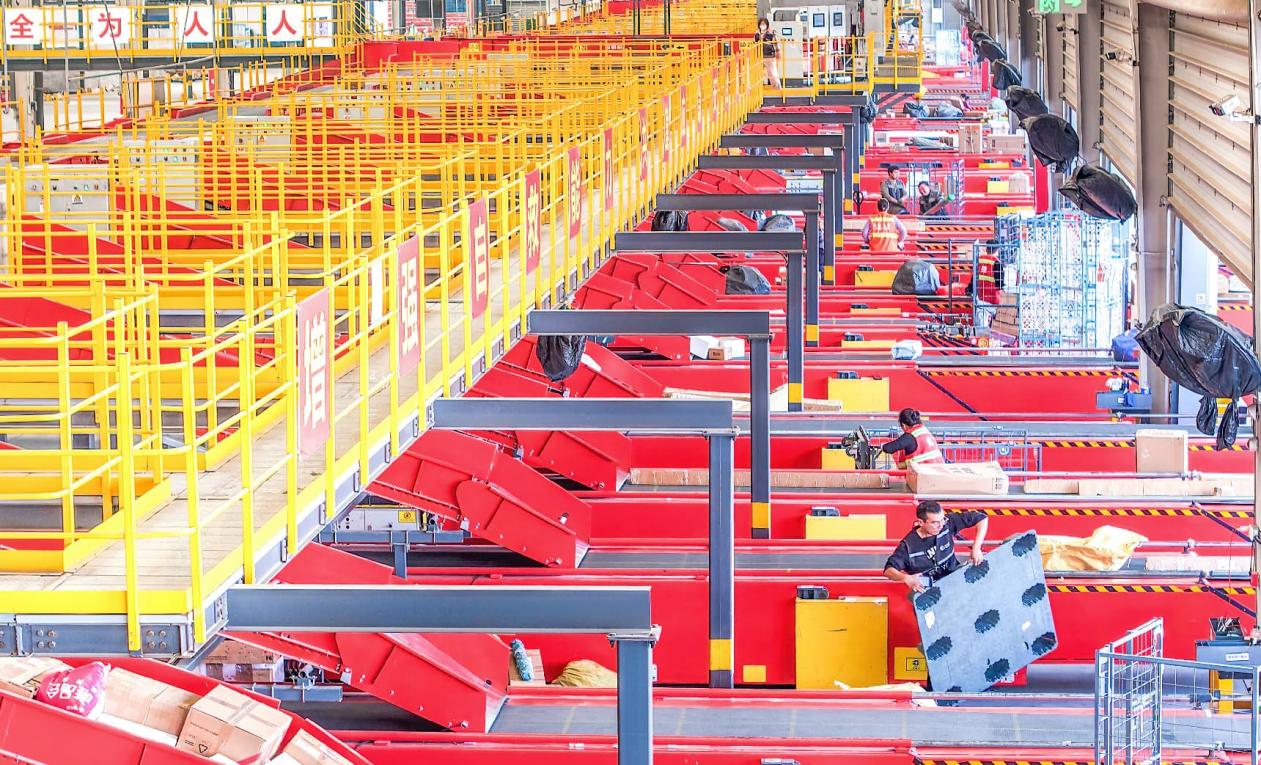
Automation has significantly accelerated the process. Inside the smart warehouse, autonomous and vertical-lift robots move swiftly between shelves. At an intelligent sorting center, AI-powered recognition systems enhance sorting efficiency. At delivery stations, unmanned delivery vehicles coordinate with couriers to reduce last-mile delivery time.

More than 1,300 automated sorting centers are operating nationwide, alongside thousands of unmanned vehicles, and over 3 million parcels have been delivered by drones. Across China, logistics parks and express delivery outlets are increasingly integrated with next-generation information technologies, forming a world-leading intelligent logistics network.

In warehousing, shelving, picking, and outbound processes are becoming fully unmanned, yielding substantial efficiency gains. AI vision systems achieve millisecond-level recognition, minimizing errors, damage, and loss. In transportation, vertical AI models help dynamically optimize routing. In pickup and delivery, drone and unmanned vehicle pilot programs continue to expand, effectively lowering operational costs.

“Science and technology are a strong driving force, injecting sustained vitality into the express delivery market,” said Liu Jiang, director of strategic planning at the Development and Research Center of China’s State Post Bureau.

Scenario 2: Upgrading consumption through logistics

During this year’s Double 11 online shopping festival, demand for consumer goods trade-in remained strong. Taking advantage of relevant subsidies, a woman surnamed Wang from Linyi, east China’s Shandong province, ordered a new set of furniture. The courier arrived on time, completed delivery and assembly, and finalized the entire process in under an hour.

China’s expanded consumer goods trade-in program has effectively stimulated demand for product upgrades, providing strong momentum for the express delivery sector. In the first 10 months of this year, Chinese logistics giant SF Express reported a 30 percent year-on-year increase in large-item deliveries, including furniture and home appliances.

This year, SF Express has built over 30 new air-cargo facilities dedicated to large items, reducing average processing time by more than three hours. It also upgraded more than 20 ground transit hubs to improve sorting efficiency and introduced new reverse-logistics models that integrate old-item pickup with new-item delivery. These measures have strengthened the company’s service capabilities for the consumer goods trade-in program.

On the one hand, China’s express delivery sector is embedding itself across diverse consumption scenarios from tourism and culture to sports and entertainment, driving economies of scale. In the first 10 months of this year, express delivery contributed to a 6.3 percent increase in online retail sales of physical goods.

On the other hand, by developing new service models such as in-factory logistics and international supply chains, China’s express delivery industry is becoming more deeply embedded in industrial operations. This integration is extending industrial and value chains, fostering closer alignment between logistics services and production dynamics.

Scenario 3: Rural logistics boosting regional development

In a warehouse of a fruit trade company in northwest China’s Shaanxi province, workers sort, pack, and label boxes of apples for shipment. “With couriers stationed directly in the village, parcels can be collected and shipped the same day,” said the company’s e-commerce manager. During peak harvest season, the facility processes around 100,000 orders daily.

The rapid expansion of express delivery networks into rural areas is unlocking new consumption potential. In the first 10 months of this year, Chinese express delivery company ZTO Express handled more than 12.9 billion parcels, covering over 96 percent of townships in China. Shipments of agricultural products from rural to urban markets increased by 21.5 percent year on year.

From the rich tea leaves of Baoshan in Yunnan to the fresh matsutake mushrooms of Nyingchi in Xizang, products from China’s central and western regions are reaching markets nationwide with remarkable efficiency, enabled by an increasingly robust express delivery network. 

This year, China’s rural delivery and logistics system has become more complete, with central and western regions such as Guizhou, Shaanxi, Ningxia, and Xinjiang all reporting over 30 percent year-on-year growth in express delivery volume during the first 10 months.

Liu noted that the express delivery industry not only precisely connects production and consumption, but also facilitates the flow of resources across regions, contributing to the development of building a unified national market.