Hangzhou Asian Games mascots mirror charm of host city

By Zheng Yi, People’s Daily

Taking a stroll on the streets of Hangzhou, the host city of the 19th Asian Games, one can find elements of the Games everywhere – an “Asian flower carpet” consisting of over 200 varieties of flowers along the Qiantang River, synthetic racetracks in subway stations, and Asian Games-themed Fuxing bullet train running between Hangzhou and the co-host cities of Wenzhou and Jinhua…

Unquestionably, the three mascots of the Hangzhou Asian Games, namely “Congcong”, “Chenchen” and “Lianlian” are the most eye-catching. Their figures can be spotted everywhere – from sculptures, paintings and posters dotting the streets, to traffic lights at intersections and piers of overpasses.

The designs of the three mascots are unique. Inspired by the Archaeological Ruins of Liangzhu City, “Congcong” has mythical beast facial patterns on its forehead, which imply bravery and self-transcendence. Representing the Beijing-Hangzhou Grand Canal, “Chenchen” has the Qiantang River’s tide atop its head and the Gongchen Bridge on the forehead, symbolizing the pioneering spirit of riding the wind and breaking the waves. Wearing a lotus leaf-shaped headpiece decorated with the Three Pools Mirroring the Moon, a scenic view of the West Lake, “Lianlian” seems to have emerged from the misty willows and arched bridge of the scenic West Lake, representing interconnectivity and inclusiveness.

As the visual emblems of the Asian Games, the mascots must be amiable while also showcasing the unique charm of the host city. The creative design for these three mascots was chosen from over 4,600 submissions, and underwent multiple revisions before taking their final form seen today.

For visitors setting foot in Hangzhou for the Asian Games, a cheery welcome from the mascot trio is likely the first thing they’ll encounter. In the arrival areas of the airport and train stations, life-size mascots hold greeting signs to welcome guests. Outside the athletes’ dining hall stands a spray-painted display themed with the mascots. Stuffed toys of the trio are given to journalists together with the journalist kits. Tourists are often seen snapping photos in front of the mascot statues near the West Lake.

The Hangzhou Asian Games, marking the third time for China to host this event, has evoked shared memories.

In 1990, the panda mascot of the Beijing Asian Games “Panpan” holding a gold medal, released a signal of increasing openness. In 2010, the five goats of the Guangzhou Asian Games conveyed blessings of harmony.

Today, the mascots for the current Hangzhou Asian Games embody the city’s three world cultural heritage items. They not only carry rich cultural legacy and a modern spirit, but also convey the vision of “@Future.”

Hangzhou Asian Games highlights power of intelligent technology

By Qiang Wei, People’s Daily

On the evening of Sept. 23, the opening ceremony of the 19th Asian Games kicked off at the Hangzhou Olympic Sports Center Stadium. Combining the beauty of nature, culture, sports, and technology, it touched millions of viewers.

What excited the audiences both inside the stadium and in front of TV sets the most was the moment when Olympic champion swimmer Wang Shun and a digital torchbearer jointly lit the Asian Games cauldron.

As six human torchbearers passed on the torch in the stadium, also known as “the Big Lotus,” the digital torchbearer – made up of over 100 million virtual sparks, each representing a participant of the online torch relay – took giant strides toward the cauldron. After the digital figure and Wang jointly lit the cauldron, the Asian Games flame gushed out from the fire pit inspired by the tidal bore of the Qiantang River.

It was the first digital ignition ceremony in the Asian Games’ history, and also the first one participated by over 100 million people. It highlighted the results of three years of efforts made by the technological team, who conducted over 100,000 tests and wrote more than 200,000 lines of codes. The team integrated its independently developed Web3D interactive engine Galacean, AI figures, cloud services and block chain technology to build a digital platform able to accommodate more than 100 million users, perfectly fusing the virtual and real worlds.

It was also the first time that the concept of “intelligent Asian Games” was proposed in the history of the Games. Numerous technological achievements and cutting-edge technologies have been widely applied throughout the entire process of the Asian Games.

From the deployment of the three core systems of the Hangzhou Asian Games, namely Results Distribution System, Games Management System, and Games Support System, to all event data and supporting data processed on the “cloud,” and to shuttle services by autonomous driving buses, and the use of digital twin technology to ensure venue operations, the “intelligent Asian Games” has truly lived up to its name.

The Hangzhou Asian Games has opened a window to observe China’s technological innovation, mirroring a bright future where digital technology will drive the development in multiple sectors.

Nasarawa Assembly set up 9 man Ad-hoc committee to probe sales of government properties in Lagos, other states

Nasarawa State House of Assembly, has set up 9 man Ad-hoc committee to investigate alleged sales of government properties in Lagos and other states by the then Administration of Umaru Tanko Al-Makura.

Rt. Hon Ibrahim Balarabe Abdullahi, the Speaker of the House announced the House resolution after Hon Mohammed Adamu Omadefu, the Majority Leader of the House brought the issue under the matter of Public interest during the House proceedings in Lafia today.

The Speaker has urged the committee to immediately proceed to Lagos to begin its investigation on the alleged sales of Nasarawa State Liason office in Lagos State.

He urged the committee to do a thorough investigation to unravel the alleged sales of government properties by the immediate past administration.

” Yes, this House under my watch has passed a resolution directing the former government to sale the state properties in Lagos and other states for infrastructure development as requested by the past Governor.

” With what we have seen in the media yesterday that the security men has sent indigenes of the state staying in our Lagos Liason office out of the structure was unfortunate

“We feel bad and disappointing about that.

” The protest has given a bad image to our state and the government of Nasarawa State.

” But we did not know whether the properties were sold or not and whether the proceed were used for development or not.

” And who is the beneficiary/ beneficiaries of the sale of the properties, ” he said.

The Speaker urged the committee to ensure that the right things are done in the interest of development.

” All those that involved must be invited for clarification such as the office of the SSG , Accountant General and Board of Internal Revenue Service , ” he added.

According to the Speaker, the committee will extend its investigation to status of government properties across the country and among individuals.

The Speaker named Hon Larry Ven Bawa as Chairman of the committee.

” Other members are Hon Iliya Luka Zhekaba, the Minority Leader, Hon Musa Ibrahim, Hon Mohammed Omadefu, Hon Suleiman Azara, Hon Danladi Jatau, Hon Saidu Gude, Hon Mohammed Isimbabi, Hon Mohammed Oyanki and Mr Ibrahim Musa, the Deputy Clerk is the Secretary of the committee, ” he said

The Speaker urged the committee to carry out its investigation without fear or favour.

On their parts, Hon Musa Abubakar, Hon Danladi Jatau, Hon Solomon Akwashiki, Hon Mohammed Oyanki, Hon Larry Ven Bawa all supported the need for the House to set up the committee to investigate alleged sold of government properties in Lagos and other states.

They said that there was the need for the people of the state to know how much was the proceed of the properties sold and was it used for development.

Earlier, Hon Mohammed Adamu Omadefu, the Majority Leader of the House while raising the issue said that the protest in Lagos by indigenes of the state has tarnished the image of the state.

He urged the House to set up an Ad-hoc committee to investigate the alleged sold of government properties in Lagos and other states.

The Majority Leader said that the people of the State need to know how the properties were sold and the proceeds of the properties.

It would be recall that in Sept. 2017, the Nasarawa State House of Assembly approved the request of the then Governor, Umaru Tanko Almakura, to sell the State’s properties located in Lagos, Jos and Kaduna due to their dilapidated state.

China, ASEAN join forces to build an ever closer community with shared future

By Pang Geping, Li Zong, People’s Daily

The 20th China-ASEAN Expo and China-ASEAN Business and Investment Summit was held on Sept. 16 in Nanning, capital of south China’s Guangxi Zhuang autonomous region.

Over the past 20 years, the expo and summit has built collaboration and cooperation mechanisms between China and ASEAN in multiple areas, injecting positive energy into the region and the world’s peace and stability, development and prosperity. It has served as a sound platform that strengthens communication and exchanges between the two sides.

In recent years, more and more featured products have entered the Chinese market via the China-ASEAN Expo, such as durians from Vietnam, mangosteens from Thailand and coffee from Indonesia.

The China-ASEAN Expo and China-ASEAN Business and Investment Summit has become an important platform for communication and cooperation between China and ASEAN, said Wei Zhaohui, secretary-general of the expo’s secretariat.

China and ASEAN established a strategic partnership at the China-ASEAN (10+1) leaders’ meeting in 2003, which marked a new chapter of friendship between the two sides.

At this meeting, China proposed to hold the China-ASEAN Expo in Nanning on an annual basis starting in 2004. In 2004, the first China-ASEAN Expo was successfully held and permanently settled in in Nanning, and the China-ASEAN Business and Investment Summit was also held.

The expo and summit has built a bridge of friendly cooperation in multiple fields, forming a new channel for China-ASEAN cooperation. It is a regional public product and international cooperation platform serving China and ASEAN, and even the Regional Comprehensive Economic Partnership (RCEP) and the Belt and Road Initiative.

The previous 19 sessions of the expo and summit were attended by a total of 182 Chinese and foreign leaders, over 3,800 ministerial-level guests and heads of international organizations, as well as more than 1.1 million merchants.

“Thanks to the China-ASEAN Expo and China-ASEAN Business and Investment Summit, the cooperation between the two sides has extended from trade in goods, investment, and services to more areas such as international capacity cooperation and cross-border industrial park construction,” said Zhai Kun, a professor in the School of International Studies, Peking University, adding that the expo and summit has also fostered exchanges in various fields including artificial intelligence, internet technology, and education.

As a result, the cooperation between the two sides is progressing towards a larger scope, with higher standards and at deeper levels, Zhai said.

High-level dialogue and negotiations, multi-level economic and trade activities, and wide-ranging high-level forums were held during the expo and summit. They have showcased the comprehensive cooperation between China and ASEAN over the past 20 years, which has not only brought benefits to the region, but also promoted global economic and trade development.

Last year, the RCEP came into effect, creating the world’s largest free trade bloc. “The expo has vigorously promoted the construction of the China-ASEAN Free Trade Area and the RCEP, opening up broader space for regional economic and trade cooperation, accelerating regional economic integration, and injecting strong impetus into regional prosperity and stability,” said Benjamas Tanvetyanont, Thai consul-general in Nanning.

Trade cooperation is an important witness to the progress of bilateral relations. Statistics show that the bilateral trade volume between China and ASEAN has increased from over $100 billion in 2004 to $975.34 billion in 2022.

China has maintained ASEAN’s largest trading partner for 14 consecutive years, while ASEAN has been China’s largest trading partner for 3 consecutive years. China-ASEAN economic and trade cooperation has steadily and continuously developed, becoming a successful example of regional cooperation in the Asia-Pacific region.

In recent years, with the construction and opening of more roads and railways, as well as the upgrading and transformation of various ports, the increasing logistics connectivity has accelerated the development of ASEAN countries.

China and ASEAN have joined hands to build a China-ASEAN community with a shared future, promoting common development and prosperity, and enabling over 2 billion people to live a better life. This serves as a vivid example of building a community with a shared future for mankind.

The annual throughput of the Beibu Gulf Port in Guangxi has exceeded 7 million twenty-foot equivalent units, and ASEAN products such as durians and frozen shrimps are entering the Chinese market via the port.

So far, the China-Laos Railway has transported over 20 million passengers. Besides, the agreed investment for the Malaysia-China Kuantan Industrial Park stood at about 46 billion yuan ($63.14 billion), with a cumulative industrial output value of over 60 billion yuan.

China and ASEAN are witnessing deepening and solidifying exchanges and cooperation in education, livelihood, and health. The two sides have sent over 200,000 students to each other.

Besides, Chinese universities have established majors in the official languages of the 10 ASEAN countries, and ASEAN countries have set up 42 Confucius Institutes and 39 Confucius Classrooms. Currently, all 10 countries have become popular destinations for Chinese tourists, and both sides are major sources of tourism for each other.

“In the past 20 years, the China-ASEAN Expo has played an increasingly prominent role as an international public product serving global trade. With the accelerated development and upgrading of the expo, the cooperation between China and ASEAN will undoubtedly flourish and yield even more fruitful results,” said Wei.

Monroe Doctrine must come to an end in Americas

By Zhong Sheng, People’s Daily

The U.S. government recently declassified two documents at Chile’s request. These two documents, together with previously declassified ones by the United States, indisputably prove that the United States was behind the scenes orchestrating the coup in Chile 50 years ago.

This once again shows that the United States has long regarded Latin America as its “backyard,”  seeking hegemony in the region in the name of Americas. Its reckless military intervention and economic plunder in Latin American countries have caused severe disasters for the people there.

According to the two documents, President’s Daily Briefings compiled by the Central Intelligence Agency, the U.S. government not only had prior knowledge of the information about the military coup launched by Augusto Pinochet, then Commander-in-Chief of the Chilean Army, in September 1973, but also provided support for the military coup.

Previously declassified documents from the U.S. National Security Archive also showed that the United States considered Salvador Allende, then President of Chile, a threat. The United States obstructed his administration through diplomatic, political, economic and other means, and also plotted to overthrow the administration through smear campaigns, covert assassinations, and instigating military coup.

Fifty years has passed, yet the scars left on the Chilean society by the coup remain unhealed. During a recent event in Santiago commemorating victims of the coup, Chilean President Gabriel Boric said the painful experiences brought by this coup have left an indelible mark on generations of Chileans. However, the U.S. government has not shown any remorse or apologized to this day.

In a statement released the other day, the U.S. Department of State even shamelessly claimed that the declassification of the documents “is consistent with our joint efforts to promote democracy and human rights in our own countries and around the world. “

How exactly has the United States been “promoting democracy and human rights” in Latin America?

In 1823, the country issued the Monroe Doctrine, declaring “America for Americans.” However, as a matter of fact, it was treating Latin America as its own exclusive “backyard.”

Former U.S. President Theodore Roosevelt once openly declared that the United States must exercise an international police power in the Western Hemisphere for the sake of adhering to the Monroe Doctrine.

In the 200 years since the Monroe Doctrine was introduced, the United States has adopted various means to plunder Latin America’s natural resources, undermine the economies of Latin American countries, and interfere in their domestic affairs, which led to economic decline and social turmoil, and intensified inequality in these countries.

A Harvard University study showed that in less than 100 years between 1898 and 1994, the U.S. government plotted and carried out at least 41 coups in Latin America, equivalent to one coup every 28 months.

Even today, the poisonous legacy of the Monroe Doctrine remains. The United States readily imposes sanctions and suppression against “disobedient” Latin American countries, and even attempts to use Latin American countries as pawns in camp confrontation, forcing them to take sides.

Gabriel Merino, professor with the National University of La Plata in Argentina, pointed out that Latin America and the Caribbean have been deeply harmed by U.S. hegemony.

The so-called “promotion of democracy and human rights” by the United States cannot conceal the damage inflicted on Latin American countries by the Monroe Doctrine. American hegemony is meeting increasing resistance and opposition in Latin American countries.

At last year’s Ninth Summit of the Americas hosted by the United States, the U.S. side tried to rebuild its leadership in the Americas by taking advantage of its home turf. However, due to the country’s refusal to invite the leaders of Cuba, Venezuela and Nicaragua, the summit was publicly boycotted by leaders of many Latin American countries.

A commentary on the website of U.S. magazine Foreign Policy pointed out that a major characteristic of the U.S. when it comes to Latin American issues is “ignorant arrogance.”

Mexican President Andres Manuel Lopez Obrador said that there should no longer be the Monroe Doctrine, interventionist policies, blockades against other countries in the Americas, nor should any one country dominate the region.

At present, the “Global South,” comprising emerging market countries and developing countries, is steadily increasing its voice and influence in international affairs. Latin American countries are also continuously taking new steps towards solidarity and self-strengthening.

The United States should recognize the trend of the times, genuinely respect the sovereignty of Latin American countries and their people’s rights, and practically abide by the basic norms of international relations. Only in this way can it possibly establish normal relations with Latin American countries.

Enriching Asian Games with beauty of humanity

By Dou Hao, Zheng Yi

The Asian Games is a grand sports event and a cultural feast as well.

The Hangzhou Asian Games is brimming with a rich humanistic spirit, from the ingenious designs of the venues to the cultural landscapes in the streets and alleyways of the city, and from the diverse cultural activities to the warm and caring volunteer services.

The emblem “Tides Surging” of the Hangzhou Asian Games is the first visual identity symbol revealed for the Games. Its fan-shaped design integrates elements such as the Qiantang River, Qiantang tidal bore, racetracks, internet symbols, and the sun representing the Olympic Council of Asia, fusing together the distinct culture of Jiangnan, or south of the Yangtze River, with contemporary vibrancy.

Hangzhou is known as the “City of Silk,” and the silk elements of the city inspired the graceful yet flexible, fine yet smooth, gentle yet vibrant design of the Asian Games’ core graphics “Meeting the world.” It represents the artistic conception of “meeting the world”.

From the West Lake imagery in the “Shan Shui” medals, to the featured floral branches in the victory ceremony bouquet “Fruits of Triumph,” and to the blue and white porcelain elements on the uniforms designed for the Chinese delegation, traditional culture can be seen everywhere, reflecting Hangzhou’s humanistic beauty.

The humanistic touch is also ingrained in the architectural aesthetics of the venues. The Yangshan Sports Climbing Center, located in Keqiao district, Zhejiang’s Shaoxing, resembling a silkworm cocoon, is the designated venue for the climbing events of the Hangzhou Asian Games. The hollowed exterior design reflects the silk culture in the Jiangnan water towns, seamlessly integrating elements of Chinese landscapes and international competitions.

“From the refined and elegant landscapes in the Jiangnan area, we will see a unique Asian Games. The diverse humanistic elements also reflect the cultural heritage and aesthetic charm of the city of Hangzhou,” said an official with the Hangzhou Asian Games Organizing Committee.

Beside the Hangzhou Olympic Sports Center, a dedicated Asian Flower Theme Park gathers over 200 flower varieties, conveying the vision of “Asian people progressing together.” On the Linping People’s Square, there are murals depicting the Grand Canal and intangible cultural heritage elements. In Qianwang street of Hangzhou’s Lin’an district, wall relief sculptures with Asian Games motifs installed on building exteriors are quite eye-catching. Themed landscapes celebrating the Games are greeting visitors everywhere in this city.

In the Asian Games Village, there are various “Cultural Houses” where athletes are able to enjoy a cup of tea with friends, marveling at the intricate craftsmanship of fan-making, delve into the ancient techniques of traditional embroidery and porcelain making, and design and make their own personalized artistic seals. These “Cultural Houses” are truly enlightening windows showcasing the richness and beauty of the traditional Chinese culture.

In an ancient street in Yuhang district of Hangzhou, there is an Asian Games cultural experience station where inheritors of intangible cultural heritage teach visitors the traditional craft of paper umbrella making. Fifty such cultural experience stations have been established across Hangzhou.

Currently, more than 100 cultural centers in Zhejiang province are collaborating to launch over 5,300 public cultural activities centered around the Asian Games. These activities encompass a wide range of artistic forms, including music, dance, traditional opera, traditional storytelling, fine arts, photography, and more.

Following the spirit of “Everyone is a Host,” the 1.48 million city volunteers in Hangzhou are extending the warmest welcome to guests across streets and neighborhoods, and at dedicated volunteer stations.

At the Asian Games Village, athletesare guided by smiling young volunteers.. At a volunteer station in Xiaoshan district, volunteers offer not only rental services but also traffic guidance and scenic spots introduction for visitors.

The Hangzhou Asian Games not only brings together Asian athletes for competition, but also upholds the vision of “beauty in diversity.” By adding non-Olympic events with unique Asian cultural characteristics, such as sepak takraw, Kabaddi, and karate, the Games encourages broader participation from more countries and regions.

It is believed that the Hangzhou Asian Games, with utmost sincerity, will deliver profound humanistic heritage and warmth to guests.

African youth paintings exhibited on China’s space station

By Wan Yu, Huang Weixin, Liu Hui, People’s Daily

A unique painting exhibition, embodying the beautiful dreams of African youths, was recently held some 400 kilometers above Earth at China’s Tiangong space station.

The creative works made their debut at an awarding ceremony for the “My Dream” painting competition for African youth.

The competition was launched in March this year by the Secretariat of the Chinese Follow-up Committee of the Forum on China-Africa Cooperation (FOCAC), the China Manned Space Engineering Office and some Chinese embassies and consulates in African countries. It received submissions from some 2,000 youths from 42 African countries.

At the end of May, 10 works were selected as winners of the Tianhe Award, named after the core module of China’s space station. They flew into space along with the crew of China’s Shenzhou-16 mission, and were exhibited on the Tianhe core module on Sept. 13.

Three Chinese astronauts of the Shenzhou-16 mission, namely, Jing Haipeng, Zhu Yangzhu and Gui Haichao, showed and introduced the works to the audience on Earth from the space station via video link.

Looking at an astronaut-themed painting, Zhu said the work shows the enthusiasm of African youth for manned space, and also boosts his confidence in future China-Africa space cooperation.

Exploring the unknown universe and developing space technology are the common endeavors of mankind, Zhu noted, emphasizing the full cooperation of all countries in the world, including Africa.

“We sincerely hope that Chinese and foreign astronauts can work together to make even greater contributions to human exploration of the universe,” he added.

The awarding ceremony was simultaneously held in Beijing and eight African countries including the Central African Republic, Comoros, Egypt, Equatorial Guinea, and Kenya. The award-winning African painters and other African youths repeatedly cheered and applauded during the video link, expressing their excitement.

They asked questions actively to Chinese astronauts, covering various topics such as the possibility of growing vegetables in the space station, the feeling on the space station, the contributions of the space industry to national development, and whether astronauts can see Africa’s Congo River from space.

Chen Dong, a Chinese astronaut who has conducted two manned space missions to Tiangong, answered their questions via video link in Beijing. He is the first Chinese to stay in orbit for more than 200 days.

Kenyan student Melissa Wanjala, a second-prize winner, said joining the competition sparked her dream of space.

She said she was deeply inspired by Chinese astronauts saying that vegetables can be grown in space She wanted to study agriculture and grow food in space to help alleviate poverty and hunger.

China’s cooperation with Africa in space is deepening, which has become a new highlight of China-Africa cooperation. Modern aerospace technology is playing an increasingly important role in promoting the economic and social development of African countries and benefiting the lives of African people.

In recent years, China, giving full play to its advantages in satellite remote sensing technology and resources, has signed memorandums of understanding on satellite data application cooperation with institutions and regional organizations in 13 African countries.

China has provided nearly 40,000 scenes of high-resolution satellite remote sensing data of Chinese natural resources to 23 African countries and has held multiple technical exchanges and training sessions. They have effectively enhanced the satellite remote sensing application capabilities of African countries and laid a solid foundation for further deepening China-Africa cooperation in the field.

Cooperation between Africa and China in aerospace technology is becoming increasingly close, said Ibrahima Sory Sylla, Ambassador of Senegal to China.

This event was another example of how China has been sincerely sharing development results and opportunities with Africa. African youths who participated via video link said the event aroused their curiosity about exploring the vast universe, and they hope to contribute to promoting friendly cooperation between Africa and China.

Wu Peng, Director-General of the Department of African Affairs of the Foreign Ministry of China, stated at the event that China is willing to support Africa to cultivate talents in various fields, including modernization of governance, economic and social development, technological innovation, and improvement of people’s livelihood and welfare, through the implementation of the Plan for China-Africa Cooperation on Talent Development.

This will create more favorable conditions and provide a broader space for African youths to pursue their dreams and achieve success, Wu added.

China committed to building a Global South community with a shared future

By He Yin, People’s Daily

The Summit of the Group of 77 (G77) and China recently kicked off in Havana, Cuba. The event was attended by 31 heads of state and government, multiple heads of international and regional organizations, as well as high-level delegations from 116 countries.

On this important multilateral cooperation platform for developing countries, China, together with other developing countries, has held high the banner of development, focused on coordination and cooperation to address current challenges, and sent a strong voice of making global governance fairer and more equitable. This has sent a positive signal of solidarity and self-determination among Global South countries.

The world is undergoing changes on a scale unseen in a century. Developing countries are becoming stronger. South-South cooperation is playing an increasingly important role in driving the momentum of collective rise of developing countries and in sustaining the continued global economic growth.

At the same time, however, unilateralism and hegemonism are becoming rampant. Some countries are resorting to such practices as unilateral sanctions, decoupling, and disruption of industrial and supply chains, seriously undermining the legitimate development rights and interests of developing countries and their space for development.

Developing countries generally hope to strengthen solidarity and cooperation, safeguard their development rights, uphold equity and justice, and make global governance fairer and more equitable.

The summit adopted the Havana Declaration. It stressed the urgent need for a comprehensive reform of the international financial architecture and a more inclusive and coordinated approach to global financial governance, and rejected unilateral sanctions against developing countries.

It fully proves that the G77 and China, practicing true multilateralism, represent a force of justice pursuing solidarity, cooperation and development. They firmly safeguard international equity and justice, strive to make a stronger voice of developing countries, and protect the common interests of developing countries.

UN Secretary-General Antonio Guterres termed the G77 and China “a champion of multilateralism” in his speech, saying they will always be essential for the UN system.

As the world’s largest developing nation and a natural member of the Global South, China breathes the same breath as other developing countries and pursues a shared future with them.

As the world has entered a period of turbulence and transformation with increasing uncertainties and instabilities, China is committed to building a Global South community with a shared future, encouraging developing countries to stay true to the original aspiration for independence and greater collective strength through unity, to advocate equity, justice and inclusiveness, and to pursue development, revitalization and win-win cooperation.

Only by rejecting bloc confrontation and the Cold War mentality and seeking to resolve differences and disputes between countries by peaceful means can developing countries better maintain world peace and tranquility.

Only by actively making their voice heard loud and speaking up for justice on the international stage can developing countries constantly strengthen their voice and representation in global governance and better safeguard their common interests.

South-South cooperation is always a high priority in China’s cooperation with other countries. It is always a staunch advocator and active contributor to global development.

Today, China provides development assistance to more than 160 countries, joins hands with more than 150 countries in building the Belt and Road, and works with over 100 countries and international organizations to advance the Global Development Initiative (GDI), showing its role as a responsible major country.

China will continue to maintain close communication and coordination with G77 members in order to optimize allocation of development resources, ensure efficient use of public goods of the Belt and Road Initiative (BRI) cooperation, and resolve problems in development.

Participants from many countries believe that China’s active promotion of South-South cooperation has played an important role in promoting social progress and improving human welfare in developing countries.

Nicaraguan President Daniel Ortega noted that China’s assistance to the people of Asia, Africa, and Latin America is provided with no conditions attached, and has contributed to the social progress and well-being of developing countries.

Chinese President Xi Jinping has proposed the vision of building a community with a shared future for mankind, the BRI, the GDI, the Global Security Initiative, and the Global Civilization Initiative, which offer a Chinese approach to lasting peace, greater development, and closer cooperation in the world, and also provide an important platform for deepening South-South cooperation.

The declaration approved by the summit incorporates multiple Chinese ideas and propositions, explicitly stating that relevant parties should strive to achieve global development and win-win cooperation based on the principle of extensive consultation, joint contribution, and shared benefits, promoting the building of a community with a shared future for mankind.

This once again demonstrates that the Chinese approach is in line with the trend of the times and meets the common expectations of developing countries for development and cooperation.

Cuban President Miguel Diaz-Canel Bermudez pointed out that the GDI is of great significance and value, and this inclusive initiative conforms to the trend of establishing a new international order featuring equity and justice.

Djiboutian Prime Minister Kamil Mohamed stated that developing countries should explore relevant mechanisms and measures to promote domestic production and technological progress, thereby promoting sustainable development, and the GDI proposed by China is in line with this.

China stands firmly on the right side of history, and believes that a just cause should be pursued for the common good. No matter what stage of development it reaches, China will always be part of the developing world and a member of the Global South.

No matter how the international landscape changes, China will remain a sincere friend and reliable partner of developing countries, always firmly support and stand together with the G77, and stay committed to realizing their common development and rejuvenation and an even brighter future for mankind.

Gathering at Hangzhou Asian Games for better future

By Gong Yuhua

A dedicated Asian Flower Theme Park featuring over 200 varieties of flowers held its grand opening in Hangzhou, east China’s Zhejiang province; the torch relay for the Hangzhou Asian Games passed through 11 cities in the province; preparations for catering services have been completed…

With the countdown to the opening of the Hangzhou Asian Games underway, Hangzhou is making final preparations, pulling out all stops to refine organizational details and raise service standards.

From venue maintenance to support services, and from cultural exchange to atmosphere building, Hangzhou welcomes guests from all over the world with great passion and vibrancy.

After the 1990 Beijing Asian Games and the 2010 Guangzhou Asian Games, the Asian Games torch will be lit up in China for the third time.

Over the past 33 years, the Asian Games has witnessed the vigorous development of China’s sports undertakings, and recorded China’s steady march forward.

Since Hangzhou won the bid to host the Asian Games, the city and the 5 co-host cities of Ningbo, Wenzhou, Jinhua, Shaoxing, and Huzhou have upheld the concept of “green,””intelligent,””frugal,” and “civilized” in organizing the Games. They are committed to delivering a splendid Asian Games with Chinese characteristics and Asian styles.

It will be a green Games, with the fruitful outcomes of the green development philosophy.

All the Asian Games venues and offices use green electricity, helping create the first carbon-neutral Asian Games in history. Electric power networks deliver green power from thousands of miles away to the venues of the Asian Games; electric vehicles running the streets help foster a new fashion for green transportation; ingeniously designed Asian Games venues utilize technologies to reduce energy consumption and enable sustainability. The “Green Asian Games” matches words with action, reflecting China’s ethos of protecting the ecological environment and caring for the planet.

It will be an intelligent Games, with technological innovation to be seen in every aspect.

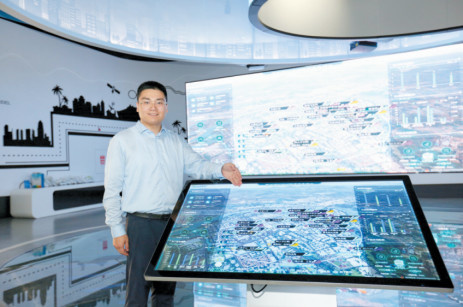
At the Asian Games information technology management center located in Binjiang district of Hangzhou, energy consumption of venues, real-time conditions, passenger flow, traffic flow and other information are shown clearly. On the roads outside the Shaoxing Baseball & Softball Sports Center, autonomous buses decorated with Asian Games elements stand ready to welcome spectators…

Thanks to the extensive use of technologies, venue management for the Hangzhou Asian Games is much more refined, and services comprehensively upgraded, allowing spectators to have better experiences.

It will be a frugal Games, embracing “simple yet sophisticated” as both the pursuit and course of action.

The vast majority of venues for the Hangzhou Asian Games are reconstructed and renovated rather than newly built. For example, the squash venue of the Asian Games is temporarily converted from an exhibition hall at the Hangzhou International Expo Center. The LED screens, spectator seats, and fire equipment inside the venue are rented, so after the Games ends, the venue can be dismantled in the shortest time to restore the exhibition hall to its original function.

A frugal Games does not mean abandoning innovation or lowering standards, but spending less, doing more, and doing things well, following the principle of “substance over extravagance.”

It will be a civilized Games, with the host city showcasing new heights of civility.

The Asian Games spirit and ethos of good manners will prevail. Over 10,000 events have been held as part of extensive efforts to improve urban quality, governance, and civility. Around 10,000 accessible facilities and nursing rooms have been set up at 56 venues. New practices promoting courteous conduct have been pioneered province-wide, enriching urban culture and elevating urban refinement.

Multifaceted enhancements to the city’s image, surroundings and scenery of Hangzhou have stirred a sense of communal pride in all citizens, making it the prevailing ethic that every citizen contributes to the Games.

Over 12,000 athletes from 45 countries and regions across Asia have gathered along the banks of the Qiantang River, coming together for this grand sporting event.

“It’s the home that we love. From our hearts love grows. Near or far we’re together. A million voices full of pride, sing it loud and clear, we are all here in Asia.” As the song “The Love We Share” goes, the Hangzhou Asian Games is becoming an important opportunity to jointly create a better future for Asia and the world.

With sports as a carrier to tell China’s stories and spread China’s voice, the Hangzhou Asian Games, themed “Heart to Heart, @Future,” will make a valuable contribution to building a community with a shared future for mankind.

Hangzhou Asian Games mirrors China’s vibrancy, progress

By Li Zhongwen, Zheng Yi, People’s Daily

The 19th Asian Games opened in Hangzhou, east China’s Zhejiang province on Sept. 23.

Hangzhou, together with five co-host cities, namely Ningbo, Wenzhou, Huzhou, Shaoxing, and Jinhua, have always adhered to the concept of hosting a “green, intelligent, frugal and civilized” Asian Games.

Aiming to make the event streamlined, safe and splendid, they are striving to present a wonderful Asian Games with Chinese characteristics and Asian styles.

The Hangzhou Asian Games has by far the largest scope, biggest number of events, and most extensive coverage in history. With 40 sports and 61 disciplines, over 12,000 athletes from 45 countries and regions will compete for a total of 481 gold medals.

From formulating the plans for torch relay and the opening and closing ceremonies, to continuously improving the urban transportation system and comprehensively lifting urban image, Hangzhou has meticulously prepared for the Asian Games in every aspect.

With world-class venues and facilities, smooth event organization, and thoughtful services, Hangzhou is committed to providing Asian athletes with a stage to showcase their talent.

“Hangzhou is fully prepared. This Asian Games will allow the world to see the beauty of Hangzhou, the vitality of Zhejiang, and the splendor of China,” said Chen Weiqiang, executive secretary general of the Hangzhou Asian Games Organizing Committee.

Greenness is the distinct feature of the Hangzhou Asian Games. From venue planning and construction to energy coordination and utilization, and from transportation support to event organization and operation, greenness is highlighted throughout the Games.

Hangzhou has rolled out a Zero-waste Asian Games Improvement Action Plan, setting up 16 “zero-waste Asian Games cell” demonstration sites and striving to make the Hangzhou Asian Games the world’s first large-scale zero-waste sporting event.

Wind and solar power from thousands of miles away is transmitted to Hangzhou and the co-host cities, lighting up 56 competition venues.

The concept of green development is integrated into every aspect of the preparation for the Games, showing the world China’s innovation and actions in creating a green future.

The Hangzhou Asian Games is the first smart Asian Games in history, with numerous technological achievements and cutting-edge technologies widely applied throughout the preparations.

At this Asian Games, venue support, event operations, cloud services and other aspects all strongly demonstrate the power of intelligent technology.

Relying on cloud computing, the Asian Games core system provides a powerful data processing platform for athletes, staff, spectators and more.

Spectators can fully enjoy the Games through a digital platform offering one-stop services. They can also visit scenic spots and museums, and take public transport with the digital package “Asian Games Pass.” Besides, a digital torchbearer program has been launched, allowing everyone to participate in the Asian Games.

With an aim to host a frugal Asian Games, the organizers focused on renovating existing venues rather than building new ones. Out of the 56 competition venues, 44 are renovated or temporary structures, and all 31 training venues remodeled.

The approach for event-related facilities and equipment is to prioritize borrowing over renting, and renting over buying, with a strong emphasis on recycling and reusing whenever possible.

To reduce waste, staff members are encouraged to bring their own water bottles and meals are kept simple to minimize food waste. Paper waste is also reduced wherever possible. Additionally, franchised stores provide eco-friendly mascots and packaging is minimized.

Simple yet sophisticated. More resources are invested into optimizing services. The innovative approach of reducing unnecessary elements greatly contributes to the success of the event.

Hangzhou has launched a campaign to strengthen urban quality, governance and civility in preparation for the Asian Games, holding over ten thousand related events and activities.

Ningbo has implemented and promoted various initiatives to improve urban civility in a coordinated manner, resulting in a noticeable transformation of the city’s urban, rural, and Asian Games environments.

The renovation of Shaoxing Olympic Sports Center Gymnasium focused on the wellbeing of people, enabling people with disabilities to easily access seats with assistive devices.

Taking concrete actions to host a “green, intelligent, frugal and civilized” Asian Games, Hangzhou is doing its best to welcome guests from across Asia and the world.

At the 42nd General Assembly of the Olympic Council of Asia, newly elected President Sheikh Talal Fahad Al-Sabah said that he believes Hangzhou is fully ready to host an exceptional Asian Games.

The Asian Games provides another opportunity for the world to experience and understand China. China’s preparation for the Games not only represents the fulfillment of its promises and efforts to promote development, but also showcases the country’s historic achievements in the new era.

As the third Asian Games hosted in China, the Hangzhou Asian Games has been vibrant since the beginning of its preparation. The event is showing prospects, openness and hopes through the smiles of the 37,600 volunteers for the Games and the 1.48 million city volunteers.