A fresh look at China’s innovation boom

By Li Zheng, People’s Daily

As the first quarter of 2025 unfolds, China’s innovation landscape reveals compelling patterns through three distinct regional narratives. The eastern tech stronghold of Hangzhou continues its ascendancy, while central China’s Henan province emerges as an unexpected cradle of commercial innovation, and western regions demonstrate growing cultural influence through cinematic achievements.

Hangzhou’s tech corridor now hosts Game Science, the visionary studio behind the global gaming phenomenon Black Myth: Wukong, alongside robotics pioneer Unitree whose Spring Festival Galaperformance became a national talking point. This eastern metropolis solidifies its position as China’s answer to Silicon Valley, nurturing enterprises that blend technological prowess with cultural resonance.

Henan’s commercial sector has undergone a significant evolution, exemplified by Pangdonglai. Once a regional player, the Xuchang-based retail complex attracted millions of visitors during this year’s Spring Festival, achieving daily revenues exceeding 100 million yuan across the eight-day holiday—a figure that parallels the earnings of Henan’s major cultural landmarks during peak seasons.This retail revolution accompanies the national expansion of homegrown brands like Mixue Bingcheng and Guoquan Shihui, challenging conventional wisdom about innovation geography.

Ne Zha 2, the animated sequel from China, has shattered global box office benchmarks, securing its place as the first Asian cinematic work to rank among the world’s top ten highest-grossing films. This historic achievement underscores the robust animation ecosystem and profound cultural legacy of Chengdu, Sichuan province—the film’s production hub. Once a regional cultural cornerstone, Chengdu is rapidly emerging as a pivotal player in the global creative economy, driven by its fusion of technological innovation and heritage-inspired storytelling.

These regional trajectories collectively sketch an evolving national innovation map where eastern tech dominance now faces vibrant challenges from central commercial innovators and western cultural producers. The emerging paradigm suggests China’s next developmental phase may be characterized not by singular hubs, but by a networked ecosystem of specialized regional competencies driving multidimensional growth.

So, what’s fueling this wave of breakthroughs?

Some point to the power of curiosity and entrepreneurial spirit. Neither Feng Ji, the mastermind behind Black Myth: Wukong, nor Jiaozi, the director of Ne Zha 2, had formal training in their respective fields. Yet, driven by passion and curiosity, they broke boundaries, crossed disciplines, and remained deeply committed to their craft.

Equally critical is the symbiosis between state policy and private enterprise.In tech hubs like Hangzhou, municipal officials routinely collaborate with investment executives during on-site consultations, fast-tracking resource allocation and regulatory support for fledgling firms.

Long-term vision and an open, inclusive innovation environment have also played a key role. Hangzhou, for example, allows government-guided funds to sustain loss ratios of up to 30%, deploying tolerant capital reserves to catalyse private-sector participation.This long-horizon approach fosters ecosystems where experimental ideas mature unimpeded.

Viewed holistically, these developments signal not serendipity but structural maturation. Parallel strides in industrial infrastructure, cutting-edge R&D, human capital, and market sophistication have collectively elevated the nation’s innovative capacity. The result is a self-reinforcing cycle: China’s innovation “water table” rises, drawing global enterprises to its fertile ground.

China boasts the world’s largest talent pool. Annually, over 5 million STEM graduates enter its workforce—forging a strategic reservoir for disruptive innovation.

The nation’s vertically integrated consumer ecosystem compounds this advantage. A seamless domestic market—spanning 1.4 billion consumers—enables frictionless scaling of viable innovations. As arbitrary market distortions dissolve, commercialized R&D achieves exponential scalability, leveraging China’s unique capacity to convert technical prototypes into mass-market phenomena overnight.

Critically, next-generation infrastructure acts as force multiplier. With 1.1 billion digitally native citizens and 5G coverage density surpassing 60%, China’s symbiosis between digital and industrial domains creates a global testbed for AI-driven enterprises. Here, algorithmic innovation converges with manufacturing heft—a petri dish where industrial metaverses and autonomous supply chains transition from speculative theory to operational reality.

Meanwhile, China’s institutional framework continues to mature. The socialist market economy has become more efficient, fostering a culture that values innovation and tolerates trial and error. The country not only leverages the advantages of centralized coordination but also embraces the flexibility and diversity of market-driven experimentation.

With talent to drive innovation, markets to reward it, application scenarios to support it, and institutional advantages to safeguard it, China has created an ecosystem where innovation flourishes.

Innovation here operates as a synergistic interplay—skilled human capital ignites ideation, consumer markets validate scalability, real-world applications pressure-test viability, and institutional framework mitigates systemic friction. The result is a self-reinforcing cycle of ideation, commercialisation, and iterative refinement.

Looking ahead, the vast potential of artificial intelligence and other emerging technologies will inspire more pioneers to explore uncharted territories. The wealth creation effect of China’s massive market will encourage bold new ideas. And in the years to come, even more groundbreaking innovations and compelling stories from China will captivate the world.

Anambra election: APC stakeholders reject imposition of governorship candidate, indirect primaries

The Anambra State chapter of the All Progressives Congress (APC) has been embroiled in an alleged bribery scandal, with stakeholders claiming that a governorship aspirant within the party attempted to bribe the party’s National Working Committee (NWC) with $3 million.

The spokesperson of Anambra APC Stakeholders Forum, Chief Hyacinth Okonkwo, during a press conference on Tuesday in Abuja, alleged that the aspirant sought to influence the NWC to adopt indirect primaries for the forthcoming gubernatorial elections in Anambra State.

Chief Okonkwo alleged that the aspirant boasted about securing the support of the APC NWC due to the illicit funds.

We have received credible intelligence that a certain governorship aspirant within our party has attempted to subvert internal democracy by *offering a staggering $3 million bribe to the National Working Committee (NWC) of the APC in a bid to impose indirect primaries for the forthcoming gubernatorial elections in Anambra State.

“This desperate move is aimed at rigging the process in his favor, manipulating party structures, and denying the people of Anambra the opportunity to choose their candidate freely and fairly.

“This individual, in his arrogance, has boasted openly that the APC NWC is now on his side due to the illicit funds he has deployed. That the National Chairman will not conduct any delegate election but will use his delegate list to deliver him as the Governorship candidate of APC.

“Even more disturbing is the fact that he attempted to lobby and bribe the First Lady, Senator Oluremi Tinubu, to secure her endorsement for his corrupt scheme. We commend the First Lady for her principled stance in rejecting all offers and standing firmly for justice, transparency, and the rule of law.

He condemned the alleged actions, stating that they undermine the integrity of the APC and the democratic process, while emphasizing that the party must not become a platform where money determines leadership.

“We insist that such an aspirant should be disqualified immediately from the race, as his actions are a direct affront to the integrity of the APC and the democratic principles that our great party stands for,” Okonkwo said.

The AASF spokesman called on the APC National Leadership, President Bola Ahmed Tinubu, and party members to ensure that the primaries in Anambra State are conducted transparently, through a direct or consensus process that reflects the true will of party members.

The forum warned that any attempt to impose indirect primaries as a result of corrupt inducement would be resisted by party members and the people of Anambra.

“We urge all genuine aspirants to engage in issue-based campaigns rather than resorting to criminal acts of bribery and electoral fraud.

“The APC must not become a party where money determines leadership—integrity, competence, and the will of the people must always prevail”, he said.

As of press time, the APC NWC and the accused aspirant have not publicly responded to the allegations.

China’s Demographic Crossroads: Can High-Quality Development Offset an Ageing Population?

By Liu Nian, People’s Daily

China stands at a pivotal juncture as its demographic landscape shifts: birth rates continue to fall while the proportion of citizens aged 60 or older has surpassed 20% of the total population, according to its National Bureau of Statistics. This “silver wave” coincides with the nation’s push toward common prosperity, yet it raises a pressing paradox—how to reconcile rapid ageing with the challenge of achieving widespread affluence.

Does this demographic transition signal the erosion of China’s famed population dividend? Or can evolving definitions of productivity and innovation redefine its economic trajectory?

The answer lies in untangling the interplay between demographic trends, policy frameworks, and economic resilience. While China’s meteoric rise since the 1980s was undeniably fueled by its vast labor pool, analysts argue that institutional strengths—from socialist governance with Chinese characteristicsto decades of reform and opening-up—unleashed an economic miracle no less critical than sheer workforce size.

Quantity alone no longer dictates prosperity. Even as the working-age population contracts, policymakers emphasize that technology investment, upskilling initiatives, and capital inflows can mitigate labour shortages. A case in point is China’s burgeoning talent reservoir: over 240 million citizens now hold higher education qualifications, fostering a skilled workforce driving sectors from AI to green energy.

This pivot from “population dividend” to “talent dividend” underscores a strategic bet—that quality, not just numbers, will sustain China’s modernization. As automation and innovation hubs like the Greater Bay Area expand, the narrative shifts from demographic anxiety to human capital’s transformative potential. The ultimate test? Whether high-quality development can turn an ageing society into an engine of sustainable progress.

The correlation between population structures and economic dividends defies reductionist arithmetic. It demands the analytical rigour of multivariate calculus, where shifting age coefficients interact with technological vectors and institutional constants. This complexity necessitates a systems-level perspective to truly decipher the demographic dividend equation.

Contemporary economic modelling reveals a paradigm shift: the dividend manifests not merely through crude growth metrics, but through strategic activation of latent human capital. While youth demographics remain crucial, a silent revolution is emerging from an unexpected quadrant – silver-haired populations redefining post-retirement economic agency.

Historical anxieties about elderly technological alienation now confront empirical contradictions. The digital metamorphosis of China’s elderly cohort has become a socioeconomic epiphany. Where pundits once predicted generational obsolescence, silver-haired netizens now dominate Douyin livestreams, orchestrate Taobao storefronts, and curate Xiaohongshu tutorials with the acuity of digital natives.

China’s silver wave of 170 million senior netizens is reinvigorating the digital ecosystem, proving the nation’s demographic dividend maintains potent socioeconomic currency.

This cohort’s renaissance extends far beyond screens. From mist-shrouded Huangshan peaks where septuagenarians clad in Arc’teryx gear deploy DSLR rigs, to Beijing’s frost-kissed ski slopes where grandmothers carve parallel turns, their vitality mirrors youth culture’s intensity. The lifelong learning revolution sees retired accountants mastering Python through digital lecture while former teachers monetize calligraphy tutorials – wisdom economies thriving.

Official metrics quantify the movement: China’s post-retirement cohort channels over700 billion yuan ($96.31 billion) yearly into cultural pursuits and wanderlust, with 35 million silver-haired scholars crowding digital academies and marathon finish lines witnessing a surge of septuagenarian sprinters – concrete manifestations of a nation where sunset years glow brightest.

China’s sunset years fuel economic engines rather than brake them, as evidenced by the  phenomenon achieving statecraft recognition. The codified “silver economy” now anchors national policy blueprints, while its lexical zeitgeist cousin “silver power” penetrated mainstream discourse through annual buzzword rankings. Concurrently, medical chaperone services and biographical scribing emerge as legitimate professions among youth entrepreneurs – tangible proof that demographic shifts birth new economic ecosystems.

China has unveiled a national geriatric framework blueprint, mandating creation of multi-tiered, equitable geriatric care apparatus spanning megacities to agrarian counties. The policy white paper prioritizes market-driven eldercare industrialization to address China’s “grey wave” – the coalescing demands of pensioners seeking tailored retirement ecosystems.

By tapping into the potential of an aging society, China aims to generate new economic dividends. The country’s top-level policy design is providing clear direction for future development.

A broader perspective reveals that addressing both the declining birth rate and population aging requires a balanced approach. Further deepening reforms and expanding opening up will provide fresh momentum for Chinese modernization, even amid demographic shifts.

In today’s China, whether young or old, the common goal is to move forward with confidence and live a better life.

China’s EV industry Shakeout: growing pains and breakthroughs

By Lin Lin, People’s Daily

The abrupt collapse of electric vehicle maker Jiyue, hot on the heels of HiPhi’s decline, has ignited fresh scrutiny over the sustainability of China’s new energy automotive ambitions. Two urgent questions emerge: Do these failures signal systemic fragility? And what trajectory awaits the world’s most prolific EV market?

Industry analysts contend such corporate casualties reflect an inevitable maturation phase–the Darwinian “growing pains” inherent to any disruptive sector. China’s EV landscape, they observe, embodies a paradox of vibrancy and volatility.

The dynamism is undeniable. An unrivaled proliferation of models, relentless technological innovation, colossal manufacturing heft, and aggressive pricing strategies have cemented China’s global EV dominance. Driving this momentum is a tech-savvy demographic wave: post-90s and Gen-Z consumers now dictate market trends through digital-native purchasing behaviors.

Yet the sector remains brutally competitive. Breakneck expansion has compressed profit margins to precarious levels, with even market leaders reportedly earning under 8,000 yuan ($1,094) per vehicle. This cutthroat environment claims weaker players while pushing survivors toward relentless optimization.

The tremors extend beyond automakers. Traditional combustion-engine manufacturers face existential pressures as EV adoption accelerates, while petrol stations confront obsolescence amid charging infrastructure proliferation. Such collateral impacts underscore a fundamental truth: China’s EV revolution isn’t merely evolving–it’s actively reshaping industrial ecosystems through creative destruction.

Yet adversity holds no veto over ambition. History attests that China’s industrial ascendancy has been galvanised not by smooth passage but by friction–each obstacle a whetstone for innovation.

Decades ago, its automotive progress demanded trading market access for foreign technology. Today, the EV sector charts an autonomous course, dominating global supply chains. Parallels abound: the solar industry, once shackled by overseas monopolies over raw materials and distribution channels, now commands over 80% of worldwide photovoltaic production. Similarly, China’s once-struggling shipbuilding sector has led global output across three core benchmarks for 15 consecutive years. These trajectories share a DNA–transformative growth forged through pressure.

Contemporary battles mirror this pattern. The EV and solar sectors now navigate dual fronts: cutthroat domestic competition and geopolitical headwinds abroad. Shipbuilders, encircled by established maritime powers, systematically dismantle technical bottlenecks. Crucially, each conquered challenge begets not complacency but capacity for the next trial–a self-reinforcing cycle where industries evolve through perpetual problem-solving. This iterative momentum, far from signalling crisis, builds economic muscle memory: resilience honed in the furnace of competition ultimately propels sustainable advancement.

Market dynamics obey an iron law of natural selection. As weaker contenders retreat, resilient innovators surge ahead. BYD, the venerable automaker, seized the global EV sales crown in 2024; upstart Xiaomi defied expectations by hitting annual production benchmarks; SAIC now operates across 100 markets. This new vanguard thrives not through imitation but through audacious R&D investments and disruptive product differentiation.

In Heihe, Heilongjiang province, a frigid-weather testing hub thrives as a bellwether: 70% of this year’s trial vehicles are electric. The ripple effects extend beyond automakers, galvanizing regional supply chains and economic revitalization.

Notably, coverage by EV Pulse, a U.S.-based outlet, revealed an undercurrent at Las Vegas’ CES: during test rides in Chinese EVs, its correspondent recorded “catching up with China” as a recurring refrain among auto executives, engineers, and analysts—a phrase uttered with startling frequency.

Industrial maturation mirrors human growth. Parents of rapidly sprouting teenagers know the vexation of outgrown garments—today’s perfect fit becomes tomorrow’s constraint.

Nations, too, grapple with such growing pains. China’s hypercompressed industrialization—spanning centuries elsewhere into mere decades—inevitably generates friction. From reform to comprehensive reform to deepening comprehensive reform, the nation recalibrates policies like a tailor adjusting seams. By synchronizing industrialization with digital transformation, urbanization, and agricultural modernization, China seeks to clothe its roaring economic engine in strategies that fit—not stifle—its ambitions.

‘Six Little Dragons of Hangzhou’ usher in new era of technological innovation

By Shen Mengzhe

At a Beijing symposium on private sector dynamism in mid-February, two figures symbolised China’s shifting entrepreneurial landscape: Wang Xingxing of Unitree Robotics and Liang Wenfeng of DeepSeek.Born in 1990 and 1985 respectively, these founders epitomise a new wave of Chinese innovators reshaping emergent industries through boundary-pushing technologies.

Their companies anchor an ambitious cluster in Hangzhou–Zhejiang province’s answer to Silicon Valley–alongside peers like Game Science, BrainCo, Manycore Tech, and DEEP Robotics. Dubbed the “Six Little Dragonsof Hangzhou” by online communities, this coalition has transformed the historic city into an innovation crucible.

Since the beginning of this year, from Unitree Robotics’ humanoid robots becoming the most talked-about performanceat the Spring Festival Gala to DeepSeek’s AI large model capturing global attention, a wave of groundbreaking innovations has thrust the name of the “Six Little Dragons of Hangzhou” into the global spotlight.

The phenomenon has prompted rigorous analysis among municipal governments in China. Some cities have begun reflecting on why such companies did not emerge locally, leading to deep introspection on factors such as business environment, talent support, innovation investment, and government guidance.

With cutting-edge products and thought-provoking questions, this wave of innovation can aptly be called the “Six Little Dragons of Hangzhou” phenomenon.

At its core, the phenomenon underscores China’s capacity to cultivate world-leading enterprises at technology’s cutting edge. The cohort spans disciplines from artificial intelligence to neurotechnology and cloud-native systems engineering, with members advancing existing paradigms while charting unexplored scientific frontiers.

Amidst patent thickets and technological chokepoints, the ascent of these enterprises reaffirms China’s capacity to surmount developmental constraints through autonomous innovation.

The “Six Little Dragonsof Hangzhou” phenomenon further illuminates the prodigious dynamism latent within China’s vast domestic ecosystem. These ventures epitomize a vanguard of agile private-sector innovators—youth-led teams who forged operational frameworks during metro commutes and prototyped systems amidst urban bustle, their digital architecture rising through coded logic and algorithmic frameworks.

If China’s industrial foundations were forged through multigenerational endeavor, its future horizons now beckon with equal intensity of purpose.

The “Six Little Dragons of Hangzhou” phenomenon also sends a clear message to the world: China is committed to running its own affairs well and benefiting humanity as a whole.

DeepSeek’s open-source AI models lower the barriers to AI applications;Unitree Robotics reshapes robotics economics by challenging cost-prohibitive market structures; and BrainCo pioneers neural interface breakthroughs with cross-border humanitarian implications.

These enterprises collectively embody China’s vision for “technological egalitarianism” – positioning emerging innovations as universal assets within humanity’s intellectual commons.

Amid global economic stagnation and fractious geopolitics, China’s paradigm answers the critical dichotomy: Should nations pursue exclusionary supply chain policies or collaborative technological leaps?

The “Six Little Dragons of Hangzhou” phenomenon offers inspiration for global development: Humanity does not need short-sighted speculation or fleeting stimulation, but long-term vision, perseverance and the courage to push boundaries. The future of humanity does not lie in isolation behind closed doors or in building walled gardens, but in the commitment to standing firm at the forefront and the audacity to pioneer new paths.

Chinese company makes strides in BCI-enabled prosthetics

By Dou Hao, People’s Daily

In Hangzhou’s Yuhang district – part of Zhejiang province’s sprawling tech corridor–engineers at BrainCo are redefining human-machine integration through neural interface breakthroughs. Their laboratory in China Artificial Intelligence Town recently showcased a compelling case study: 25-year-old Zhou Jian, who lost his right hand at 12, now manipulates a cognitive-controlled prosthetic with striking dexterity.

During a demonstration observed by this publication, Zhou’s aluminum-alloy prosthesis peeled citrus and typed complex code with fluid precision matching his biological hand. The device interprets residual neuromuscular signals through machine learning algorithms, converting intention into motion. “Previous prosthetics were cosmetic deadweights,” Zhou reflected while calibrating the bionic limb. “This feels like technological rebirth – reclaiming capabilities stolen by childhood trauma.”

As Zhou concluded our interview by sketching landscape art with both hands, the distinction between organic and engineered capability became provocatively blurred – a quiet manifesto for China’s patient, pragmatic brand of technological humanism.

For Zhou Jian, the once-daunting tasks of opening doors, carrying packages, and exchanging handshakes now flow with unconscious ease. During his high-speed rail commute, he instinctively assists fellow travelers struggling with oversized luggage–a role reversal he notes with quiet pride. “Years ago, I needed help managing my own bags,” he reflects. “Today, I become the helper.”

BrainCo founder Han Bicheng emphasizes their technological differentiator: “Our bionic hand employs non-invasive brain-computer interface technology–no cranial implants, no neurosurgery. This dramatically reduces medical risks compared to intracranial alternatives.”

According to Han, BrainCo’sresearch teamhas gone through thousands of iterations just to perfect the electrode material formulation and structural design.

BrainCo’s smart bionic hand is now in mass production and priced at around 100,000 yuan ($13,792), only one-fifth to one-seventh the cost of similar imported products.

In BrainCo’s innovation lab, engineers are refining the next generation of smart bionic hands. Prototypes undergoing trials boast pressure and temperature sensors designed to mimic human touch, enabling nuanced interactions–like conveying the warmth of a handshake–with unprecedented precision.

On a crisp morning in Hangzhou, 26-year-old Lin Yun laced his running shoes and set off for a jog. To passersby, he appeared an ordinary athlete, his stride fluid and assured. Few would notice the sleek prosthetic extending from his right thigh: a brain-controlled bionic leg, engineered to blend form and function.

His turnaround began with BrainCo’s bionic limb, priced at just over 100,000 yuan (roughly one-fifth the cost of imported models). The device employs embedded sensors and machine-learning algorithms to analyze terrain and adjust hydraulic resistance in real time, mirroring natural joint movement. Under the guidance of rehabilitation experts, Lin retrained his gait, rebuilding strength and stability.

“Imagine feeling the wind rush past you again,” Lin said, accelerating effortlessly during a sprint. “That’s freedom.”

Beyond walking, the prosthetic adapts to activities from rock climbing to surfing via customizable support modes. Lin now trains daily, his sights set on an audacious goal: summiting Mount Qomolangma without assistance. “This isn’t about overcoming disability,” he said. “It’s about redefining what’s possible.”

As BrainCo’s prototypes advance, such stories underscore a shifting landscape–one where technology bridges not just physical gaps, but lost dreams.

In recent years, BrainCo has actively collaborated with Chinese federations and foundations for disabled persons to provide smart bionic hands and legs at significantly reduced prices, or even free of charge, to eligible individuals.

“BCI technology holds immense potential in healthcare, rehabilitation, and next-generation human-computer interaction. We will accelerate our technological integration with AI, big data, and cloud computing, strengthen innovation, expand our product line, and offer personalized solutions, unlocking infinite possibilities for a better life,” Han said.

China as “enabler:” pursuing win-win cooperation and shared development

By He Yin, People’s Daily

As of late January2025, Peru’s Chancay Port had handled over 15,000 containers and 112,000 tons of bulk cargo, cementing its role as a pivotal hub for exports of blueberries, palm oil, and corn–products now defining Peru’s trade identity.

Born from the Belt and Road Initiative (BRI), theportis reconfiguring Peru’s economic footprint, underscoring a development model that contrasts sharply with historical precedents.

Whilepastpowers pursued modernization through expansionist strategies, often leaving developing nations burdened,China’s approach emphasizes coexistence over zero-sum rivalry.By prioritizing shared growth and leveraging its own modernization to propel global progress, China has earned recognition as an “enabler.”

Australian scholar Warwick Powell observed that just as China seeks to achieve more even development domestically, the effects of its model of global integration via trade, capital exports, transfer and knowhow is also tackling decades of uneven global development.

China has solidified its role as an indispensable engine of the global economy, with its 2024 GDP growth of 5% propelling its economic output past 130 trillion yuan ($17.88 trillion).Accounting for over 30% of worldwide growth last year,the country continues to anchor international markets even as it navigates domestic structural reforms.

This sustained momentum, economists note, reflects China’s commitment to building an open world economy while modernizing its development paradigm.

Defying global trade headwinds, China recorded 486 billion R&D expenditure, maintaining its position as the world’s second-largest innovation spender after the U.S.

The true paradigm shift emerges in green technology corridors. Chinese wind turbine shipments to emerging markets like Vietnam and Brazil exploded by 72% last year, while solar panel exports hit 200 billion threshold.

China’s global economic influence is increasingly defined by its dual focus on domestic modernization and transnational collaboration.

Tesla accelerated its energy storage ambitions last month with the operational launch of its Shanghai Gigafactory, the world’s largest battery production facility. Across the manufacturing landscape, BMW’s Shenyang Plant Lydia commenced full-scale production of its next-generation electric vehicles, while Siemens Healthineers broke ground on a R&D hub in Shenzhen’s innovation corridor. Meanwhile, Lexus finalized plans for its first wholly owned Shanghai subsidiary, signaling deepening commitment to China’s premium automotive market.

The outward ripple effects are equally measurable. Ministry of Commerce data reveals a 10.5% YoY surge in China’s non-financial ODI to $143.85 billion in 2024, marking the third consecutive year of double-digit growth.

Chinese home appliance manufacturer Haier has set up a new air-conditioner plant in Thailand, with 85 percent of its production intended for export. Meanwhile, the battery plant of China’s leading battery maker Contemporary Amperex Technology Co., Ltd. (CATL) in Hungary is fostering a local industrial cluster, reshaping Europe’s new energy landscape.

Additionally, many Chinese companies are training local technical workers in Africa and incubating local enterprises within their industrial parks in Latin America, catalyzing industrialization and modernization in these regions with China’s industrial strength.

China’s enabling role in fostering global development is underscored by its dedication to addressing contemporary challenges through scientific and technological innovation.

Today,as economic globalization is encountering headwinds and the world stands at a new crossroads, it is more crucial than ever for countries to clear away confusion and adopt long-term, forward-looking development strategies.

China’s visions are increasingly enabling other countries in their development. China always champions diverse development paths, breaking away from a one-size-fits-all approach. African scholars said that the most important experience that African countries have learned from China is the importance of choosing development models in line with national conditions rather than blindly following the approaches of others.

China upholds a people-centered approach, proposing that on the path to modernization, no one, and no country, should be left behind, which has been hailed not just as an update of economic logic, but an elevation of human civilization. As China continues to pursue win-win cooperation and shared development, more and more people have come to understand that in today’s world, development is not an exclusive competition but mutual progress.

China has been actively promoting the exchange of governance experiences, sharing both macro theories and practical experience with the world, such as”coordinating the relationship between an efficient market and an effective government,””helping poor people build the confidence and capacity to help themselves,” and “showing people how to fish instead of just giving them fish.” These ideas provide valuable insights for countries seeking to overcome development challenges.

Bytakingan open and inclusive approach to cooperation, China is creating global opportunities for common development as well as confidence and hope. As an “enabler,” China will continue to instill strong impetus in the global modernization.

China committed to open sci-tech cooperation for benefits of all

By He Yin, People’s Daily

From the mountains of Indonesia, where the Jakarta-Bandung High-Speed Railway injects fresh momentum into regional development, to the deserts of Egypt transformed into fertile farmlands through advanced drilling technologies, and Tanzania’s “Small Bean and Big Nutrition” project boosting agricultural yields–China’s cutting-edge innovations and technological prowess are driving sustainable growth worldwide.

As a new wave of scientific and industrial revolution surges, breakthroughs in artificial intelligence, quantum computing, and biotechnology are reshaping the global landscape. Nations universally seek to harness technological innovation as an engine for economic vitality. Yet, amid rising “decoupling” rhetoric and “walled gardens,” the risk of widening technological divides looms large. The choice between monopolizing breakthroughs or actively extending their benefits to all will profoundly shape the trajectory of global modernization.

China, a pivotal player in global innovation, champions open collaboration and shared prosperity. Strengthening independent innovationwhile spearheading global technological advancement, the nation rejects zero-sum dominance. Instead, it aligns technological progress with its modernization goals and the broader welfare of humanity.

The recent lunar feat of Chang’e-6–the first-ever sample retrieval from the Moon’s far side, aided by international payloads–epitomizes this ethos: China’s achievements belong to both the nation and the world.

Embracing AI’s transformative potential, China advocates for open-source technologies and inclusive access, exemplified by its high-performance, freely accessible DeepSeek model. Such strides reflect a deliberate philosophy: integrating the ancient ethos of “harmonious coexistence” into modern innovation.

From co-developing satellites with emerging economies to opening the Five-hundred-meter Aperture Spherical Radio Telescope (FAST) for global research, China fosters collaborative ecosystems. Initiatives like the Belt and Road Science, Technology and Innovation Cooperation Action Plan and the China-Africa digital technology cooperation center underscore its resolve to dismantle technological hegemony, cultivating an open, fair, just and non-discriminatory environment.By intertwining open cooperation with breakthroughs in productive forces, China charts a path where shared advancements empower sustainable development–a testament to its role as an enabler of global modernization.

This commitment to both ambitious scientific breakthroughs and inclusive sharing of innovation inspires more nations to actively explore the vast frontiers of technology and enhances global access to cutting-edge advancements.

As China harnesses technological innovation to drive new quality productive forces, it remains steadfast in promoting progress through opening up and cooperation and advancing common development through shared innovation outcomes. In doing so, China is helping power global sustainable development and accelerate modernization worldwide.

Philippines’ deployment of Typhon mid-range missile system does no one good

By Zhong Sheng, People’s Daily

Recently, the Philippines has repeatedly intensified its infringement activities, provocations and groundless accusations, attempting to link the South China Sea issue with the deployment of the Typhon mid-range missile system.

Introducing such weaponry to cater to external countries, the Philippine sideis not only creating regional tension and confrontation but treating its own national security, the well-being of its people, and regional stability as a bargaining chip. This reckless move is both ridiculous and dangerous.

China stands firm in safeguarding its territorial sovereignty and maritime rights and interests in the South China Sea. It will continue to take necessary measures to counter any infringement and provocation actions resolutely.

By bringing in the missile system, the Philippinesis inviting danger into its own backyard. Capable of carrying both nuclear and conventional warheads, the Typhon mid-range missile systemis not a defensive weapon but rather a strategic and offensive one with a range that covers most Southeast Asian nations.

Its decision to engage with external forces in deploying this strategic offensive weapon would place its national security and defense in the hands of others,and lead to geopolitical confrontation and risks of an arms race in the region.

This move poses a substantial threat to regional peace and security, ultimately harming not just the Philippines itself but others as well. Its claim that the deployment of the weapon is “legitimate and lawful” is nothing but self-deception.

The Philippine side has made a grave mistake by linking the South China Sea issue with the missile system. Its claim that it would return the Typhon missiles if China “stops claiming its territory, stops harassing its fishermen, and stops ramming its boats”is nothing more than an attempt to continue misleading the international community.

The territory of the Philippines is defined by a series of international treaties, and China’s Nansha Qundao and Huangyan Dao fall outside of Philippine territory.

China’s territorial sovereignty and maritime rights and interests in the South China Sea are solidly grounded inhistory and international law, and the merits of the maritime disputes between China and the Philippines are very clear.

It is the Philippines that has engaged in infringement and provocation first. China’s law enforcement activities to safeguard its rights in relevant waters are lawful, justified and beyond reproach.

The Philippine side has repeatedly gone back on its words and violated the consensus it reached with China. It has breached the Declaration on the Conduct of Parties (DOC)in the South China Sea, rehashed the illegitimate so-called South China Sea arbitration, unilaterally submitted a case concerning the delimitation of the outer continental shelf in the South China Sea, and illegally intruded into adjacent waters of Xianbin Jiao of China’s Nansha Qundao.

Furthermore, it has introduced egregiousdomestic acts, such as the so-called “Maritime Zones Act” and the “Archipelagic Sea Lanes Act,”repeatedly creating new disputes and infringing upon China’s sovereign rights and jurisdiction.

Having failed to achieve its attempts through such provocations, the Philippinesis now seeking external backing to stir up trouble in the South China Sea. This exposes the reckless ambitions of certain Philippine politicians who prioritize their own interests over national and regional stability.

On the missile issue, the Philippines has broken its word time and again. It promised that the deployment would be “temporary,” and that the system would be withdrawn following the conclusion of the military exercises. However, it has repeatedly reneged on its commitment and even plans to “procure” the system to increase its deterrence capabilities.

The brazen action not only seriously damages China-Philippines relations but also undermines the Philippines’ credibility on the international stage. The Philippine government’s attempt to leverage external forces for short-term gains is destined to fail, and pulling chestnuts out of the fire for the sake of others will ultimately bring disastrous consequences.

The South China Sea is not a “hunting ground” for external countries, nor should it be a “wrestling ground” for big powers. The deployment of mid-range missiles in the Asia-Pacific region seriously undermines regional peace and stability and is a regressive step that runs counter to the shared aspirations of regional countries for peace and development.

The DOC explicitly stipulates that the parties concerned undertake to resolve their disputes through friendly consultations and negotiations by sovereign states directly involved. China and ASEAN countries should make joint efforts to safeguard maritime peace.

Regional countries are the real parties that are responsible for properly handling the South China Sea issue, and external forces should refrain from provoking disputes, taking sides, or becoming troublemakers in the region.

The Asia-Pacific region needs peace and prosperity, not the deployment of mid-range missiles or confrontation. The Philippines must adhere to the DOC, honor its promises of removing the Typhon missile system, and stop making repeated mistakes when it comes to issues like Typhon.

(Zhong Sheng is a pen name often used by People’s Daily to express its views on foreign policy and international affairs.)

China’s intelligent computing power increases over 70 percent year on year in 2024

By Gu Yekai, Cheng Huan, People’s Daily

Special effects and rendering in movies, as well as everyday applications of generative artificial intelligence (AI), facial recognition, and real-time translation, all rely on intelligent computing power. Today, as large AI models and generative AI continue to advance, the demand for computing power is rising rapidly.

According to a recent report on China’s AI computing power developmentin 2025, which was jointly released byInternational Data Corporation (IDC) and Chinese IT firm Inspur Information, China’s intelligent computing power is growing faster than expected.

Based on half-precision (FP16) intelligent accelerator card performance, China’s intelligent computing power reached 725.3 EFLOPS in 2024, surging 74.1 percent year-on-year. It is expected to rise further to 1,037.3 EFLOPS in 2025, 1,460.3 EFLOPS in 2026, and 2,781.9 EFLOPS in 2028. Meanwhile, the market size hit $19 billion, surging 86.9 percent from a year ago.

At the construction site of a large-scale intelligent computing center in Jinan, east China’s Shandong province, massive modules were lifted and positioned with precision, coming together like building blocks to form a state-of-the-art facility. It took just 120 days for this Meta Brain computing power factory of Inspur Information, consisting of 119 prefabricated containers, to enter full operation from groundbreaking.

As a fundamental pillar of digital economy, computing power falls into three main categories: supercomputing power, general-purpose computing power, and intelligent computing power. Designed specifically for AI applications, intelligent computing power supports the training and execution of AI algorithms and models. Across industries, demand for intelligent computing power is surging.

The Meta Brain computing power factorybuilt in just 120 days is a testament of the rapid growth in China’sintelligentcomputing power. “In 2024, China’s intelligent computing power grew three times faster than general-purpose computing power,” said Zhou Zhengang, vice president of IDC China.

In recent years, China has been ramping up its computing power infrastructure at national, regional, and corporate levels. “Over the next two years, China’s intelligent computing power is expected to continue its rapid expansion,” Zhou added. “In 2025, it is projected to grow another 43 percent compared to 2024, and by 2026, it will have doubled from 2024 levels.”

The adoption of intelligent computing is accelerating, with many enterprises actively embracing large AI models. According to an IDC survey, 42 percent of companies are conducting preliminary tests and proof-of-concept validations for large models, while 17 percent have already integrated them into production and real-world applications.

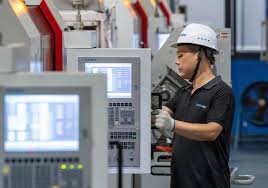
However, in manufacturing—an industry characterized by complex processes, diverse product categories, and fragmented, high-volume data—implementing AI models comes with challenges such as high costs and difficulties in data collection.

“For example, in quality inspection, obtaining a comprehensive set of defect samples is a major hurdle,” said Jia Jiaya, founder ofsmart manufacturing companySmartMore.

“In the past, production lines must be maintained operational two to three months in order to collect defect samples. But now, the deep learning of our industrial multimodal AI model allows us to accomplish the task in just a week—or even less,” Jia explained.

This AI model has already generated hundreds of defect types and is widely applied in sectors such as consumer electronics and new energy, according to Jia.

Beyond building their own intelligent computing infrastructure, many enterprises are turning to cloud computing services for digital transformation. For instance, Huawei’s Pangu large modelhave been deployed across more than 30 industries and 400 application scenarios, spanning manufacturing, pharmaceutical research, coal mining, and steel production.

At theGui’an Supercomputing Center in southwest China’s Guizhou province, rows of server cabinets hum with high-speed operations. With 1,000 high-performance graphics processors and over 700 servers, it boasts a combined computing power of 15 quadrillion calculations per second now

Diverse industry-specific needs are driving new requirements for computing power. “The financial sector requires high security and low-latency computing environments. The medical field needs to process vast amounts of medical imaging data. Manufacturing demands real-time production optimization, and the internet industry relies on large-scale user data processing and content recommendations,”said Liu Jun, senior vice president of Inspur Information. These demands call for computing power infrastructures that deliver high performance, low latency, robust security, scalability, and cost effectiveness.

Industry experts emphasized that after years of scaling up computing capacity, the next critical step for China’s computing power industry is transitioning from mere expansion to unlocking high-value applications and maximizing efficiency.